


Article by
Jesper Sorensen
Jesper Sorensen is a holistic health coach and founder of Pound Drop, a different approach to weight loss built around healthier habits. He has written ebooks and health articles for established publishers and has spent years studying nutrition, healthy eating and sustainable weight management.
What if working toward weight loss didn’t mean pushing through workouts you dread? Weight loss without extreme exercise can be a more realistic path, especially if intense routines feel uncomfortable, intimidating, or hard to keep up. You don’t have to turn every day into a fitness challenge to begin making steady changes.
If past plans have felt all-or-nothing, it makes sense to be wary of another demanding routine. Exercise can support health and weight-related goals, but it doesn’t have to be extreme to have a place in your life. Small, repeatable steps are often easier to maintain than a punishing plan that takes over your schedule.
This guide explains the role movement can play and offers practical ways to build activity into ordinary days. You’ll also find ways to think about food, rest, and habits, and criteria for choosing a routine that feels doable. The aim isn’t perfection or rapid change. It’s a steady approach you can practice, review, and adjust.
Key Takeaways
- Weight loss without extreme exercise can include movement at a pace and intensity that feels manageable for you.
- Everyday movement, eating patterns, and daily routines can work together, but exercise does not guarantee weight loss.
- Compare intense training, planned moderate activity, and incidental movement to find options that fit your circumstances.
- Start by noticing your current routines, choosing one comfortable action, and reviewing how it feels before making changes.
- The Method, the Pound Drop App, The Book, and The Journal offer self-guided tools for habit-building and reflection.
What Does Weight Loss Without Extreme Exercise Actually Mean?
Weight loss without extreme exercise means you don’t have to build your efforts around workouts that feel punishing, exhausting, or difficult to repeat. “Extreme” isn’t a fixed category with one universal time or intensity threshold. It might mean high-impact sessions, long workouts, or a demanding schedule that leaves you dreading the next one. What feels manageable depends on your experience, health, mobility, and daily life.
A gentler approach doesn’t mean movement has no value. Activity can support health and fit into a weight-management routine in different ways. The aim is to understand its place without treating intense workouts as an entry requirement or a guarantee of weight change.
Does exercise have to be intense to count?
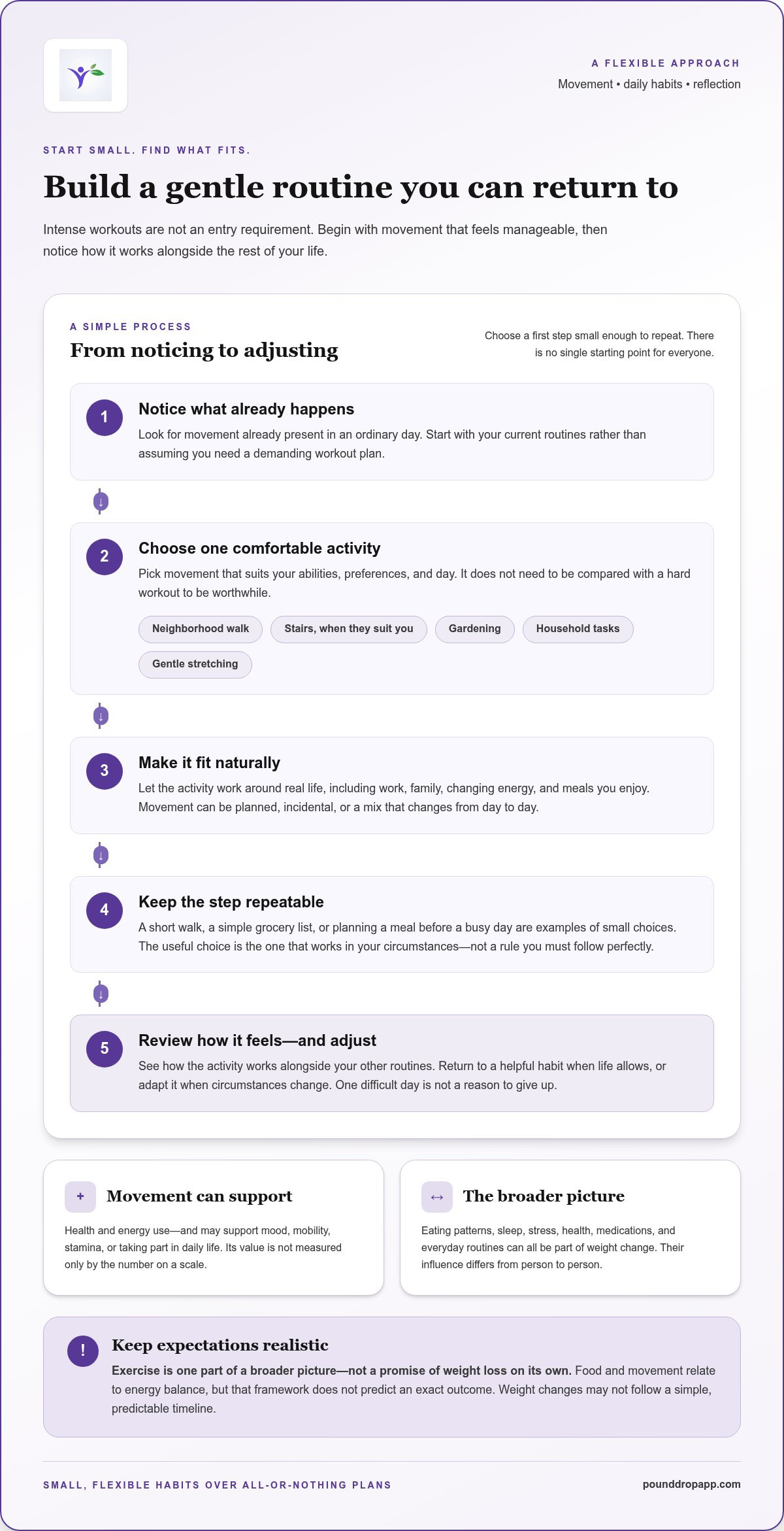
No. Activity can vary in pace, duration, setting, and physical demand. A neighborhood walk, taking the stairs when it suits you, gardening, or household tasks can all add movement to the day. Gentle stretching or another comfortable activity may also be an approachable starting point. These options don’t need to be compared with a hard workout to be worthwhile.
Choose movement because it fits your life, not as punishment for eating or a test of willpower. If a short walk feels realistic, start there. If your needs or abilities are different, another comfortable activity may suit you better.
What can influence weight besides workouts?
Weight is affected by more than exercise. Eating patterns, sleep, stress, health, medications, and everyday routines can all be part of the picture, and their influence differs from person to person. Weight changes also don’t always follow a simple, predictable timeline. An overview of Weight loss describes the range of methods and influences involved, but your own circumstances matter too.
Exercise is one part of a broader picture, not a promise of weight loss on its own. Food choices and activity can affect energy balance, the relationship between energy taken in and energy used. That general framework doesn’t account for every individual factor or predict an exact outcome, so it’s more useful for understanding the big picture than judging what someone “should” weigh.
Starting gently is a reasonable way to explore change. Notice when movement already happens in your day, then consider whether one comfortable activity could fit naturally. Choose a first step small enough to repeat, and see how it works alongside your other routines. If you have a health condition or questions about appropriate activity, a healthcare professional can offer guidance suited to your needs. There’s no single starting point everyone has to follow.
How Movement, Eating Patterns, and Daily Routines Fit Together
Weight change is connected to energy balance, the relationship between energy the body takes in and the energy it uses. Food and movement are part of that relationship, but it isn’t a simple calculation that predicts exactly what will happen. Bodies, health, sleep, stress, medications, and daily circumstances differ. A routine that works for one person may not suit another.
That’s why it can help to look beyond workouts alone. Eating patterns, activity, rest, and daily habits influence one another. A demanding plan may be difficult to maintain if it leaves no room for work, family, changing energy, or meals you enjoy. A flexible approach lets you notice what’s working and adjust without treating one difficult day as a reason to give up.
What role can physical activity play?
Movement can contribute to health and energy use, but it doesn’t guarantee weight loss. Its value isn’t measured only by the number on a scale. You may find that regular activity supports your mood, mobility, stamina, or ability to take part in daily life, even if your weight changes slowly. The Mayo Clinic’s guidance on diet and exercise for weight loss also discusses activity as part of a broader approach. If you have a health condition or concerns about suitable activity, seek advice from a qualified healthcare professional.
Why do small routines matter?
Repeatable choices can be easier to live with than sudden, sweeping changes. You might make a simple grocery list, take a short walk when it fits, or plan a meal before a busy day. These are examples, not rules. The useful choice is one that works in your circumstances and doesn’t depend on perfect conditions.
Consistency is more practical than a burst of effort you can’t sustain. That doesn’t mean every day will look the same. It means returning to a helpful routine when life allows and adapting it when circumstances change. For a related lifestyle perspective, the guide “Weight Loss Without Supplements: Sustainable Guide for 2026” explores how gradual habits can support a broader approach.
If you want structure for practicing and reflecting on everyday changes, the Pound Drop App is part of a self-guided system designed to support gradual lifestyle habits. That kind of structure can help you reflect on what feels manageable instead of relying on an extreme workout plan.
Can You Lose Weight Without Intense Workouts? Comparing Your Options
Yes. Intense workouts are not the only way to include activity in a weight-management effort. A routine might involve planned movement, everyday activity, or a mix that changes from day to day. None guarantees weight loss on its own, and no single approach suits everyone. The practical question is which option feels realistic for your body, preferences, and circumstances.
Here’s a simple comparison. “Effort level” describes how an activity might feel, not a fixed medical measure. The same activity can feel different depending on your fitness, health, pace, and surroundings.
| Option | Typical effort | Examples | Considerations |
|---|---|---|---|
| Intense training | Demanding; may require more recovery | Fast-paced intervals, vigorous sports, challenging circuits | May appeal to people who enjoy a strong challenge, but isn’t necessary or comfortable for everyone. |
| Moderate planned activity | Steady and purposeful | A brisk walk, a comfortable cycling session, a gentle class | Can be scheduled or adapted; access, ability, and preference matter. |
| Everyday movement | Varies; often woven into daily tasks | Walking for errands, standing to stretch, taking stairs when comfortable | Can be a convenient starting point, though opportunities differ by routine and environment. |
How do intense workouts differ from moderate activity?
Intense training often feels more demanding during the activity and may leave you needing more time to recover. Moderate activity is usually steadier and can feel easier to fit into an ordinary day. These descriptions are personal, not universal cutoffs. Your preferences, access, physical ability, health, and energy all shape what feels manageable. You don’t need to copy an athlete’s training routine to make movement part of your life.
A useful comparison is not “Which burns the most?” but “Which can I return to without dread?” Someone may enjoy a vigorous class; someone else may prefer a steady walk or a few short movement breaks. Either preference can guide a routine, and either can change over time.
Can everyday movement be a useful starting point?
It can. Walking part of an errand, getting up to stretch between tasks, or choosing stairs when they feel comfortable are ways to add movement without setting up a formal workout. Adapt them to your surroundings and ability, or skip them when they don’t fit. They’re options, not a prescribed program or a promise about the scale.
Pay attention to how activity feels. If you experience concerning symptoms, stop and seek appropriate medical advice. If you have a health condition or ongoing concerns about activity, a qualified healthcare professional can help you consider suitable options. Weight loss without extreme exercise can include movement, but progress also depends on broader routines and individual circumstances. Choose a realistic next step rather than comparing yourself with someone else.
How to Start a Gentle, Flexible Routine Without Overdoing It
A routine doesn’t need to begin with a full workout schedule. Notice how movement already fits into your day, choose one comfortable action to try, then review how it feels. This keeps the focus on learning what works for you instead of meeting a rigid target from the outset.
- Notice your current routine. Think about when you sit for long stretches, where you already walk, or which parts of the day feel less rushed.
- Choose one manageable action. You might walk part of an errand, stretch gently at home, or take a brief movement break between tasks.
- Review and adjust. Consider whether the action felt practical, comfortable, and easy to repeat. Keep it, adapt it, or try another option.
There’s no need to start at someone else’s pace. With weight loss without extreme exercise, a useful first step suits your current ability, surroundings, and schedule. If you have a health condition, have been inactive for a long time, or feel unsure about changing your activity, ask a qualified healthcare professional for guidance before making a change.
What is a gentle first step?
Look for a low-pressure opportunity in an ordinary day. At home, you could stand and move gently between activities. At work, a short walk during a break might fit. If going outdoors or using stairs isn’t comfortable or practical, consider another movement that suits your abilities and setting. A gym isn’t required, and everyday activity doesn’t have to become a formal workout.
Building movement into something you already do can make it easier to remember, provided it feels safe and convenient. For example, you might walk while making a phone call or stretch after finishing a regular task. Treat these as options to test, not obligations. More ideas for gradual lifestyle changes appear in “Practical Weight Loss Tips: 12 Small Changes That Fit Real Life.”
How can you adjust when life changes?
Some days leave less time or energy. A shorter, gentler option may fit better, or rest may be the right choice. If a usual activity becomes difficult because of your schedule, the weather, access, or how you feel, consider an alternative rather than forcing the original plan. A missed session is information about what needs adjusting, not proof that you’ve failed.
Keep your approach flexible. You can return to an activity when it suits you or choose a different one. If food-related worries are making lifestyle changes feel stressful, “How to Rebuild Your Relationship With Food, One Gentle Step at a Time” offers a related perspective. The Pound Drop App is part of a self-guided routine for practicing gradual changes and reflecting on your habits.
How Pound Drop Supports Weight Loss Without Extreme Exercise
Pound Drop is a self-guided weight-loss system centered on structured lifestyle changes, not promises of extreme workouts or rapid results. It offers a framework for people who want to practice gradual habits at their own pace. Movement can be one part of those habits, but the approach doesn’t depend on punishing exercise or a rigid training plan.
The system brings together digital and physical resources. These offer ways to work with a structure, reflect on your choices, and manage your progress without trying to make every change at once.
How can self-guided tools support steady change?
The Method provides a structured approach to habit formation. The Pound Drop App, The Book, and The Journal complement it with resources for practice, reflection, and progress management. Together, they can help you think through what you’re trying, notice what feels workable, and return to your intentions as daily circumstances shift. These are self-guided tools, not one-on-one coaching.
- The Method offers structure for forming and practicing habits.
- The Pound Drop App is the digital part of the system.
- The Book and The Journal provide physical resources for reflection and managing progress.
You might use these resources to reflect on a manageable routine, such as making room for movement or deciding which everyday habits you want to work on. The point isn’t to follow a perfect script. It’s to have a structure you can return to, learn from, and adapt as needed.
What is a realistic next step?
Choose one manageable routine to explore before trying to change everything. That could mean noticing a habit you’d like to practice or considering where gentle movement might fit into your day. Give yourself room to adjust. A routine that needs adapting isn’t a failure; it’s information about what may work better for you.
Progress is not the same as perfect adherence, and a self-guided system cannot promise a particular result. Sustainable practice gives you room to learn from ordinary days, including the ones when plans change. Pound Drop brings together The Method, the Pound Drop App, The Book, and The Journal as self-guided resources for gradual lifestyle changes.
If that kind of structure feels like a fit, you can explore Pound Drop as you consider your next small step.
Choose a Next Step That Feels Livable
You don’t need to redesign your whole routine today. Choose one small change you’re curious about, try it in a manageable way, and give yourself room to learn from the experience. If it doesn’t fit, adjust it. That’s part of building a routine around real life, not a sign you’ve fallen behind.
For weight loss without extreme exercise, your next step can focus on a steady habit rather than a dramatic effort. A little structure may help you keep track of what you’re practicing and reflect on what feels sustainable. Pound Drop brings together a self-guided system with The Method and the Pound Drop App, alongside the physical resources The Book and The Journal.
Start with one change that feels possible, then give yourself room to practice and adjust. To explore Pound Drop’s self-guided tools for gradual lifestyle changes, visit Pound Drop.
Frequently Asked Questions
Can you lose weight without exercising?
Yes, weight loss may be possible without a formal exercise routine, though results differ and no method guarantees a particular outcome. If structured workouts aren’t accessible or comfortable, you can focus on realistic food and daily routines instead. Movement may still be part of a broader health plan in a form that suits you. If you’re unsure what’s safe or possible, a qualified healthcare professional can help you consider options for your circumstances.
How can I lose weight without extreme exercise?
Start with changes that fit your actual schedule and preferences, rather than adopting a demanding plan you’re unlikely to keep. For example, you might make grocery shopping easier by planning a few familiar meals or choose an activity that doesn’t require special equipment. Weight loss without extreme exercise involves more than workout intensity, and outcomes vary. If a health concern affects your activity, seek guidance from a qualified healthcare professional before making changes.
Is walking enough to support weight loss?
Walking may support an individual weight goal, but whether it does depends on personal circumstances and other parts of daily life. There isn’t one amount or pace that can be called “enough” for everyone. Choose a route and rhythm that feel appropriate, and consider whether the activity is comfortable to repeat. If walking causes pain, feels unsafe, or raises concerns because of your health, pause and ask a healthcare professional for advice.
Do I need to go to the gym to lose weight?
No, a gym isn’t a requirement for everyone. It can be a useful setting if you enjoy the equipment or structure, but it’s also reasonable to choose options that involve less travel, cost, or planning. You could try a short home-based movement session or a community activity, depending on what’s accessible to you. The best setting is one that fits your needs, not one that makes progress feel harder to begin.
Can everyday movement help if I do not like working out?
Yes, everyday movement can help you include activity without treating it as a workout. If it feels comfortable, you might stand and move gently during a break from desk work or do a few mobility movements while waiting for something to finish. These are optional ideas, not a weight-loss prescription. Notice which activities feel natural in your day, and adapt or skip them if they don’t suit your body or circumstances.
What if I cannot exercise because of a health condition?
Don’t follow general exercise advice if it conflicts with medical restrictions or causes concerning symptoms. A qualified healthcare professional can help you discuss whether any activity is appropriate and what limitations to respect. It may help to describe which movements feel difficult, what guidance you’ve already received, and what you hope to work toward. Weight management isn’t defined by workouts alone, so your next steps can be shaped around your individual health needs.
Will gentle exercise make me lose weight faster?
No, gentle exercise can’t promise faster weight loss. The pace of change varies, and comparing your progress with another person’s may not give you useful guidance. Instead, notice whether an activity feels comfortable enough to repeat or fits more easily into your routine over time. Those observations can help you decide whether to continue or adjust, while keeping expectations realistic and seeking individualized advice when you need it.


