


Article by
Jesper Sorensen
Jesper Sorensen is a holistic health coach and founder of Pound Drop, a different approach to weight loss built around healthier habits. He has written ebooks and health articles for established publishers and has spent years studying nutrition, healthy eating and sustainable weight management.
Setting polite food boundaries with coworkers at the office starts with saying what you need clearly and kindly. You can protect your lunch break, personal space, and food choices without criticizing anyone else’s habits. Five practical approaches can help you make your limits clear while keeping everyday interactions respectful.
It can feel awkward to decline a shared snack, end a food-related conversation, or ask for uninterrupted time to eat. That doesn’t mean you’re being difficult; a calm, brief response is often enough. Decide which boundaries matter most, find words that feel natural, and respond steadily if a coworker misses the signal. You can also make shared meals more comfortable by communicating preferences without judgment.
Key Takeaways
- Set expectations about your lunch time and availability before frustration builds.
- Use calm, direct language to decline food offers or personal conversations without overexplaining.
- Decide which food and privacy boundaries are firm and where you’re comfortable finding a compromise.
- Protect your break and personal space with simple, consistent actions.
- Help make shared meals more comfortable by respecting coworkers’ food choices and needs.
1. Setting expectations and protecting time and energy at work
Setting polite food boundaries with coworkers at the office starts with clear expectations about your time and attention. Before lunch, say, “I’m taking my break now, so I’ll catch up after I’ve eaten.” If a coworker offers personal advice about food while you’re busy, try, “I can talk about that over lunch, but I need to finish this first.” Suggesting a specific alternative protects your focus without dismissing the person.
Keep personal and medical details private if you don’t want to discuss them. A brief, friendly response such as “I keep that personal, but thanks for understanding” can close the conversation without inviting follow-up. You don’t need to explain a health condition or dietary choice to make a boundary clear. If a colleague asks why you brought a particular meal, simply say, “This works for me today,” then return to your work.
For food allergies or dietary restrictions, state the practical need plainly before a shared meal. Tell coworkers which known allergen must be avoided, and ask that they leave it out of the shared meal. Avoid negative comments about anyone’s food, and don’t eat foods known to be allergens for a teammate. These steps keep the conversation respectful and focused on making the meal more comfortable.
Time off also benefits from advance expectations. Tell your team when you’ll be away and who can handle project questions; identify a backup for the backup if coverage matters. If you need to remain somewhat available, set a clear limit, such as responding to urgent requests within 24 hours. Outside work hours, communicate your schedule directly. If you usually stop answering messages after 6 p.m., tell coworkers and supervisors. An automatic reply can repeat when you’ll return.
Workplace boundaries may need adjusting when colleagues have different schedules or needs. If someone raises a food-related concern while you’re focused, offer a specific time to talk later. If you can’t take on a full project, offering half an hour to review a final draft sets a manageable limit. A calm compromise protects your energy while making the next step clear.
If a coworker repeatedly crosses a food-related boundary after you’ve stated your request clearly, document what happened and when, then consider raising the pattern with HR. Describe the specific behavior and its effect on your work rather than assuming the coworker’s intent. If the issue involves a known food allergen at a shared meal, explain the safety concern and the steps you’ve already communicated.
2. Communicating boundaries politely and assertively
Setting polite food boundaries with coworkers at the office works best when your words are calm, specific, and easy to understand. Try a simple pattern: name the request, state your limit, then offer a next step if you want one. For example, “I’m not available to talk about food choices during this meeting. Let’s focus on the agenda.” A steady tone keeps the message firm without turning the conversation into a criticism.
If a coworker asks to share your lunch, you can say, “Thanks for asking, but I’m keeping this for myself.” If someone offers you food, respond, “That’s kind of you, but I’ll pass.” You don’t need to invent a reason or explain your appetite. A brief thank-you and clear answer are tactful, and let the other person move on without guessing.
When colleagues comment on your diet or meal, keep your reply focused on your preference. “I’m comfortable with what I’m eating, and I’d rather not discuss it” sets a limit without judging their choices. You might prefer a private conversation, a short message, or a direct response in the moment. Choose the approach that feels natural and clear; don’t hint when a straightforward sentence would prevent confusion.
If food sharing continues after you’ve declined, repeat the same message instead of adding explanations. You might say, “I appreciate the offer, but I’ve said I’m not sharing my lunch.” If the behavior persists, speak with the coworker privately and describe what you want to stop. A manager can address repeated issues by setting a respectful team expectation, speaking privately with those involved, and applying the expectation consistently.
To keep the relationship warm, separate your boundary from your feelings about the person. “I enjoy having lunch with you, but I don’t share food” makes both points clear. If you want company, suggest sitting together without exchanging meals. If you prefer quiet, say, “I’m taking this break on my own today.” Setting polite food boundaries with coworkers at the office can protect your comfort while leaving room for connection.
Communication styles differ across a workplace, so notice what helps the conversation stay clear. A direct coworker may appreciate a concise request; someone who prefers written details may respond better to a short message. For ongoing personal food goals, structured support for building food habits can complement the boundaries you’re practicing at work. Keep your request specific, repeat it calmly when needed, and avoid turning a personal limit into a debate.
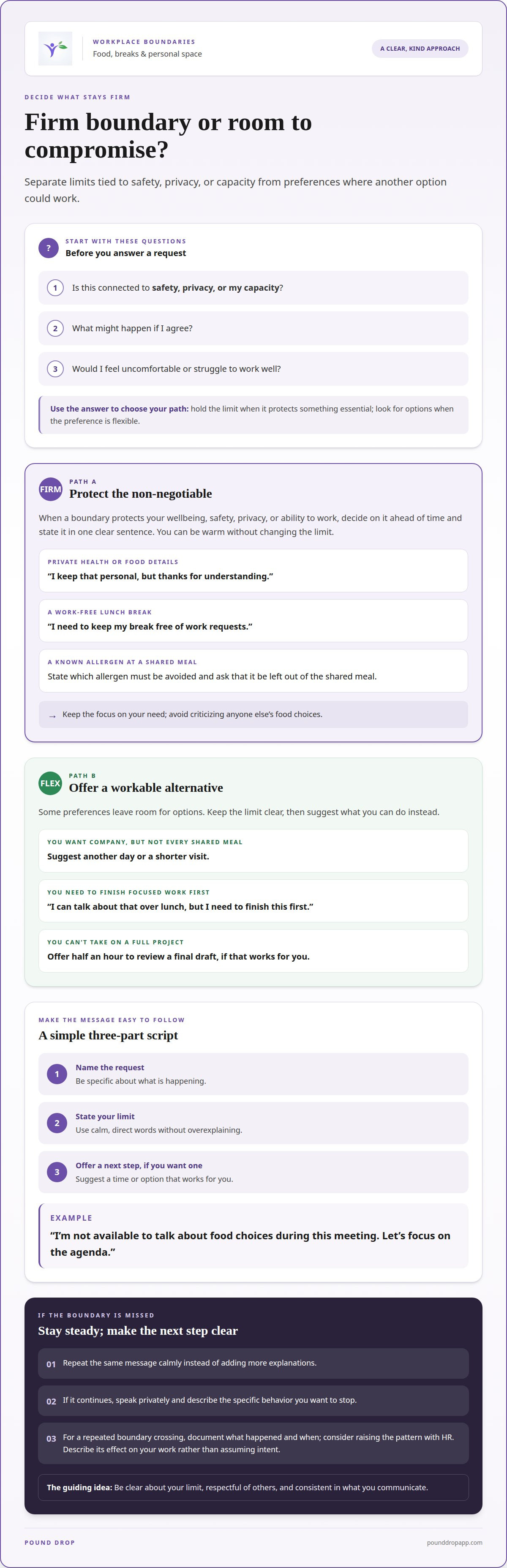
3. Classifying boundaries as non-negotiable or open to compromise
First, distinguish a personal preference from a limit tied to safety, privacy, or capacity. Ask yourself what would happen if you agreed, and whether you’d feel uncomfortable or struggle to work well. Joining a team meal may be flexible, while keeping a private health detail to yourself may not be. Naming the reason helps you decide steadily instead of agreeing automatically to avoid awkwardness.
A non-negotiable boundary protects something essential to you. Decide what that means before a request comes up, then express it in one clear sentence. You might say, “I’m not discussing my eating habits at work,” or, “I need to keep my break free of work requests.” You can be warm and still hold the limit. A coworker’s disappointment doesn’t require you to change a boundary that protects your wellbeing.
Other preferences can leave room for options. If you enjoy company but don’t want to join every shared meal, suggest another day or a shorter visit. If a coworker likes to talk while you prefer quiet, agree to catch up after you’ve finished eating. A useful compromise gives both people a workable choice without turning your preference into an obligation. Be specific about what you can offer, and don’t say yes to an arrangement you know won’t suit you.
Workplace culture and personal relationships can affect how a request feels, but they don’t have to determine your answer. A close friend at work might offer to share food as a sign of connection; you can appreciate the gesture while declining. A team tradition may also make opting out feel conspicuous. Consider whether you’d like to take part another way, such as joining the conversation without sharing a meal, or whether you’d rather keep the boundary firm.
When a boundary affects how a task gets done, identify the work need and discuss practical alternatives with your manager. If a team plans a food-centered meeting during time you need for focused work, explain the conflict and suggest another way to contribute. If coworkers’ preferences clash, describe what matters to you, listen to their needs, and look for an option that respects both sides. Classifying your limits first clarifies what can change, what cannot, and what you’re willing to offer.
4. Protecting lunch breaks and physical space
A lunch break can create a clear pause between work and personal time. Put it on your calendar, step away from your desk, and let colleagues know when you’ll return. If someone brings up work while you’re eating, try, “I’m on my break now. I can discuss this when I’m back.” A predictable routine helps others know when you’re available and gives you space to eat without turning every meal into another meeting.
Choose a lunch setting that fits your needs. If the shared table feels noisy, eat in a quieter area or take a brief walk. If you enjoy company but want to focus on your food, say, “I’d love to sit together, but I’m keeping lunch work-free today.” Stepping away from your workstation can make the boundary visible. You don’t need to criticize colleagues who choose differently.
Food at your desk may also need a clear boundary. If colleagues take food from your lunch or workspace, say, “Please ask before taking anything from my desk. I’m saving this for later.” Keep the request specific and apply it consistently, whether it’s a snack or part of your meal. If the behavior continues, repeat the request privately and describe what you want to stop.
Physical space matters during shared meals, too. Choose where to sit, keep your belongings beside you, or move if a conversation becomes uncomfortable. If a coworker reaches across your plate or handles your food, calmly say, “Please don’t touch my meal.” Direct words can feel difficult at first, especially with friendly colleagues, but they make clear what respect looks like in that moment.
Keep the boundary about your needs, not another person’s character. “I need a quiet lunch today” is easier to respond to than a complaint that someone is disruptive. If stress makes it hard to speak in the moment, prepare a short phrase beforehand and use it next time. A healthy workplace allows colleagues to take breaks in different ways and treats each person’s meal, desk, and personal space with care.
Boundaries can extend beyond the meal itself. If you prefer not to hug, offer a handshake instead. Keep meetings focused by avoiding food unless the gathering is a lunch-and-learn event. Companies can make expectations easier to understand by sharing office food guidance through posters in common spaces and a chapter in the company handbook. Clear, consistent communication can help colleagues know what is welcome without turning a personal preference into a conflict.
Protecting a break can also mean protecting the time around it. Block focused work time on your calendar or tell coworkers you’re unavailable for a chat. When someone responds with unjustified anger, blame, or disappointment, try not to internalize it; another person’s reaction does not define whether your boundary is reasonable. Breaks may be encouraged unevenly across workplaces: in the American Psychological Association’s latest Work in America survey, 35% of employees said their workplace culture encouraged breaks. That finding can be a useful reminder to make your own needs clear, even when taking a pause is not yet part of the workplace routine. A calm, direct explanation can help preserve both your time and your working relationships.
5. Setting clear boundaries with coworkers
Healthy boundaries depend on shared expectations, not guesswork. The American Psychological Association defines a boundary as a psychological demarcation that protects an individual's integrity. At work, that might mean keeping your lunch private, choosing whether to join food-centered gatherings, or asking colleagues not to comment on your plate. Clear team norms help these choices feel ordinary rather than personal and make it easier to respond consistently when the same situation happens again.
Start by describing the behavior and the expectation you want to establish. For example, “Please ask before taking food from the shared refrigerator” is more useful than “People need to be more considerate.” If you’re organizing a team meal, explain how people can share dietary needs and preferences without pressure. A manager can reinforce practical expectations through a team conversation or a note in the handbook, so everyone understands the same approach.
Shared meals are easier when coworkers avoid judging one another’s food. A remark like “That’s a strange lunch” can make someone feel singled out, even if it was meant as a joke. Keep conversation focused on the gathering, not on whether someone’s meal is good, healthy, or appropriate. If a teammate asks you to stop commenting on their food, accept the request without asking them to defend it.
Respect includes taking known allergens seriously at shared meals. If a teammate has told the group that a food is an allergen for them, choose another option for that gathering. This is a clear, practical expectation, not an invitation to debate someone’s needs. A manager can help plan meals with those needs in mind and make it comfortable for employees to raise concerns before the event.
Boundaries may need repeating when a workplace has an established habit, such as routinely eating together or sharing snacks. Keep your message steady and suggest an alternative that preserves connection: “I’m skipping the food order, but I’d be glad to join the conversation.” If a coworker is disappointed, you can acknowledge their feelings without changing your decision. Consistency helps prevent resentment and burnout from growing around unspoken expectations.
To make personal routines easier to maintain alongside workplace expectations, explore structured support for your food habits. A clear approach lets coworkers understand what feels comfortable, while leaving room for friendly relationships and respectful differences.
At shared work meals, avoid negative comments about other people’s meals. If a comment slips out, move on without asking the person to explain their choices. Keep the focus on the gathering rather than making someone’s food a topic of discussion. Don’t bring or eat foods known to be allergens for someone on your team at shared meals. Leave those foods out when choosing what to bring or order, and don’t make the teammate responsible for policing everyone else’s choices. These practical steps show consideration without putting anyone on the spot.
Pound Drop
Pound Drop can support your broader food habits as you practice clear, respectful boundaries at work. The Pound Drop App, The Method, The Book, and The Journal offer structured tools for self-guided lifestyle changes. They can help you build manageable routines alongside busy workdays, without making a coworker responsible for your choices.
Turn to Pound Drop if you want ongoing structure for personal progress beyond shared meals and office conversations. Choose the tool that best fits how you prefer to learn and build new habits. Progress can be steady and practical, even when workplace routines change.
Contact Pound Drop to learn more about its offerings.
Make your next workday feel more intentional
Practicing setting polite food boundaries with coworkers at the office can become part of caring for your time and wellbeing. You don’t need to get every conversation exactly right. Notice what feels comfortable, choose words that reflect your needs, and keep practicing when familiar situations come up. Each calm, clear interaction makes your expectations easier to understand.
Your food choices and workplace relationships can both matter. A boundary doesn’t have to close off connection; it can help you take part in ways that feel right for you. If you’d like support with your broader food habits, explore Pound Drop’s tools and decide whether they fit your next step.
Explore Pound Drop and take your next step. Progress can begin with one choice that feels manageable today.
Frequently Asked Questions
What happens when everyone sets and respects boundaries?
Shared expectations make everyday interactions more predictable and reduce misunderstandings about food, space, and breaks. For example, a team that agrees which refrigerator shelves are communal can avoid confusion over packed lunches. Respect also makes it easier for coworkers to raise concerns without turning them into personal conflicts. The result is a workplace where people can join shared routines while keeping their own preferences.
What is Office Food Etiquette?
Office food etiquette means showing consideration around meals, snacks, and shared eating spaces. It can include cleaning up after yourself, considering strong food smells in shared areas, and asking before assuming food is communal. During a team meal, make room for different preferences and keep conversation welcoming. These simple habits help coworkers share a space without expecting everyone to eat the same foods or join every food-related activity.
What are workplace etiquette rules for shared office food and refrigerators?
For a shared refrigerator, use a sealed container, label your food clearly, and place it where it won’t block other items. Take only food marked for sharing, and remove your leftovers before they become forgotten clutter. Clean up spills promptly. In a shared snack area, return serving utensils and leave the space ready for the next person. Follow any specific workplace instructions for shared storage.


