


Article by
Jesper Sorensen
Jesper Sorensen is a holistic health coach and founder of Pound Drop, a different approach to weight loss built around healthier habits. He has written ebooks and health articles for established publishers and has spent years studying nutrition, healthy eating and sustainable weight management.
Dessert doesn’t have to turn into a cheat day, and a cheat day doesn’t automatically undo your progress. Learning how to enjoy dessert without triggering a cheat day spiral starts with letting go of the idea that food choices make a day either “good” or “bad.”
If you’ve ever felt that one treat means you’ve already “blown it,” that reaction can make sense, especially after periods of strict rules or restriction. But you don’t need to punish yourself or wait for a fresh start. Instead, notice what’s happening, enjoy the dessert you chose, and return to your usual routine.
Self-compassion, grounding, and reframing can soften the urge to turn one choice into an all-or-nothing day. You can also explore personal triggers and consider what cheat days mean in the context of weight loss, so dessert becomes part of a more flexible, sustainable pattern.
Key Takeaways
- Respond to food-related guilt with self-compassion instead of treating dessert as a reason to punish yourself or start over.
- Use a grounding practice to pause, notice what you’re feeling, and make your next choice more intentionally.
- Question all-or-nothing thoughts by separating what you feel from what you know to be true.
- Notice situations or rules that make food feel scarce, since anticipating restriction can shape how you respond to dessert.
- Consider whether labeling days as “strict” or “cheat” days is keeping you stuck in an all-or-nothing pattern.
1. Building self-compassion and internal security
Self-compassion gives you room to respond to dessert without turning it into a judgment about your character. Try naming the moment plainly: “I ate cake, and I’m feeling worried.” That separates what happened from the harsh conclusion that you’ve failed. A compassionate response can be practical, not indulgent: “I can enjoy this and continue with my usual routine.”
If a spiral is already underway, pause before making a new food rule. Put both feet on the floor, take a slow breath, and notice the urge to compensate or keep eating. Then choose one next step, such as sitting somewhere calmer or returning to an ordinary planned activity. The goal isn’t to force anxiety away. It’s to build enough awareness and self-trust that anxiety doesn’t make the decision for you.
Self-care can be a gentler way to treat yourself than using food as either a reward or a punishment. Choose an activity that fits the moment: read a few pages, take a warm bath, step outside, or dance to a song at home. If social media is increasing comparison or guilt, put your phone aside and give your attention somewhere else to land. These small actions support well-being without making dessert something you must earn.
Journaling can help turn a rush of feelings into information. Set a timer for 5-10 minutes and free-write what happened, what you’re feeling, and what you need next. For example: “I had ice cream after dinner. I’m afraid it means I’ll lose control. I need a calm evening, not a stricter rule.” Keep the focus on understanding, not grading your choices.
How can you choose a satisfying dessert with protein or fiber? Pick something that genuinely appeals to you, then consider options such as yogurt with berries or fruit with nuts if they sound enjoyable. Protein and fiber can be part of your choice, not requirements that make a treat acceptable.
How do you enjoy dessert without overeating or guilt? Serve it, sit down, and take a moment to taste it without scrolling. If guilt appears, name the feeling and return to the experience instead of treating guilt as an instruction.
A reasonable portion is one that feels satisfying and suits your appetite. There is no single portion that fits everyone. To pause after one serving, put the plate down, notice whether you feel content or still want more, and decide without calling either choice a failure.
Restricting sweets can make them feel more urgent. Expecting restriction may prompt overeating, while repeatedly resisting food can make moderation harder when restrictions lift. Self-compassion can help replace that cycle with a steadier choice.
2. Mindfulness and grounding techniques
Mindfulness means noticing what is happening without instantly judging or reacting. Around dessert, you might notice a tight stomach, hurried thoughts, or an emotional urge to keep eating. Naming the experience, such as “I feel tense and rushed,” creates a pause. That pause can make your next choice feel less automatic and your relationship with food less overwhelming.
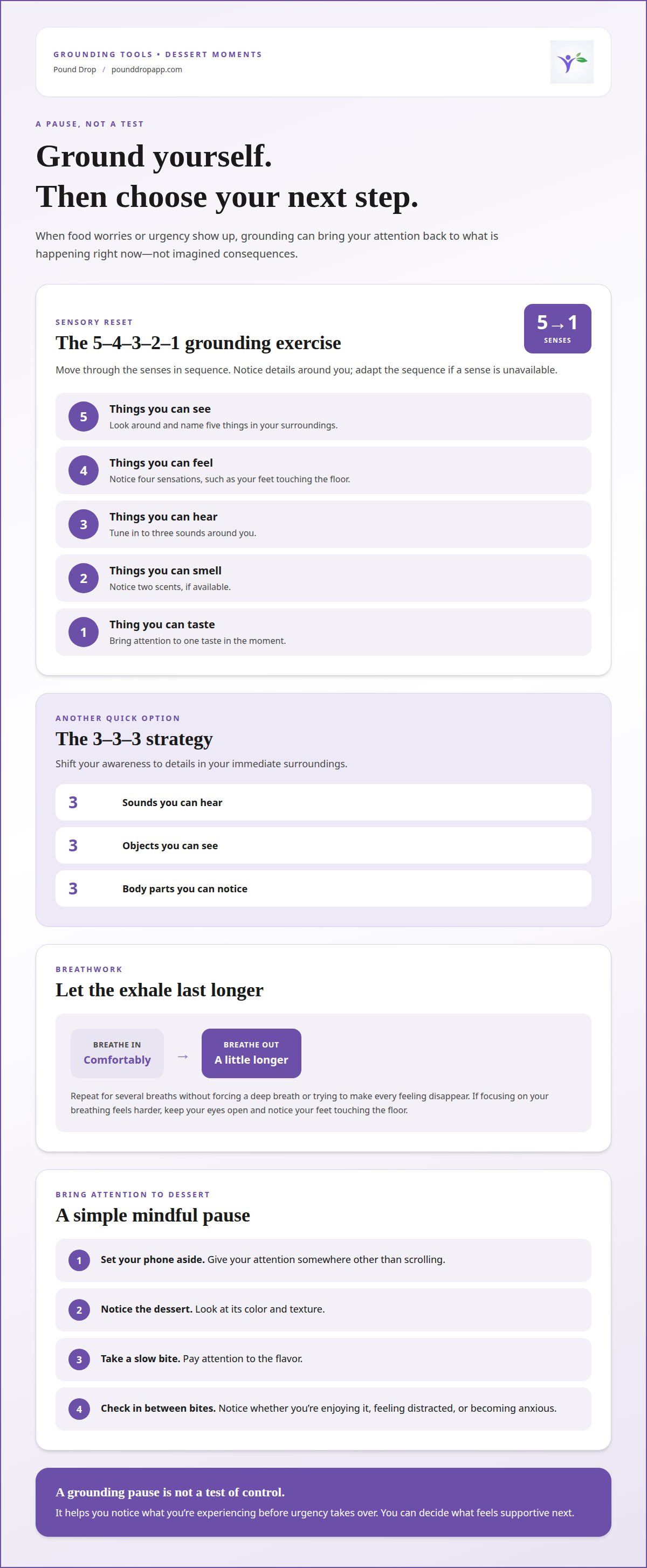
Breathwork offers a simple way to bring your attention back to the present. Breathe in comfortably, then let your exhale last longer than your inhale. Repeat for several breaths without forcing a deep breath or trying to make every feeling disappear. A prolonged exhale can encourage the body’s calming response. If focusing on your breathing feels harder, keep your eyes open and notice your feet touching the floor.
For a sensory reset, use the 5-4-3-2-1 grounding exercise. Notice five things you can see, four things you can feel, three things you can hear, two things you can smell, and one thing you can taste. You can adapt the sequence if a sense is unavailable. Another option is the 3-3-3 strategy: identify three sounds, three objects, and three body parts. Both exercises shift awareness from imagined consequences to details in your immediate surroundings.
Bring that attention to the dessert itself. Set your phone aside, look at the color and texture, and take a bite slowly enough to notice its flavor. Between bites, check whether you’re enjoying it, feeling distracted, or becoming anxious. This isn’t a test of control. It’s a way to recognize what you’re experiencing before urgency takes over.
If guilt or pressure grows, change something in your environment. Move from a crowded kitchen to a chair, step outside for fresh air, or put social media away if it’s increasing comparison. A brief pause can help you decide what would feel supportive next, whether that means continuing your dessert or moving on. You don’t have to settle every thought before choosing.
Mindfulness can also be practiced outside mealtimes. Notice sounds during a walk, or take a quiet moment to appreciate something specific, such as a friend’s message or warm sunlight. Even a brief gratitude pause can widen your attention beyond food worries. Repeating small practices during ordinary parts of the day can make them easier to remember when emotions feel intense.
To connect these pauses with everyday choices, try a mindful eating routine that brings attention back to your feelings, habits, and next step.
3. Reframing negative thoughts
A thought spiral can turn one dessert into a sweeping prediction: “I ate cake, so I’ve ruined everything.” The thought may feel convincing, but that doesn’t make it a fact. Anxiety can make one choice seem like proof of future failure. Recognizing the difference gives you a practical place to begin. Ask, “What happened, and what conclusion am I adding?” For example, the event may be eating cake; the conclusion may be that you can’t make balanced choices.
Thought spirals often repeat the same alarming idea and push for an immediate fix. You might notice a racing heart, shallow breathing, tension in your chest or stomach, or a hard-to-sit-with sense of urgency. These feelings can arrive alongside thoughts such as “I have to compensate tomorrow.” Treat them as signs to pause and examine the thought, not commands you must follow. If persistent spirals interfere with daily life, relationships, or well-being, professional support may help.
Try a simple fact-or-feeling check when a harsh thought appears. First, write down the exact sentence in your mind. Next, label each part as something observable or an interpretation. “I ate a brownie” is observable; “I’ve lost control” is an interpretation. Then create a more balanced response: “I ate a brownie, and I can choose what feels right next.” You don’t need to force positivity. This practice helps you include the facts without treating fear as certainty.
- All-or-nothing thought: “I already messed up, so the day is ruined.”
- More balanced thought: “Dessert was one part of today, not the whole day.”
- All-or-nothing thought: “I must avoid sweets from now on.”
- More balanced thought: “I can notice what I enjoy and make choices without a new ban.”
Gratitude can also widen your attention when your mind fixates on one uncomfortable moment. Make a daily note of specific things you appreciate, such as a kind message, a satisfying meal, or time spent outdoors. Keep it honest; you don’t need to feel grateful for dessert-related anxiety. The point is to make space for other parts of life, too. Combining thought-checking with a brief gratitude practice gives you more than one strategy to use.
Reframing is a skill, not a demand to silence difficult thoughts. If your first balanced response feels unconvincing, try a gentler question: “What would I say to a friend who ate the same dessert?” It can help you find a kinder, more realistic perspective. Practicing this approach can help you separate an emotional prediction from the next decision you can make.
4. Identifying personal triggers
A trigger is a situation, thought, or feeling that makes a familiar response more likely. Around dessert, it might be skipping lunch, seeing strict food rules online, or hearing someone call a treat “bad.” Learning how to enjoy dessert without triggering a cheat day spiral can start with noticing what happened just before your response shifted. This isn’t about blame. It’s a way to understand how specific experiences shape your choices.
Look for the story that appears in the moment. Perhaps you think, “I’m starting a diet tomorrow, so I should eat everything I want tonight.” Expecting restriction can prompt overeating, sometimes called the “last supper effect.” A similar response may follow a demanding day, when dessert seems like the only available comfort. Naming the situation helps separate the trigger from what you do next.
Map a recent episode in a few simple steps. What was happening? What were you feeling? What did you expect would happen next? For example, seeing diet posts on social media might bring up anxiety, followed by the thought that sweets will soon be off limits. The useful detail is the connection between those events, not a score for what you ate.
- Situation: You see a post promoting strict food rules.
- Feeling: You feel anxious about losing access to favorite foods.
- Story: You tell yourself you need to eat them now.
- Alternative: You can enjoy dessert without creating a new restriction.
Next, consider other explanations for the urge. If you want more dessert after a stressful day, ask whether you’re hungry, tired, seeking comfort, or reacting to a rule you expect to follow. Several factors can be present at once. A pause and a few slower breaths can help you feel grounded enough to notice those possibilities, rather than treating the first explanation as the only one.
Patterns become clearer when you compare experiences without demanding perfect records. You might notice dessert feels harder after a long gap between meals, or guilt grows after conversations about dieting. These observations can point toward a realistic adjustment, such as avoiding a new ban for tomorrow. The aim is awareness, not control over every feeling.
When a familiar trigger appears, name the situation, identify the story, then choose what supports you now. “I’m worried sweets will be restricted, but that’s an expectation, not a rule I have to create.” If you’re figuring out how to enjoy dessert without triggering a cheat day spiral, this pause can help you make room for a choice that fits the moment. You can decide whether dessert sounds satisfying or another activity would help.
5. Cheat days and weight loss
Are cheat days actually bad for weight loss? The label alone doesn’t determine what happens; the pattern around it matters. Calling one day “strict” and another a “cheat day” can reinforce an all-or-nothing relationship with food. A brownie on an ordinary Tuesday, for example, can start to feel like breaking a rule instead of simply eating dessert. That framing may make it harder to return calmly to your usual choices.
Repeatedly resisting foods can also make moderation more difficult when restrictions are lifted. The mental energy spent holding tightly to rules may leave less room for flexible decisions later. This doesn’t mean one dessert causes a spiral or determines weight-loss progress. It means the cycle of restriction, anticipation, and overeating deserves attention when it keeps repeating.
Instead of asking whether you’ve earned a cheat day, consider the pattern you want to build. Do your food choices feel workable on ordinary days? Can you include a favorite dessert without treating it as a special exception? These questions shift attention from one event to everyday habits that support consistency. They can also make uncertainty easier to handle, because no meal has to define the next one.
A useful way to loosen the cheat-day pattern is to notice the rule beneath it. You might tell yourself, “I can’t have cookies tomorrow,” then eat more tonight because restriction feels close. Try replacing that prediction with a choice you can make in the present: “I can decide what I want tomorrow when tomorrow comes.” The goal is to remove the perceived need for a cheat day, not simply rename or ban it.
How can you fit dessert into a balanced diet without calling it a cheat day? Include it among your food choices instead of setting aside a special day for foods you usually forbid. For example, enjoy a slice of cake at a gathering, then continue your ordinary routine without compensation or a “fresh start.”
Notice what happens after that choice. If you feel pulled toward extra restriction, consider whether a rule or fear is driving the reaction. A calm next step might be eating your next usual meal and carrying on with planned activities. This supports a more consistent pattern than responding to dessert with skipped meals, extra rules, or a promise to start over.
When does loss of control around food warrant professional help? If recurring episodes or food-related thoughts impair daily functioning, relationships, or well-being, professional help can be appropriate. For example, consider reaching out when anxiety about eating repeatedly disrupts social plans or takes up much of your day. That level of distress deserves care, not blame.
The practical takeaway is simple: dessert doesn’t need a separate label, and one eating occasion doesn’t define your overall pattern. Notice whether “cheat day” language increases restriction or uncertainty, then choose a more flexible way to approach your next meal. Sustainable progress is built through repeated, realistic choices, not a perfect record.
Pound Drop
Pound Drop offers a structured, self-guided way to work on weight-loss habits without treating dessert as a reason to start over. The Method, Pound Drop App, The Book, and The Journal provide tools to track and manage progress. They can help you reflect on food patterns, notice what supports consistency, and keep individual choices in perspective.
If you’re ready to bring a steadier approach to eating and weight loss into your routine, explore the Pound Drop tools that suit how you prefer to learn and reflect. Progress can begin with noticing one pattern and choosing a practical next step. Explore the Pound Drop App, The Method, The Book, and The Journal to get started.
Make your next choice a gentle one
Your next dessert can be a chance to practice a different response, not a test you have to pass. Before you eat, take a moment to ask what you want from the experience. Afterward, let your next choice be guided by what feels workable, rather than guilt or a promise to compensate. This is one practical way to keep learning how to enjoy dessert without triggering a cheat day spiral.
Change often begins with noticing a familiar thought and choosing not to turn it into a strict rule. You don’t need to get every moment right. You can build a steadier approach through small choices that fit real life, including occasions when dessert brings up mixed feelings.
If you’d like structured tools to support your weight-loss habits, contact Pound Drop. Keep the next step simple, and give yourself room to practice.
Frequently Asked Questions
Are cheat days actually bad for weight loss?
A cheat day isn’t automatically harmful to weight loss; the broader pattern matters more than the label. Consider whether the idea leads you to eat in a way that feels uncomfortable, then compensate or restrict afterward. If that cycle repeats, the “cheat” label may be part of the pattern worth changing. A flexible routine that includes enjoyable foods can be more workable than dividing eating into perfect days and exceptions.
How do I avoid spiraling out of control?
Make your next decision smaller and less urgent. If you’re upset after dessert, step away from food-related decisions briefly and choose a neutral activity, such as getting ready for bed or replying to a friend. You can also tell someone you trust, “I’m feeling overwhelmed; could you listen for a moment?” Ask for listening rather than solutions if that would help. Return to your usual routine instead of creating a corrective plan.
Why am I emotionally spiraling and how do I stop it?
An emotional spiral can happen when distress, uncertainty, and alarming thoughts reinforce one another. For example, a stressful conversation may leave you tense, then a worry about eating may add another layer. Start by identifying what else was happening, rather than assuming dessert caused the entire feeling. If recurring thought spirals disrupt your daily life, relationships, or well-being, consider seeking support from a qualified mental health professional.
Why do I always binge on my cheat day?
A cheat day may feel like your only chance to eat certain foods, especially if everyday rules make them seem off limits. That pressure can make it harder to notice comfort, enjoyment, or fullness. Look at what comes before the day: strict plans, skipped meals, or thoughts about starting over. Replacing the “last chance” mindset with permission to make ordinary food choices can help reduce the sense of urgency.
What should I do after overeating dessert without compensating or restricting?
Let the episode end without adding a punishment. Avoid skipping your next meal or setting a new rule; continue with your usual eating routine instead. If you feel physically uncomfortable, give yourself time and choose an ordinary, comfortable activity, such as changing into relaxed clothes. Later, reflect on what may have contributed, such as arriving very hungry or feeling stressed. Use that information to understand the experience, not judge yourself.
How do I handle all-or-nothing thinking about food?
Notice absolute words such as “always,” “never,” or “ruined,” then replace them with language that leaves room for choice. For example, change “I can’t eat dessert if I want progress” to “I can decide how dessert fits today.” You can also describe the situation without evaluating it: “I had dessert at dinner.” More precise wording can prevent one eating occasion from becoming a rule about every future choice.
What are mindful eating techniques for enjoying dessert?
Choose a dessert you genuinely want, then give the experience your attention. Notice its temperature, texture, and flavor, and check whether you’re enjoying it or eating automatically while distracted. You can pause partway through and ask, “Would I like another bite?” The answer can be yes or no. Mindful eating isn’t about reaching a required stopping point; it’s about noticing your experience and making an intentional choice.


