

What if the reason you've struggled isn't a lack of willpower, but a flaw in the system you were given? Consistency is a design problem, not a character flaw. Understanding how to stay consistent with weight loss is less about trying harder and more about building a structure that supports your life, even on your messiest days. It's time to stop blaming your discipline and start looking at your daily environment instead.
We've all felt that familiar sting of diet burnout. It's exhausting to feel like a failure after one unscripted meal or to face the constant decision fatigue that comes with restrictive eating. You aren't alone in this cycle. In fact, research shows that up to 95% of conventional dieters regain weight because they rely on fleeting willpower rather than habit-based automation. You deserve a path that feels like a relief rather than a chore.
This guide provides the behavioral shifts and practical tools needed to stop starting over and build a routine that lasts. We'll walk through the 66-day habit formation process, the 2026 "Eat Real Food" guidelines, and how to use The Method to make your progress feel automatic. You'll learn to lose weight without the constant mental struggle, moving toward a life of quiet confidence and long-term maintenance.
Key Takeaways
- Understand why shifting from willpower to a low-friction system is the foundation of lasting, peaceful change.
- Discover how to stay consistent with weight loss by using habit stacking to build routines that eventually feel automatic.
- Identify your daily anchor habits to create a stable environment and reduce the mental weight of decision fatigue.
- Learn to move past the all-or-nothing trap so that one unscripted meal never feels like a failure again.
- Explore how the Pound Drop App and The Book provide a self-guided, structured path toward long-term maintenance.
Why Willpower Fails and What Actually Drives Consistency
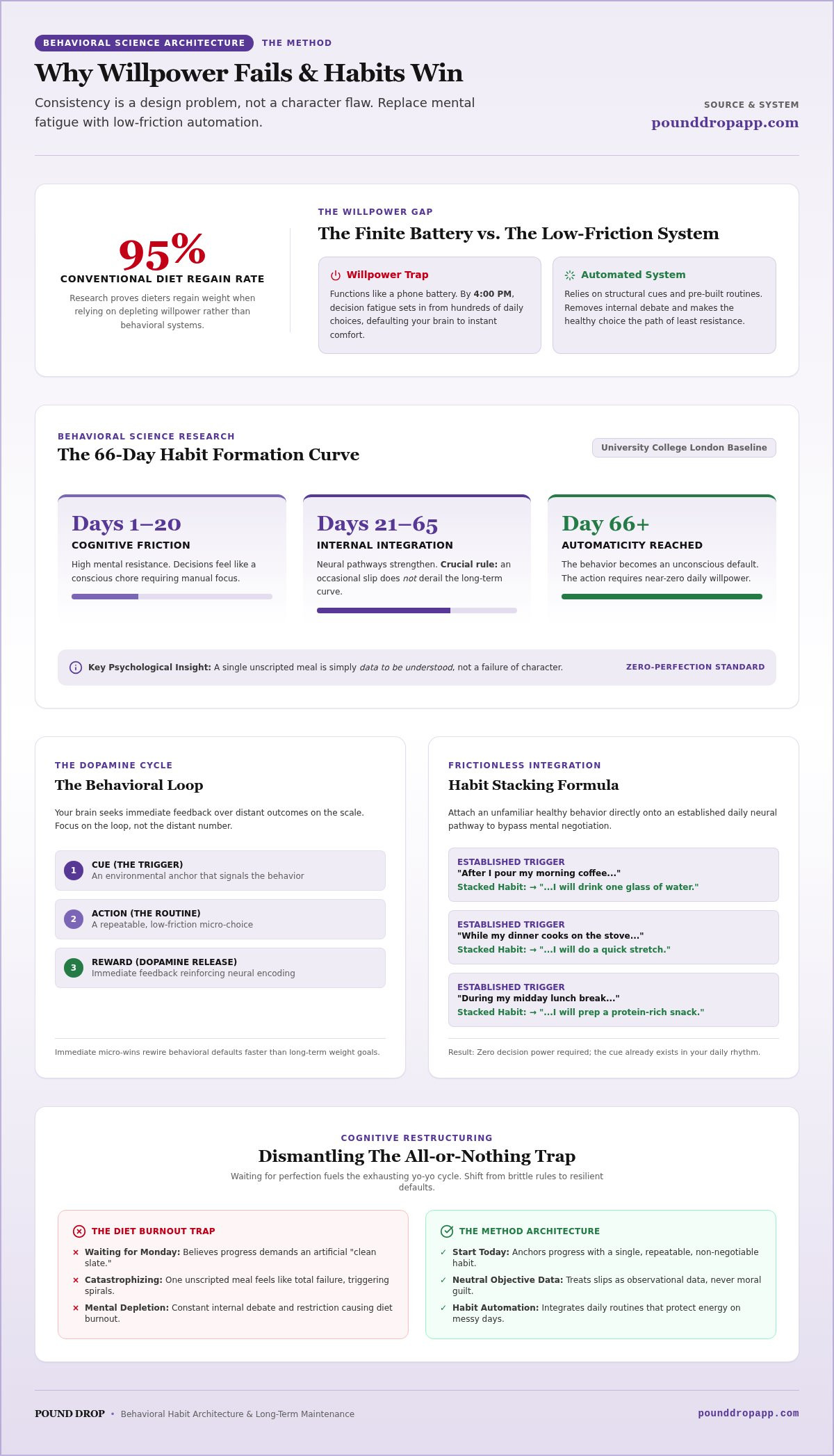
Many people believe that a lack of discipline is the only thing standing between them and their goals. They think that if they just tried harder, the weight would stay off for good. But willpower isn't a personality trait. It is a finite resource, much like a phone battery that drains throughout the day. By the time 4 PM rolls around, you've likely made hundreds of decisions at work and home, leaving your mental reserves depleted. This is decision fatigue. When your brain is tired, it defaults to the path of least resistance. This is why learning how to stay consistent with weight loss isn't about mental toughness. It's about designing a life where the healthy choice is the easiest one.
Consistency is simply a series of low-friction daily choices. If every change you make feels like a constant battle, your brain will eventually fight back to protect your energy levels. We call this the "Willpower Gap." To close it, we must shift our focus away from "trying harder" and toward building better systems. When you stop relying on your mood and start relying on a routine, you find a sense of relief and stability that a temporary diet can never provide.
The Myth of the "Perfect" Start
Waiting for Monday, the first of the month, or New Year's Day is a hidden trap. It implies that you need a clean slate to succeed. This all-or-nothing mindset is what fuels the exhausting yo-yo cycle. When you wait for a perfect start, you're also waiting for a perfect end. One unscripted meal feels like a total failure, leading to the "I'll start again next week" spiral. Real progress happens when you start today with a single, non-negotiable habit. It doesn't have to be a total overhaul. It just has to be repeatable. Small, imperfect steps taken every day are far more powerful than a perfect plan that only lasts a week.
Understanding Your Brain’s Reward System
Your brain is naturally wired to repeat actions that provide a reward. This process involves dopamine, a chemical that signals your brain to pay attention to a specific behavior. When you achieve a small win, like finishing a healthy breakfast or choosing water over soda, your brain gets a small hit of encouragement. This immediate feedback is much more effective than chasing a distant goal on the scale. To build lasting change, it helps to understand the mechanics of habit formation and automaticity. This psychological process turns a conscious chore into an unconscious routine. Behavioral consistency is a repeatable loop of cue, action, and reward. By focusing on the loop rather than just the outcome, you allow your habits to take over the heavy lifting.
The Psychology of The Method: Building Habits That Stick
Most weight loss advice focuses entirely on the plate. It tells you what to eat but ignores how the brain actually forms a routine. This is where The Method differs. It provides a structured framework to internalize change, moving beyond the surface level of "dieting." The Book serves as your foundational guide for this mindset shift, helping you understand how to stay consistent with weight loss by changing your internal defaults. When you shift your focus from restriction to integration, the mental exhaustion of trying to be perfect begins to fade.
We prioritize a non-judgmental approach to progress. If you miss a day, it isn't a failure; it's simply data to be understood. Research into behavioral psychology, such as the studies conducted at University College London, shows that it takes an average of 66 days for a new behavior to become automatic. During this window, an occasional slip doesn't derail the long-term curve. Understanding how to stay consistent with weight loss means accepting that perfection isn't required for success. This realization offers a sense of relief and stability, allowing you to focus on the overall journey rather than the stress of a single meal.
Habit Stacking for Weight Loss
Habit stacking is the art of attaching a new behavior to one you already perform without thinking. Think about your morning coffee or your evening commute. Instead of trying to remember a new task, stack it onto an existing one. Tell yourself, "After I pour my coffee, I will drink one glass of water." You're using an established neural pathway to pave the way for a new one. This makes the healthy choice the easy choice by removing the need for a constant internal debate.
When habits are stacked, they eventually become almost invisible. They require zero willpower because the cue is already built into the rhythm of your day. Whether it's doing a quick stretch while your dinner cooks or prepping a protein-rich snack during your lunch break, these micro-steps lead to steady, sustainable progress. You aren't fighting your routine; you're simply enhancing it. You can explore these techniques in the Pound Drop App to see how they fit into your specific lifestyle.
The Power of Self-Reflection
Tracking habits is far more effective than obsessing over every calorie you consume. Calories are just numbers, but habits are the engine that drives your results. The Method encourages using a physical space like The Journal to reflect on your daily choices. This reflection helps you identify triggers, such as stress, boredom, or exhaustion, before they lead to a lapse. It puts you back in the driver's seat of your own health journey.
Shifting from external validation to internal satisfaction changes the entire game. You aren't chasing a gold star or a coach's approval. You are building a life that feels good from the inside out. Self-guided progress creates a quiet, resilient confidence. It's about learning to trust your own choices again. When you stop looking for someone else to tell you what to do, you start discovering what you're truly capable of achieving on your own.
Creating Your Daily Routine for Weight Loss Success
Building a routine is like laying a track for a train. It provides a clear direction and removes the need for constant internal negotiation. When your day is structured, you don't have to wonder what to do next. Learning how to stay consistent with weight loss starts with these four practical steps to reduce friction and build momentum.
- Step 1: Identify your Anchor Habits. These are the small, non-negotiable actions you already do, like brushing your teeth or checking the mail. By attaching new health behaviors to these anchors, you make them part of your existing flow.
- Step 2: Simplify your food environment. Decision fatigue is a real obstacle. Psychological research on the limits of willpower in health behavior confirms that we cannot rely on resolve alone. Clear your counters of distractions and keep whole foods in plain sight to make the healthy choice the easiest one.
- Step 3: Schedule your reflection time. Consistency requires awareness. Dedicate a specific time each day to check in with yourself using The Journal. This practice turns vague intentions into concrete observations.
- Step 4: Use digital tools for automation. You don't have to remember everything on your own. The Pound Drop App can automate your reminders and track your habits, allowing you to focus on the action rather than the logistics.
The Morning Routine: Setting the Tone
The first 30 minutes of your day often dictate your level of consistency until bedtime. Use this time to ground yourself before the world starts making demands. Instead of scrolling through news or social media, spend five minutes with The Book. Its daily grounding philosophy helps you align your mindset with your long-term goals. Simple habits, like drinking water or eating a protein-rich breakfast, support your metabolic health and provide the mental clarity needed to stay on track.
Evening Review: Preparing for Tomorrow
A five-minute evening review is the best way to prevent "starting over" tomorrow. Use your habit tracker to visualize your progress and celebrate the small wins from the day. It isn't about being perfect; it's about being present. The Journal acts as a physical bridge between intention and action, giving you a space to process your day and prepare your environment for the next morning. When you go to bed with a plan, you wake up with purpose. This steady, intentional rhythm is the secret to how to stay consistent with weight loss over the long term.
Overcoming Diet Burnout and the All-or-Nothing Trap
Diet burnout feels like hitting a physical and emotional wall. It is a physiological response to extreme restriction that often contributes to the 80% to 95% weight regain rate seen in conventional dieting. When your brain feels threatened by a lack of nourishment or constant mental pressure, it pushes back with intense cravings and exhaustion. This is when the "all-or-nothing" trap usually appears. You might think one unscripted meal ruins your entire week, so you stop trying altogether. But learning how to stay consistent with weight loss is about realizing that a single choice is just a data point, not a verdict on your character.
To navigate a messy schedule, we use the "Two-Day Rule." Life is unpredictable. You might miss a habit because of a late flight or a family emergency. That is perfectly fine. The goal is simply to never miss two days in a row. Missing one day is a minor lapse; missing two starts to build a new, unwanted habit. This rule provides the psychological safety you need to remain resilient without the crushing pressure of being perfect every single day. It allows you to stay in the game even when life doesn't go according to plan.
Reframing "Failure" as Data
When you have an off-plan meal, your first instinct might be to listen to a harsh inner critic. Instead, try talking to yourself like a wise mentor. Ask yourself what was happening in your environment right before that choice. Were you over-tired, or had you gone too long without eating? The Method encourages you to "fail forward" by using these moments to learn about your triggers. Every lapse is an opportunity to adjust your system so it works better for your actual life. You aren't starting over; you're just refined.
Practical Tips for Busy Professionals
Consistency shouldn't require a perfect calendar. For busy professionals, the key is the "Minimum Viable Habit." This is the smallest version of your habit that you can do even when you have zero energy. If you can't do a full workout, do five minutes of stretching. If you can't cook a healthy dinner, choose the best protein-rich option from the menu. This keeps the neural pathway active without causing burnout. You can download the Pound Drop App to keep your structure intact even when your daily schedule is chaotic.
How the Pound Drop System Automates Your Consistency
The goal of any health journey is to reach a point where your healthy choices no longer require a struggle. This is why The Method is designed as a lifelong operating system rather than a temporary fix. It provides the structure needed to internalize new behaviors until they become a natural part of who you are. Understanding how to stay consistent with weight loss becomes much simpler when you have a system that removes the friction of daily decision-making.
The Pound Drop App serves as the digital heartbeat of this process. Unlike traditional apps that focus solely on calorie counting or scale weight, this platform tracks your habits. It guides you through a 28-day habit-formation baseline, helping you build a foundation of behavioral automaticity. By focusing on the actions you take rather than just the numbers you see, the app helps you stay grounded in your daily progress rather than worrying about a distant goal.
Digital and Physical Synergy
While digital tools offer convenience, there is a unique power in physical reflection. Using a tool like The Journal alongside the app creates a powerful synergy. The act of writing by hand helps to solidify your intentions in a way that digital input alone cannot. This combination allows you to track your progress in real-time while providing a quiet, screen-free space for deeper thought at the end of the day. It helps to eliminate the exhausting cycle of "starting over" because it keeps your growth visible and tangible. Start your journey with the Pound Drop App today to see how this dual approach can transform your daily routine.
Joining a Community of Self-Guided Success
Many industry voices suggest that professional 1-on-1 coaching is the only way to achieve long-term results. However, this often creates a cycle of dependency where you only feel successful when someone else is watching. The Pound Drop System values your autonomy and self-sufficiency. It offers a structured path through The Habit Ladder™, which staggers changes sequentially. You master breakfast first, then lunch, and finally dinner.
This self-guided approach builds a quiet confidence that external coaching cannot replicate. You aren't following someone else's rules; you're mastering your own habits. When you use The Book as your foundational knowledge base, you shift your mindset from "dieting" to "living." Consistency isn't a final destination you reach after a few weeks of effort. It is a daily practice that becomes easier and more rewarding the longer you stay on the path. By focusing on systems instead of willpower, you build a routine that truly lasts.
Your Path to Lasting Change
True transformation begins when you stop fighting your own biology and start working with it. We've explored how shifting from willpower to a low-friction system allows your habits to do the heavy lifting. By identifying your anchor habits and using the "Two-Day Rule," you create a routine that withstands the unpredictability of daily life. This isn't about being perfect; it's about being persistent. Learning how to stay consistent with weight loss is a journey of small, manageable steps that eventually lead to a routine that feels entirely automatic.
The Method offers a habit-based system designed for permanent results. By using the Pound Drop App, The Book, and The Journal in harmony, you integrate digital tracking with physical reflection for total psychological consistency. You don't have to carry the mental weight of a "diet" anymore. Instead, you can focus on living a life that feels balanced and sustainable. Download the Pound Drop App and start The Method today. You have the tools and the wisdom to make this year different. Trust the process, and remember that every small win is a step toward a more confident you.
Frequently Asked Questions
How do I stay consistent with weight loss when I have no motivation?
Motivation is a fleeting feeling, but consistency is a reliable system. You don't need to feel inspired to brush your teeth, and the same principle applies to your health. By building low-friction routines, you remove the need for constant willpower. The Method focuses on creating these automatic behaviors so you can keep moving forward even on days when your energy is low. Systems, not moods, drive long-term results.
What is the best way to stop starting over on a diet?
The best way to stop the cycle is to move away from an all-or-nothing mindset. Instead of waiting for a perfect Monday to begin again, focus on making your very next choice a supportive one. Using the Pound Drop App helps you track your habits rather than just a number on the scale. This shift ensures that one unscripted meal doesn't feel like a reason to quit, but rather a simple moment to learn.
Can I lose weight without a coach or personal trainer?
Yes, you can achieve lasting results through self-guided progress. Many people find that one-on-one coaching creates a dependency that is difficult to maintain for years. Pound Drop provides the structure and tools, like The Book and The Method, to help you become your own expert. This approach builds the quiet confidence and autonomy needed to manage your health independently. You are capable of leading your own journey toward sustainable change.
How does habit stacking work for weight loss?
Habit stacking involves attaching a new behavior to a routine you already perform daily. For example, you might decide that after you finish your morning coffee, you will immediately write your intentions in The Journal. This uses an existing neural pathway to make the new action feel natural and effortless. It is a core strategy for how to stay consistent with weight loss because it reduces the mental effort required to start.
What should I do if I mess up my routine for a few days?
Practice the "Two-Day Rule" and avoid missing your habits two days in a row. If life gets messy and you miss a day, acknowledge it without judgment and focus on returning to your routine tomorrow. This prevents a temporary lapse from becoming a permanent slide. Remember that consistency is a practice of returning, not a state of perfection. Your progress is cumulative, and one or two days don't erase your hard work.
Why is a physical weight loss journal better than just an app?
A physical journal provides a tactile space for reflection that a digital screen cannot replicate. While the Pound Drop App is excellent for tracking and automation, The Journal allows you to slow down and process your triggers more deeply. This physical bridge between your intentions and your actions helps to solidify your commitment. Using both tools together creates a synergy that supports both your daily logistics and your psychological growth over time.
How long does it take for weight loss habits to become automatic?
Research indicates it takes an average of 66 days for a new health-related behavior to become automatic. This timeline can range from 18 to 254 days depending on the individual and the specific habit. Understanding this timeframe helps you stay patient and persistent. By following the 28-day challenge in the Pound Drop App, you build the initial baseline needed for these behaviors to eventually feel like a natural part of your day.
Is it possible to lose weight without restrictive meal plans?
It is absolutely possible, and it's often more sustainable to do so. Restrictive plans frequently lead to decision fatigue and eventual burnout. Instead, focus on food quality and behavioral shifts as outlined in The Method. By learning how to stay consistent with weight loss through habit formation rather than strict rules, you can enjoy your life while still reaching your goals. This approach prioritizes long-term maintenance over rapid, unsustainable results.


