

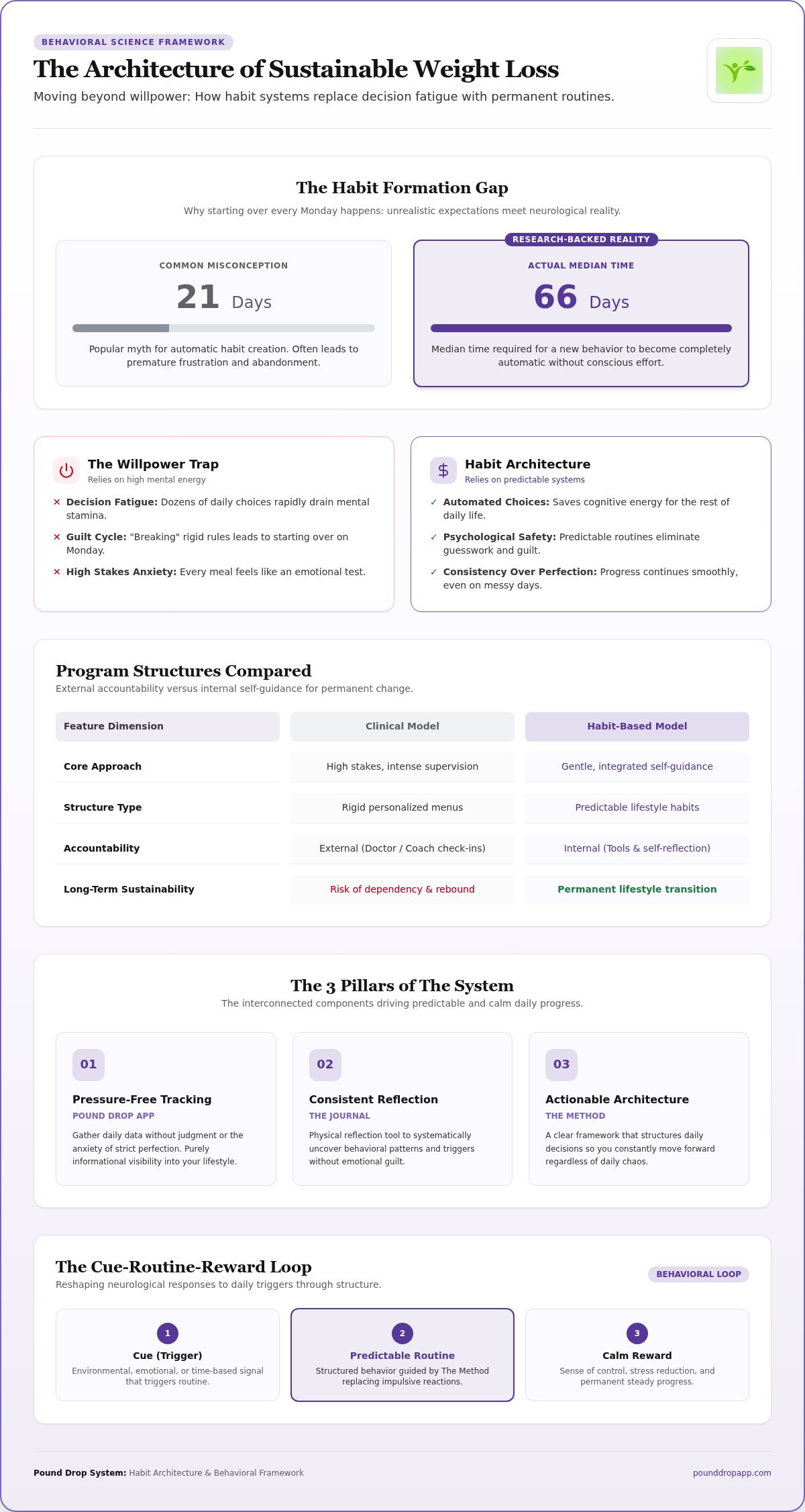
What if the reason you keep "starting over" every Monday isn't a lack of willpower, but a lack of architecture? It's a heavy feeling to carry. You've likely experienced the decision fatigue of complex meal plans and the guilt that follows "breaking" a strict rule. This cycle is exhausting, but it's not your fault. Most people believe habits form in 21 days, yet research shows it actually takes a median of 66 days for a new behavior to become automatic. Without a supportive system, those two months can feel like an impossible uphill climb.
A structured weight loss program provides the psychological framework you need to bridge that gap. It's not about more rules; it's about creating a predictable daily routine that prioritizes consistency over perfection. You can find freedom from the yo-yo cycle through a non-judgmental system that focuses on how you live, not just what you eat. In this guide, we'll explore how habit-based systems provide the stability needed for permanent weight management. We'll look at the mechanics of daily routines and how a structured approach can finally bring you a sense of calm, steady progress.
Key Takeaways
- Learn how a structured weight loss program replaces the chaos of fad dieting with a predictable system of habits that ends the cycle of starting over.
- Understand why a gentle, self-guided approach like The Method creates more sustainable results than high-pressure clinical environments.
- Discover the behavioral science behind the "Cue-Routine-Reward" loop and how to use it to reshape your brain's response to daily triggers.
- Identify how to choose a framework that solves your specific obstacles by prioritizing habit architecture over rigid menus or restrictive rules.
- Find out how to integrate digital tools like the Pound Drop App with physical resources to build a permanent foundation for healthy change.
Understanding the Structured Weight Loss Program
A structured weight loss program isn't a list of forbidden foods or a set of impossible rules. It's a reliable system of predictable habits and routines designed to provide a sense of stability. Most of us are used to the chaos of fad dieting, where every meal feels like a high-stakes test. This creates a state of constant anxiety. By contrast, true structure offers psychological safety. It provides a clear path forward, so you don't have to wonder what to do next or worry about making the "wrong" choice.
The real magic happens when you shift your focus. Instead of obsessing over what you can't have, you start focusing on what you do every day. This approach aligns with the core principles of long-term weight management, which emphasize lifestyle modification over temporary fixes. It's about building a foundation that lasts long after the initial excitement of a new plan fades. You aren't just losing weight; you're practicing a new way of living.
To better understand this concept, watch this helpful video:
The Core Components of an Effective System
An effective system relies on a few key pillars that work together to create change. First, there's daily tracking. In a supportive structured weight loss program, tracking is done without the pressure of being perfect. It's simply a way to gather data about your life through tools like the Pound Drop App. Second, you need consistent reflection periods. Using a physical tool like The Journal allows you to identify patterns in your behavior without judgment. Finally, everything is guided by a clear methodology, like The Method, which acts as the architecture for your daily choices. This framework ensures you're always moving forward, even on messy days.
Why Willpower Is Not the Problem
Many people blame a lack of willpower for their past difficulties. This is rarely the case. The real culprit is often decision fatigue. When you have to make dozens of choices about food and activity every day, your mental energy drains quickly. It's hard to stay "strong" when you're exhausted. A structured system automates these choices for you. By using a system like The Method, you save your mental energy for other parts of your life. You stop "trying hard" and start simply following the system. This transition from effort to automation is what makes the progress feel manageable and, eventually, permanent.
Clinical vs. Habit-Based Structures: A Comparison
Choosing a structured weight loss program often feels like a choice between two different worlds. On one side, you have the clinical path. It's supervised, medical, and often intense. On the other side, you have a habit-based system. It's gentle, self-led, and integrated into your life. Both aim for results, but they feel very different in your daily experience. One relies on external pressure, while the other focuses on building internal strength.
The clinical model often feels like a temporary intervention. It's something you "go on" for a period of time. By contrast, a habit-based approach is something you "become." It’s about practicing a new way of being until it feels natural. When evaluating your options, consider the guidelines for choosing a safe weight loss program to ensure the system you pick supports your long-term health without causing unnecessary stress.
The Clinical Model: High Stakes and Supervision
Clinical programs rely heavily on external accountability. This might include frequent doctor visits or check-ins with a coach. While this supervision provides a safety net, it can also create a sense of dependency. What happens when the program ends and the coach is gone? This often leads to a "rebound" effect where old habits return because the individual never learned to guide themselves. Additionally, personalized meal plans frequently fail in the real world. They don't account for late meetings, family dinners, or the simple desire for variety. They are rigid, and in a messy life, rigidity often leads to breaking.
The Habit-Based Model: Empowerment through Self-Guidance
A habit-based model focuses on empowerment. It gives you the tools to be your own guide. Using a weight loss tracking journal shifts the focus from following external rules to developing internal awareness. You learn to recognize your own patterns. This ownership is what creates a consistent weight loss routine that actually fits your unique life. There is no one to "fail" or disappoint if you have a difficult day. Instead, you have The Method. This system provides the logic you need to navigate unpredictability without guilt. If you're ready to start building this personal architecture, the Pound Drop App offers a quiet, supportive space to begin your journey. This self-guided approach isn't a lack of support; it's the ultimate form of support because it teaches you how to support yourself forever.
The Behavioral Science of Habit Architecture
The brain is a pattern-seeking machine. It constantly looks for ways to conserve energy by turning repeated actions into automatic scripts. In a structured weight loss program, we use this biological tendency to our advantage. Habit architecture isn't about forced discipline. It's about designing a path that your brain wants to follow. This process relies on a feedback loop known as "Cue-Routine-Reward." A cue triggers a behavior, the routine is the action you take, and the reward tells your brain that the action is worth repeating. When you apply these behavioral and psychological strategies for weight control, you stop fighting your nature and start working with it.
Digital tools like the Pound Drop App are excellent for tracking, but the brain also responds deeply to physical interaction. This is why "The Book" and "The Journal" are essential components of the system. They provide tactile reinforcement. Holding a physical object anchors your intention in the real world. It makes the abstract concept of habit change feel solid and manageable. Writing by hand engages different neural pathways than typing, helping to cement new concepts into your long-term memory.
Reducing the Mental Load of Weight Loss
Weight loss often feels heavy because of the immense mental load it carries. You're constantly deciding what to eat, when to move, and how to stay on track. This constant negotiation leads to exhaustion. Habit stacking helps solve this by anchoring a new action to an established routine. For example, you might practice a five-minute reflection right after your morning coffee. This creates "mental shortcuts." Soon, healthy living isn't a series of difficult choices. It's just what you do. This eliminates the "Monday morning" start-over mentality. You don't need to start over when you're simply following a system that's already in motion. Consistency becomes your default state.
The Power of Daily Reflection
Reflection is the missing link in most attempts to change. When you write down your progress, you change your relationship with food and your body. It's no longer about "good" or "bad" days. It's about data. Using a journal allows you to identify emotional triggers without judgment. Why did you reach for a snack at 3 PM? Was it hunger, or was it a specific stressor at work? Mindful weight loss strategies help you see these patterns clearly. Over time, this awareness builds a sense of psychological safety. You become a student of your own habits. This perspective shift turns a struggle into a practice, making permanent change feel like a natural evolution rather than a forced transformation.
Choosing the Right Structured Program for Your Lifestyle
Finding the right structured weight loss program starts with a simple question. What is actually standing in your way? For some, it's a lack of time. For others, it's the exhaustion of trying to stay motivated without a clear plan. If you've spent years jumping between diets, you know that "lack of willpower" is rarely the true issue. The real obstacle is often a system that asks too much of you and gives too little back in terms of psychological support. You need a framework that fits into the gaps of your existing life rather than one that demands you build a new life from scratch.
When you're evaluating your options, look for programs that prioritize "The Method" over "The Menu." A menu tells you what to eat for a week; a method teaches you how to manage your habits for a lifetime. It's also vital to avoid programs that rely on supplements or restrictive meal plans. These are often red flags. They suggest that the program is interested in quick, unsustainable results rather than lasting behavioral change. A healthy system respects your intelligence and your autonomy, offering you tools instead of strict commands.
Digital vs. Physical Tools: Why You Need Both
Modern life moves fast. You need the convenience of an app for real-time tracking when you're on the go. However, digital tools alone can sometimes feel fleeting. This is where the psychological weight of a physical book and journal comes in. There's a grounding effect when you touch the pages of The Book or write in The Journal. This tactile experience creates a sense of permanence. It turns your goals into something you can hold. A self-guided weight loss plan succeeds because it integrates these two worlds. It offers the speed of technology and the mindfulness of the physical page.
Evaluating the Tone of the Program
The voice of the program matters more than you might think. Many systems use "bootcamp" language or rely on guilt and shame to drive compliance. This approach is rarely sustainable. It creates a state of high stress that eventually leads to burnout. Instead, seek out a program that feels like a wise mentor. This voice is patient. It values steady, incremental progress over perfection. Non-judgmental tracking allows you to see your habits clearly without the fog of self-criticism. When you feel safe to track your "messy" days, you're much more likely to stay consistent over the long term. If you're ready to leave the guilt behind, you can download the Pound Drop App and begin building your own resilient routine today.
Implementing The Method: Your Path to Permanent Change
Transitioning into a structured weight loss program shouldn't feel like a high-stakes event. It's a gentle shift toward a new way of being. At Pound Drop, we believe that the path to permanent change is paved with small, intentional actions rather than drastic overhauls. Our approach centers on The Method, a system designed to help you navigate the complexities of daily life with quiet confidence. You don't need to wait for a perfect moment to begin. You only need to be willing to practice a new set of routines.
This process is about building a foundation that supports you even when life gets messy. It's not about being a "perfect" version of yourself. It's about being a more aware version of yourself. By focusing on the mechanics of your daily habits, you create a sense of stability that fad diets simply cannot provide. You're moving from a state of uncertainty to a state of informed action, one day at a time.
Starting Without Starting Over
The most important step is moving away from the "fad" mindset. We've been conditioned to think that if we aren't perfect, we've failed. This leads to the exhausting cycle of starting over every Monday. In a habit-based system, there is no starting over because you never truly stop. During your first 30 days, focus on learning the tools rather than seeing a specific number on the scale. Set realistic expectations. Your goal is to show up for your routines, even when you don't feel like it. Consistency outranks perfection every time. If you miss a day of tracking, you simply pick up your tools the next morning. This non-judgmental approach is what makes a structured weight loss program sustainable for the long term.
The Pound Drop Ecosystem
Our system works because it provides a complete architecture for your habits. The Pound Drop App, The Book, and The Journal work in harmony to keep you grounded. The App is your digital companion for real-time tracking and data. The Book explains the logic behind The Method, helping you understand the "why" behind your actions. Finally, The Journal serves as your daily habit anchor, providing a physical space for reflection and pattern-seeking. You'll notice there are no meal plans or supplements in this system. We omit them because they are temporary crutches. We want you to learn how to nourish yourself in the real world. Your first step is simple: download the app and commit to the process of self-discovery. Trust the system, practice the routines, and allow yourself the grace to grow at your own pace.
Build Your Future on Habits, Not Willpower
Permanent weight management isn't found in a restrictive menu or a high-pressure clinical setting. It's built through the quiet, daily practice of habit architecture. By choosing a structured weight loss program, you replace the exhaustion of decision fatigue with a predictable system that actually respects your life. You've learned that structure provides the psychological safety to track progress without judgment and that reflection is the missing link in lasting change.
The Pound Drop system is designed to be your partner in this unhurried evolution. Our proprietary system, The Method, relies on proven behavioral science rather than temporary willpower. No coaches. No supplements. Just habits. By integrating the Pound Drop App with physical tools like The Book and The Journal, you create a tangible foundation for growth. It's a self-guided journey that empowers you to take full ownership of your health and your daily choices.
Begin your journey with the Pound Drop App and discover The Method today. You have the capacity to build a routine that lasts. Trust the process, take it one day at a time, and enjoy the steady, unhurried progress ahead.
Frequently Asked Questions
What exactly makes a weight loss program "structured"?
A weight loss program is "structured" when it replaces guesswork with a predictable system of daily habits and routines. This framework acts as the architecture for your choices, ensuring you always know your next step. Unlike loose goals, a structured weight loss program provides specific digital and physical tools to track progress. It focuses on the mechanics of your routine rather than just the results on a scale, creating a sense of psychological safety.
Can I really lose weight without a one-on-one coach?
You can absolutely achieve permanent weight management without a one-on-one coach. In fact, self-guidance is often a strength because it fosters true ownership of your journey. By using The Method, you learn to become your own guide through evidence-based habit formation. The Pound Drop App and The Journal provide the necessary accountability and feedback loops. You aren't relying on an external enforcer; you're building the internal skills needed for a lifetime of success.
Does a structured program mean I have to eat specific meals?
No, a healthy structured system focuses on your behavioral patterns rather than a rigid list of allowed foods. Pound Drop explicitly avoids personalized meal plans because they are often unsustainable in the real world. Instead, we prioritize The Method, which teaches you how to integrate healthy habits into your existing lifestyle. You learn to make informed choices in any environment. This flexibility ensures the program feels like a natural part of your life rather than a temporary restriction.
How much time does it take to follow a habit-based system daily?
Following a habit-based system typically requires less than fifteen minutes of focused time each day. Digital tracking in the Pound Drop App takes seconds after a meal, while daily reflection in The Journal usually takes five to ten minutes. These small windows of time are designed to fit into the busiest schedules. By using habit stacking, you anchor these new actions to established routines, making them feel effortless. The goal is a high return on a small time investment.
What is the difference between a structured program and a diet?
A diet is often a temporary, restrictive intervention focused on what you can't have. A structured weight loss program is a permanent framework focused on what you do every day. While diets rely on short-term willpower, structure utilizes the science of habit formation to create automatic behaviors. Diets often feel like a battle against your nature. A structured system like The Method works with your brain to build a sustainable, non-judgmental lifestyle that lasts forever.
Is a structured program suitable for busy professionals?
Structured programs are ideal for busy professionals because they significantly reduce decision fatigue. When your day is filled with high-stakes choices at work, you don't want to negotiate with yourself about your health. The Method provides a clear logic for your daily routine, automating your healthy choices. Using the Pound Drop App allows for quick, on-the-go tracking. This structure saves your mental energy for your career while ensuring your personal health goals remain on a steady, predictable track.
How do I know if I need a physical journal or just an app?
Most people find the best results by using both digital and physical tools in harmony. The Pound Drop App is perfect for real-time tracking and data management when you're busy. However, The Journal offers a tactile experience that encourages deeper reflection and pattern-seeking. Writing by hand engages different parts of your brain, helping to anchor your intentions. Together, they provide a complete architecture for your habits, covering both the logistical and psychological aspects of change.
What happens if I "mess up" on a structured program?
There is no such thing as "messing up" in a non-judgmental structured system. If you miss a day or deviate from your routine, it's simply data to be observed, not a reason for guilt. You don't need to start over because you never truly stopped. You simply pick up your tools and continue with your next scheduled habit. This resilience is the core of The Method. It acknowledges that life is messy and focuses on steady progress over impossible perfection.


