


Article by
Jesper Sorensen
Jesper Sorensen is a holistic health coach and founder of Pound Drop, a different approach to weight loss built around healthier habits. He has written ebooks and health articles for established publishers and has spent years studying nutrition, healthy eating and sustainable weight management.
A holiday meal doesn’t have to become an argument about what’s on your plate. Dealing with food pusher relatives during family holidays can feel easier when you pause before answering, redirect the conversation, decline simply, plan ahead, and calmly repeat a boundary if needed.
It can be especially hard to say no when food is offered with affection or tradition behind it. You’re allowed to appreciate the gesture without eating more than you want, and you don’t need a long explanation to make your choice valid.
These practical approaches can help you find comfortable words, prepare for familiar pressure, and step away when a conversation becomes too much. The goal isn’t to control what anyone else does. It’s to make room for your needs while staying present with the people you came to see.
Key Takeaways
- Give yourself a moment before answering a food offer so you can respond with intention rather than pressure.
- Shift the conversation with a warm compliment or a question about the dish.
- Keep refusals simple and polite; you don’t need to justify your choice.
- Plan ahead by practicing a response and identifying someone supportive to turn to at the gathering.
- If a relative keeps pushing, calmly repeat your boundary or step away to regroup.
1. Delaying a response to an offer of more food
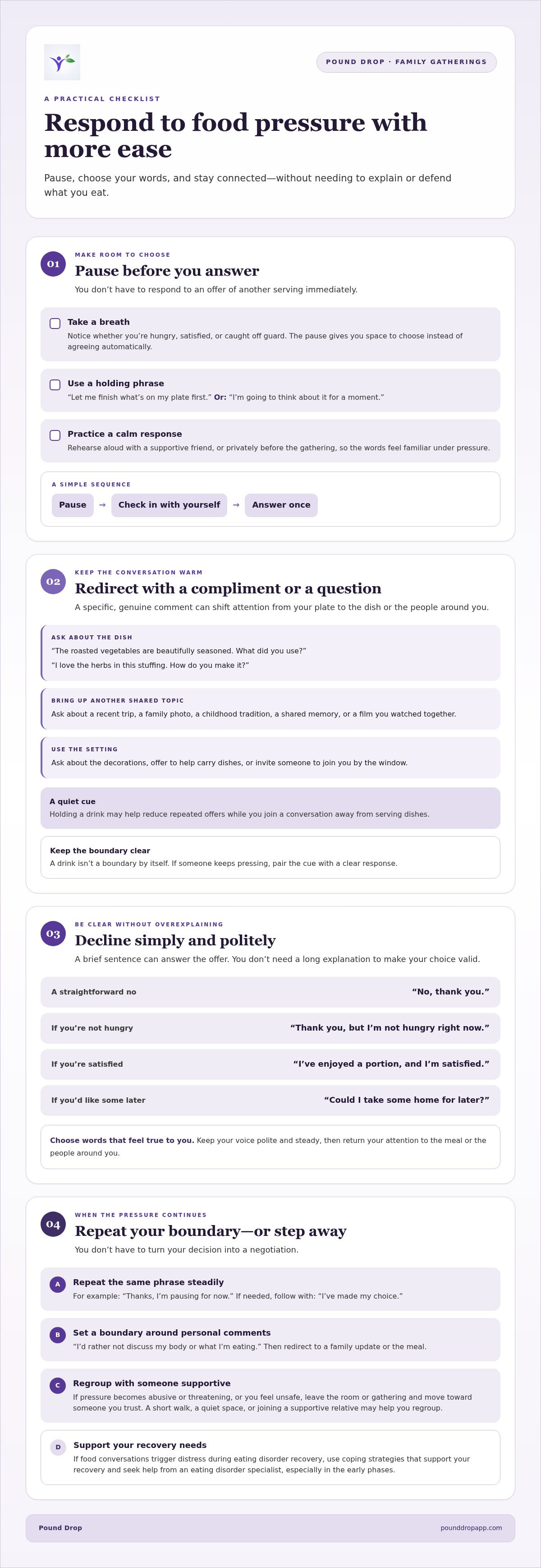
When a relative offers another serving, you don’t have to answer immediately. Pause, take a breath, and notice whether you’re hungry, satisfied, or simply caught off guard. That brief pause gives you room to choose instead of agreeing automatically. You might say, “Let me finish what’s on my plate first,” or, “I’m going to think about it for a moment.” Both responses acknowledge the offer without committing to eating more.
Practise a few calm phrases before the gathering, when you’re not under pressure. Say them aloud to a supportive friend, or rehearse them privately while getting ready. Try, “I’m enjoying this, and I’ll decide about more later,” or, “Thanks, I’m going to pause for now.” Practising makes the words feel familiar, so you’re less likely to search for an explanation while someone waits. Choose language that fits your relationship and sounds like you.
If the offer comes again, repeat your response steadily instead of adding new reasons. For example: “Thanks, I’m pausing for now,” followed by, “I’ve made my choice.” A relative may mean well, may not notice the pressure, or may be testing whether you’ll change your mind. You don’t need to work out their motive before deciding what feels right. A brief pause followed by the same clear phrase can keep the conversation from becoming a negotiation.
How should you handle relatives commenting on your weight or eating habits? You can say, “I’d rather not discuss my body or what I’m eating,” then redirect attention to a specific topic, such as a family update or the meal. Food comments can reflect misconceptions, so don’t treat them as a verdict on your choices. If teasing continues, calmly repeat your boundary instead of defending your plate.
If the pressure becomes abusive or threatening, or makes you feel unsafe, leave the room or gathering and move toward someone you trust. A short walk, a quiet space, or joining a supportive relative can help you regroup. If food conversations trigger distress during eating disorder recovery, use coping strategies that support your recovery and seek help from an eating disorder specialist, especially in the early phases. You’re not required to stay in an interaction that feels harmful.
For a simple practice, picture a relative offering seconds, then rehearse three steps: pause, check in with yourself, and answer once. If they tease you or ask again, repeat your chosen phrase or step away. The aim isn’t to deliver a perfect response. It’s to give yourself time to make a decision that feels like yours.
2. Redirecting a food offer with a compliment or recipe question
A warm compliment can shift attention from whether you’ll take more food to the care behind the dish. Try, “The roasted vegetables are beautifully seasoned. What did you use?” or, “I love the herbs in this stuffing. How do you make it?” The question invites the cook to share something they know and gives you a comfortable way to move the conversation along.
Keep the compliment genuine and specific. Mention the crisp edges on a pie, the flavor of a sauce, or the color of a salad. Then ask a simple follow-up, such as, “Is that a family recipe?” If your relative returns to offering food, respond to their answer first. You could say, “I can see why everyone looks forward to it,” and ask who first made the dish.
A different topic works just as well when food talk feels repetitive. Ask your cousin about a recent trip, invite your aunt to tell you about a family photo, or ask the host how the garden is doing. An open-ended question gives the other person something new to answer. It also reminds you both that a holiday visit includes more than the meal.
Choose a subject that suits the person instead of reaching for a generic distraction. With a grandparent, ask about a tradition from their childhood. With a sibling, bring up a shared memory or a film you watched together. If the person keeps returning to your plate, gently guide the conversation back: “I’d love to hear more about your trip. What was your favorite part?”
Holding a drink can offer a quiet, nonverbal cue that you’re occupied. Keep a glass of water or another drink in hand while joining a conversation away from the serving dishes. This may reduce repeated offers without requiring an announcement. A drink isn’t a boundary by itself, though, so pair the cue with a clear response if someone keeps pressing you.
Use your surroundings to make the redirect feel natural. Ask someone to show you the holiday decorations, offer to help carry dishes, or invite a relative to join you by the window. These small actions shift attention and conversation toward a shared activity. If the other person brings up food again, answer briefly, then ask about what you’re doing together.
Rehearse a few transitions before the gathering: “That smells wonderful. How did you season it?” “Tell me about the photo on the mantel.” “Would you help me find the serving spoons?” These phrases don’t require you to debate your choices. They offer practical ways to stay engaged with relatives while steering the conversation toward another topic.
3. Using a simple statement to decline more food
A brief refusal can be enough. Try, “No, thank you,” or, “I’m full, but I enjoyed it.” You don’t need to explain your appetite, health goals, or what you ate earlier. A clear sentence answers your relative without inviting a debate about whether your choice is reasonable. Keep your voice polite and steady, then return your attention to the meal or the people around you.
Choose words that match what you genuinely feel. If you’re not hungry, say, “Thank you, but I’m not hungry right now.” If you’ve already had some, try, “I’ve enjoyed a portion, and I’m satisfied.” If you’d like to save the dish, say, “That looks lovely. Could I take some home for later?” Each response acknowledges the offer while making your decision clear.
- “No, thanks. I’m all set.”
- “I’ve had some already, and it was delicious.”
- “Not right now, thank you.”
- “I’d enjoy taking a little home for later.”
A relative may ask why you’re declining, especially if they’re concerned or used to serving you more. You can answer briefly without giving a detailed account: “I’m listening to what feels comfortable for me.” If the questions continue, repeat your original response. You’re not required to debate your choices or come up with new reasons each time someone asks.
For a dish you appreciate but don’t want now, separate gratitude from eating. “Thank you for making this. I’ve had some and really enjoyed it,” recognizes the effort without agreeing to another serving. You could also ask to have a portion packed for later or shared with someone who wants it. That keeps the exchange warm and gives the food a place beyond your plate.
Humour can soften a refusal if it feels natural with that relative. You might say, “That pie is making a strong case, but I’m going to pass for now,” with a friendly smile. Or try, “I’m saving room for conversation, not another serving.” Keep the joke gentle and focused on your decision, not the cook or the food. If humour might sound dismissive, choose a straightforward “No, thank you” instead.
If you’re unsure which phrase will feel comfortable, ask a trusted friend to role-play a family exchange before the gathering. Let your friend offer seconds, then practise saying your chosen line in your everyday voice. For example: “Would you like more?” “No, thank you. I’ve had enough.” Practising the exact words helps them feel familiar. At the table, one kind sentence can communicate appreciation and a firm decision at the same time.
4. Managing pressure to eat at family gatherings and holidays
A plan for dealing with food pusher relatives during family holidays starts before you arrive. If hunger makes offers harder to handle, have a balanced snack or small meal beforehand. Choose a response to comments about your plate, and tell a supportive friend or relative what choices you’re working to maintain. You might say, “I’m practising listening to my body. Please help me change the subject if food becomes a big topic.”
Practise your plan aloud before leaving home. Ask someone you trust to pretend to offer another serving, comment on your plate, or tease you for passing. Try your response, then decide what you’ll do if the pressure continues. You could help in the kitchen, join another conversation, or take a short walk. For a potluck, bringing a dish that fits your dietary needs can give you a familiar option.
How can you support a child pressured to eat by relatives? Stay close, let the child decide whether they want more, and calmly tell the relative, “Thanks for offering; they can choose.” If comments continue, change the subject or move with the child to another activity. This makes clear that the child doesn’t have to eat to please someone else.
If you’re recovering from an eating disorder, plan with support that fits your recovery. In the early phases, seek help from an eating disorder specialist. Before the gathering, tell a trusted friend or family member what support would help. If a conversation feels triggering, use coping strategies that work for you, such as stepping outside with that person. Your recovery doesn’t depend on what relatives do or don’t do.
At the gathering, check in with your body rather than eating to make someone else happy. If a small portion feels socially easier, you can choose one without treating it as an obligation to keep eating. You can thank the host for making a favorite pie and ask to take some home, or say you’d rather enjoy it later when you’re hungry. Let your own needs guide the decision.
Dealing with food pusher relatives during family holidays can take practice, and one difficult exchange doesn’t define the whole visit. If you accepted food you didn’t want, return to your usual intentions at the next meal instead of giving up on them. Before the next gathering, adjust your plan: choose a supportive companion, practise a boundary, and decide where you can go for a quiet reset. Notice what helped, then carry that learning forward.
5. Setting boundaries with relatives and other food pushers
A boundary is a clear statement about what you will discuss or do. For example, tell your uncle, “Please don’t comment on my plate. I want to enjoy dinner with everyone.” Keep your request focused on a specific behavior. You’re not asking someone else to agree with your choices; you’re letting them know how you want to be treated.
If a relative continues, calmly repeat the same words instead of building a longer case. You might say, “I’ve asked you not to comment on my eating,” then turn to another guest or step away. Repeating a boundary can feel uncomfortable at first. Staying consistent makes your position clear, even if the other person doesn’t respond as you hoped.
People who push food may have caring intentions, poor awareness, or motives that feel less kind. You don’t need to decide which explanation is true before setting a limit. If a relative says, “I made it just for you,” you can answer, “I appreciate the thought, and I’m still deciding what I want.” Their feelings don’t require you to eat more.
How should you respond when a relative ignores a dietary restriction or allergy? State the restriction clearly, then ask what ingredients are in the dish and whether it was prepared to meet that need. If the answer is unclear or the dish doesn’t fit your restriction, decline it and choose an option you can eat safely.
Before a meal out or family gathering, tell a supportive person what may help. For example, ask your sister to change the subject if your aunt comments on your food, or to sit beside you during dinner. If a relative’s remarks continue, use a prepared exit: “I’m going to help in the kitchen now.” A short walk or another conversation can give you space to regroup.
Comments can reflect someone’s assumptions about food, not an accurate understanding of your needs. Don’t treat every remark as a judgment you must answer. You can say, “I’m not discussing my eating today,” and move on. At the same time, support from a trusted person or a treatment professional during eating disorder recovery is different from unsolicited comments. Follow the coping strategies that support your recovery when a conversation becomes triggering.
Choose a response that fits your relationship and feels possible to say. A close friend may hear, “I know you care, but please stop offering me more.” A relative you see less often may get, “No, thank you. I’ve made my choice.” If the pressure continues, repeat your limit or leave the interaction. A boundary doesn’t need to persuade someone else; it helps you decide what you’ll do next.
Pound Drop: Pound Drop App
Pound Drop App offers a structured way to track and manage your progress as you practise food choices that feel sustainable beyond holiday gatherings. If you want more structure for carrying those choices into everyday routines, The Method provides the system behind Pound Drop, supported by The Book and The Journal. These tools can help you reflect on your habits and keep your own goals in view, including when family comments feel distracting. They don’t replace specialist support during eating disorder recovery, but they may suit people looking for a self-guided approach to lifestyle changes. Start with the tool that feels most useful for your next step, whether that’s tracking progress or learning the method. If you’d like to explore how Pound Drop could fit your routine, contact Pound Drop.
Carry Your Boundaries Into the Next Gathering
Progress doesn’t depend on every family meal going smoothly. A more useful measure is whether you can stay connected to your needs, even when someone else has opinions. As you continue dealing with food pusher relatives during family holidays, notice which moments feel hardest and what support might make the next gathering easier. You can build on that insight gradually, without expecting yourself to handle every comment perfectly.
If you’d like a structured, self-guided way to support your ongoing lifestyle changes, consider exploring Pound Drop. Choose a next step that feels manageable, and give yourself room to practise at your own pace. Contact Pound Drop for support if you’d like to learn more. Your choices are yours to make, one gathering at a time.
Frequently Asked Questions
How to politely decline food from relatives during holiday meals?
Thank your relative, then give a clear, brief answer: “That looks lovely, but I’m not having any more right now.” If they offer a second serving, repeat your answer without adding a long explanation. You can also redirect the moment by asking about the recipe or offering to help clear the table. A warm tone shows appreciation for the gesture without making you responsible for eating more.
What to say to relatives who keep pressuring you to eat?
Use a calm, repeatable sentence such as, “I’ve decided what feels right for me, thanks.” When you're dealing with food pusher relatives during family holidays, changing your wording each time can invite more debate, so stick with one simple response. If someone jokes or insists, try: “I know you mean well, but I’m not discussing what I eat.” Then turn to another person or topic.
How to set boundaries with food-pushing family members?
Set the boundary before the meal, ideally in a private conversation rather than across the table. You might say, “I’m looking forward to seeing you. Please don’t comment on how much I eat or offer food after I’ve declined.” Be specific about what you want to change. If the behavior continues, calmly end the exchange by stepping away to help in the kitchen or speak with another guest.
How to deal with food pressure at family holidays without starting an argument?
Keep your reply short, neutral, and focused on your choice rather than the other person’s intentions. For example: “No, thank you. Let’s enjoy dinner.” If they challenge you, don’t try to prove your point; repeat your response, take a sip of water, or ask someone about their holiday plans. If the conversation becomes tense, excuse yourself briefly. You can return when the focus has moved elsewhere.
How to plan ahead for holiday meals when family members push food?
Before you go, choose a response you can say comfortably and identify someone you can sit with or check in with if pressure builds. If it feels useful, tell the host privately that you’d prefer not to be urged to take seconds. Decide how you’ll handle repeated offers, such as changing seats or helping with another task. A small plan gives you options without requiring the gathering to go perfectly.


