


Article by
Jesper Sorensen
Jesper Sorensen is a holistic health coach and founder of Pound Drop, a different approach to weight loss built around healthier habits. He has written ebooks and health articles for established publishers and has spent years studying nutrition, healthy eating and sustainable weight management.
Rebuilding self-trust after decades of failed diets starts with noticing the conflicting feelings dieting has left behind, questioning rules that no longer fit, and making small promises you can realistically keep. Rather than forcing one side of you to win, consider what each feeling is trying to protect, then choose your next step with care. Self-trust grows through practice, not stricter rules.
If part of you still wants weight loss while another is tired of tracking, restriction, or starting over, that tension doesn’t mean you’re doing anything wrong. Old rules can feel familiar even when they leave you disconnected from what you need now. You don’t have to resolve every feeling at once.
This article will help you explore those mixed responses, notice when food rules are steering your choices, and loosen labels like “good” and “bad” around food. You’ll also learn to pay attention to changing needs and make realistic promises based on what matters to you, so your next step can feel steadier and more genuinely yours.
Key Takeaways
- Give conflicting feelings about dieting room to speak, then choose your next step with compassion.
- Notice when outside rules are guiding food choices, and practise checking in with your own signals.
- Let go of moral labels for food and explore what different choices mean for you.
- Pay attention to how your needs change, especially when stress or daily demands affect what feels manageable.
- Before making a promise to yourself, understand why it matters and choose a step you can realistically keep.
1. Using parts work to understand conflicting feelings about dieting
After years of dieting, you may notice competing reactions whenever food or weight comes up. One part may fear eating freely because it expects weight gain. Another may long to stop tracking meals and feeling judged. Parts work means noticing these reactions without treating either as your whole identity. Try naming them gently: “the rule-following part” and “the part that wants ease.” Then ask what each is trying to protect. Fear might be trying to prevent criticism; the longing for ease might be asking for less pressure. Listening gives both a voice without letting either make every decision.
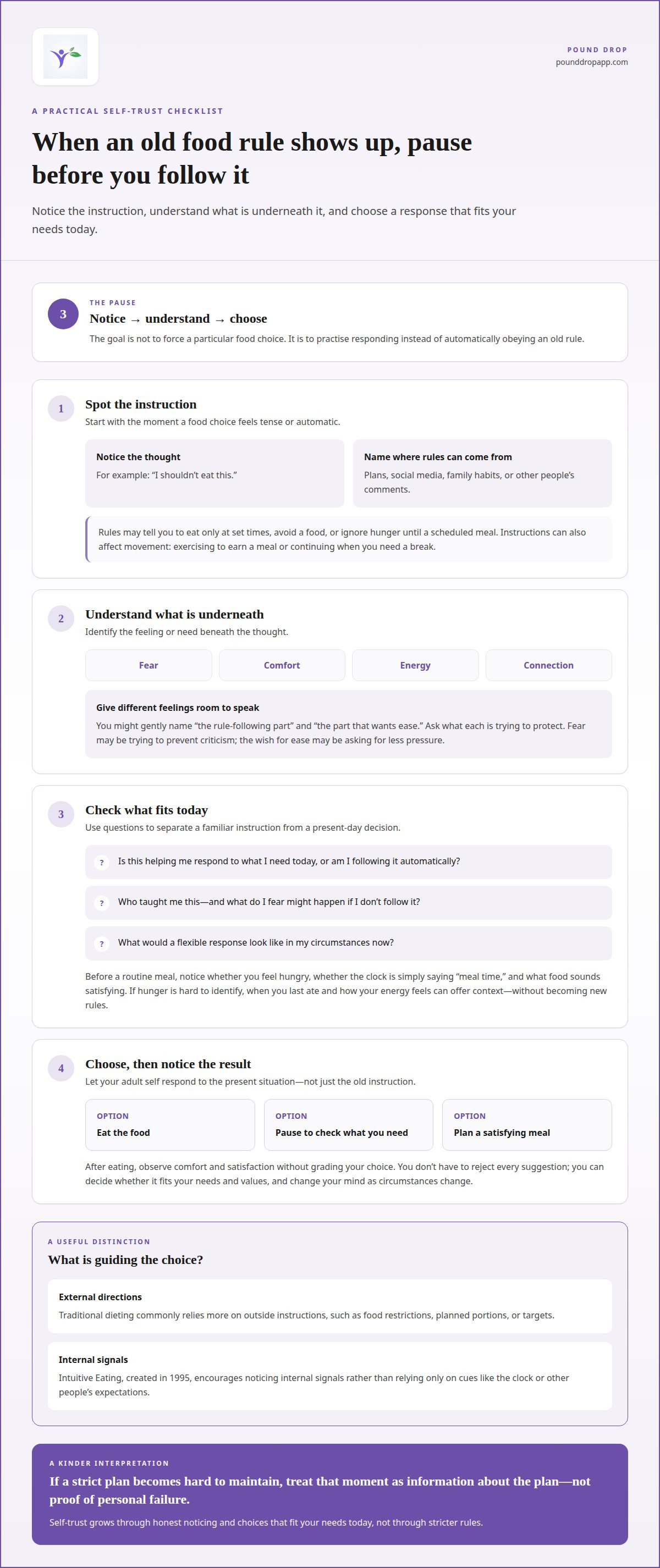
Try this three-step pause when a food choice brings tension. First, notice the thought, such as “I shouldn’t eat this.” Next, identify the feeling or need underneath it: fear, comfort, energy, or connection. Finally, let your adult self choose a response that respects the present situation. You might eat the food, pause to check what you need, or plan a satisfying meal. The point isn’t to force a particular choice. It’s to practise responding rather than automatically obeying an old rule.
Repeated dieting can weaken trust in hunger and body cues when outside rules repeatedly override them. If a plan says to delay eating despite hunger, you may learn to second-guess that signal. If a meal is labelled “too much,” fullness can become another cue to distrust. Notice specific moments instead: Did you eat because the clock said so, or because you felt hungry? Did a rule keep you from eating enough to feel satisfied? These observations help separate current needs from learned instructions. Self-blame often follows when a strict plan becomes hard to maintain. Treat that moment as information about the plan, not proof of personal failure.
A registered dietitian can support someone dealing with chronic dieting by helping them examine eating patterns and make practical changes. In the United States, fees depend on location, insurance coverage, appointment format, and visit length. Ask your insurer about coverage and whether a referral is needed; those details affect out-of-pocket cost.
Weight cycling means repeated weight loss followed by regain. Health risks aren’t determined by the label alone; the pattern and a person’s overall health matter. A clinician can consider those factors alongside eating history, rather than treating each change as a personal failing.
For body-image concerns and chronic dieting, therapy can offer space to examine thoughts, feelings, and learned food rules. Cognitive behavioral therapy can focus on thought patterns, while acceptance and commitment therapy can explore values and actions. A therapist may also use body-image-focused approaches. Choose a starting point by naming the concern you want to work on, such as fear around meals or harsh self-judgment. Rebuilding self-trust begins with honest noticing, followed by choices that fit your needs today.
2. Challenging external food rules
Food rules often come from plans, social media, family habits, or other people’s comments. A rule might say to eat only at set times, avoid a food, or ignore hunger until a scheduled meal. Notice when one of these instructions starts directing your choices. Ask: “Is this helping me respond to what I need today, or am I following it automatically?” That pause helps separate a familiar rule from a present-day decision.
Outside guidance can also shape thoughts about rest and movement. You might feel you must exercise to earn a meal or keep moving despite needing a break. Write down the instruction and where it came from. Then consider its effect: does it help you feel grounded, or make eating and resting feel like tests? You don’t have to reject every suggestion. You can decide whether it fits your circumstances, values, and needs now.
Intuitive Eating, created in 1995, encourages people to notice internal signals rather than relying only on external cues, such as the clock or other people’s expectations. Traditional dieting commonly relies more on outside directions, such as food restrictions, planned portions, or targets. The distinction is about what guides a choice: your changing experience, or rules set elsewhere.
Try a small check-in before one routine meal. Notice whether you feel hungry, whether the time simply says it’s “meal time,” and what food sounds satisfying. After eating, observe comfort and satisfaction without grading your choice. This isn’t a test you need to pass. It’s a way to gather information and practise responding to your experience. If hunger feels hard to identify, noticing when you last ate and how your energy feels can offer context, without turning those observations into new rules.
When a rule appears, use three questions to examine it: Who taught me this? What do I fear might happen if I don’t follow it? What would a flexible response look like today? For instance, if a social post says a food is off limits, notice the worry it triggers and choose what feels right for your meal. The aim is not to replace one strict rule with another. It’s to make room for choice, including changing your mind as your circumstances change.
Practise noticing rules around one situation at a time, such as lunch breaks, weekend meals, or exercise plans. Record the rule, its source, and your response in a few words. Over time, those notes can help you see which instructions still serve you and which pull your attention away from internal signals. A useful next step is to make one decision based on what you notice, rather than what someone else expects.
3. Food morality and labeling foods as good or bad
Calling a food “good” or “bad” turns a meal into a judgment about character. A cookie after lunch doesn’t make you careless, just as choosing a salad doesn’t make you virtuous. Food is food. Different choices can offer different tastes, textures, convenience, and satisfaction, without assigning moral worth to the person eating them. This distinction matters because self-trust is harder to practise when every choice becomes evidence for or against your worth.
Notice what happens after a label appears. You might eat a slice of cake and hear, “I’ve been bad,” then feel pressure to compensate by skipping a later meal. That response can create a cycle of restriction and guilt, rather than help you understand what you wanted or needed. Try replacing the verdict with a neutral observation: “I ate cake at the birthday gathering, and I enjoyed it.” The observation describes an event. It doesn’t demand punishment or a new rule.
Neutral language doesn’t mean ignoring your experience. It creates room to consider it more accurately. If a meal left you hungry soon afterward, note that detail. If a snack felt satisfying during a busy afternoon, notice that too. You can also consider practical context, such as what was available, how much time you had, and whether you wanted comfort or convenience. These details help you learn from an eating experience without turning it into a pass-or-fail result.
Use a short reflection after a meal that brings up self-criticism. First, identify the label you used, such as “clean,” “cheat,” or “bad.” Next, describe what happened without judgment: “I chose fries with lunch.” Then name something you noticed, like taste, satisfaction, or fullness. Finally, ask what would support you next, without proposing compensation. You might choose your usual next meal, drink water because you’re thirsty, or simply continue your day.
Other people’s language can reinforce food morality, too. A relative might call dessert “naughty,” or a social post might describe an ingredient as something to “avoid.” You can notice that message without adopting it as your own rule. For example, silently translate “I shouldn’t eat this” into “I’m deciding whether I want this right now.” That small shift puts the choice back into your hands. The goal isn’t to make every food equally appealing; it’s to approach each choice with curiosity rather than shame.
When a label returns, treat it as a cue to pause, not a command to restrict. Naming the thought, describing the meal, and noticing your response are practical ways to loosen food morality. With practice, a meal can become information about your preferences and circumstances, not a verdict on your character.
4. Getting to know yourself and your changing needs
Your needs can shift with sleep, stress, routine, and the people around you. A lunch that feels satisfying during a quiet workday may not suit a rushed afternoon. That difference doesn’t mean you’re inconsistent. It means the circumstances changed. Self-knowledge grows when you observe what’s happening now, rather than expecting one routine to fit every day.
Intuition can be harder to hear when you’re dysregulated. Stress, poor sleep, or feeling overwhelmed can make it difficult to notice what you need. In those moments, pause before demanding a clear answer from yourself. Try a simple check-in: What have I eaten? Have I had water? Am I tired, tense, or looking for connection? You’re gathering clues, not trying to diagnose yourself or force a perfect choice.
Use a brief daily note to see patterns without turning observation into another food rule. Record the situation, what you noticed, and what helped. For example: “Back-to-back meetings; low energy; a snack and a quiet break helped.” On another day, you might note that a meal with a friend felt more settling than eating alone. Over time, these examples can show how your schedule, rest, and social connection affect what feels supportive.
Basic supports matter, too. Food, water, sleep, time outdoors, joyful movement, and connection with people and nature can all contribute to feeling more regulated. Treat them as areas to notice, not boxes you must complete. A short walk outside might feel restorative after a screen-heavy day, while rest may be more useful after a tiring night. Supplements are part of the broader picture, but don’t assume you need them; individual needs differ.
When you feel unsure, choose one gentle question instead of searching for a rigid answer: “Would food, rest, movement, or company help most right now?” If the answer changes later, you can respond to that change. You might want a quiet meal at noon and conversation at dinner. Both can be true. Your needs aren’t a fixed checklist, and noticing them takes practice.
Review your notes after a few ordinary days, including busy and calmer ones. Look for specific patterns: perhaps you feel more settled after eating before errands, or more connected after sharing a meal. Don’t turn one observation into a universal rule. Use it as information for your next decision, then stay open to new circumstances. This steady attention helps you understand yourself as you are today, rather than measuring every choice against an older version of you.
5. Keeping realistic promises to yourself
A promise can rebuild trust when it reflects your real motivation, not pressure to become someone else. Before committing, ask what you hope the promise will give you. “I’ll pack lunch tomorrow” might come from wanting a calmer workday, while “I’ll never eat dessert again” may come from fear or self-criticism. Understanding the difference helps you choose a commitment that supports your life, rather than repeats a strict rule.
Make the promise specific enough to act on, but flexible enough for an unpredictable day. Instead of “I’ll eat perfectly,” try, “I’ll bring a satisfying snack for my afternoon meeting.” The first promise has no clear finish line; the second names an action and its context. You can decide what counts as following through without requiring every other choice to match an ideal plan.
Check the conditions before you commit. Consider your schedule, energy, access to food, and responsibilities that could get in the way. If you plan to cook dinner after a demanding shift, ask whether that’s realistic that evening. A smaller promise, such as choosing a simple meal or setting aside an option earlier, may fit better. Adjusting a commitment because circumstances changed isn’t the same as abandoning your needs.
Radical honesty supports trust: describe what you can do today, not what sounds impressive. Keeping promises matters, but a broken promise can also provide useful information. If you intended to take a walk after work and felt exhausted, note the mismatch. You might choose gentler movement next time or prioritize rest. Regulation and self-knowledge matter because stress and fatigue can affect what feels manageable.
Try a brief review at the end of the day. Name the promise, what happened, and what you learned. For example: “I planned lunch before errands; the appointment ran late, so I ate when I got home.” This account is more useful than calling yourself undisciplined. It identifies the circumstances and gives you a practical detail to consider when making your next commitment.
Choose one small promise that connects to a need you’ve noticed, and write it in plain language. Keep it focused on an action you control, such as preparing a snack or making space for rest. You can record a realistic commitment and reflect on your progress, then use what you learn to shape your next step. Trust grows through honest choices, including thoughtful adjustments when life doesn’t follow the plan.
Pound Drop: Pound Drop App
Pound Drop App offers a structured, self-guided way to work on weight-loss habits when you want support beyond reflection alone. It sits within a broader system that includes The Method, The Book, and The Journa, giving you tools to track and manage your progress. These resources can help you put realistic intentions into practice while keeping your choices grounded in your own day-to-day experience. You can start by exploring the approach and deciding whether its structure suits the way you want to move forward. Rebuilding trust takes time, and a tool is most useful when it supports thoughtful, sustainable choices rather than adding pressure. Visit pounddropapp.com to explore Pound Drop.
Let your next choice be a fresh start
Rebuilding self-trust after decades of failed diets doesn’t require a dramatic reset. It can begin with a single choice that feels honest and workable today. Let your next step be small enough to fit real life, then notice what you learn from it. If your needs change, you can adjust your approach without treating that change as a setback.
Progress may look less like following a perfect plan and more like becoming willing to listen, choose, and begin again. You don’t need to settle every question about food before taking your next step. Keep learning what supports you, and let your experience guide what comes next.
If you’d like a structured resource to support your next steps, explore Pound Drop. Start where you are, and give yourself room to build trust one choice at a time.
Frequently Asked Questions
How can you rebuild self-trust after years of failed diets?
Rebuild trust by making one small commitment that reflects your current priorities, then reviewing what happened without judging yourself. For example, if you planned to bring lunch but ran out of time, identify what got in the way and choose a more workable option next time. Rebuilding self-trust after decades of failed diets is a gradual practice: learn from each choice, adjust your expectations, and don’t treat one difficult day as proof you can’t rely on yourself.
What steps help rebuild trust in hunger and fullness cues?
Try observing one meal without trying to change it. Before eating, note whether hunger feels like low energy, an empty sensation, or a desire to eat; afterward, notice comfort and whether you feel satisfied. Your cues may not feel clear at first, especially after years of following outside instructions. A simple note in your phone can help you recognize patterns across situations, such as eating during a work break or after a long commute.
How can you set realistic health goals without restrictive dieting?
Choose goals based on supportive actions you control, rather than a target weight or a list of forbidden foods. For example, you could bring a snack on a long errand day or plan time for an enjoyable walk. Make the goal fit your actual schedule and energy. If a work shift changes, adapt the action instead of labelling the goal a failure. Review whether it supports your daily wellbeing, then keep, adjust, or replace it.
How can you cope with shame and guilt after repeated dieting?
Start by separating what happened from what you tell yourself it means. “I ate more than I planned at dinner” describes an event; “I have no self-control” turns it into a judgment. If guilt is strong, write down the situation and what you needed, such as comfort, food, or a break. You might also share the feeling with someone you trust. Responding with curiosity can help you choose what would support you next.
What are signs that dieting has contributed to disordered eating?
Consider seeking support if food or weight concerns take up much of your attention, or eating choices regularly bring intense distress. Other concerning patterns can include avoiding social meals, hiding eating, or using exercise or skipped meals to compensate for food. These signs don’t establish a diagnosis, but they deserve care and attention. A qualified health professional can help you discuss your experiences and consider appropriate support without reducing you to a label.


