


Article by
Jesper Sorensen
Jesper Sorensen is a holistic health coach and founder of Pound Drop, a different approach to weight loss built around healthier habits. He has written ebooks and health articles for established publishers and has spent years studying nutrition, healthy eating and sustainable weight management.
What if turning down a second helping didn't feel like rejecting the person who cooked it? For many of us, learning how to handle peer pressure to overeat at family dinners feels like walking an emotional tightrope. You want to honor your body's signals, but you dread the guilt of declining food made with love, or the exhaustion of explaining your choices to well-meaning relatives.
It's easy to see why these gatherings often end in regret and physical discomfort. The social pressure to please everyone can quickly overpower your own intentions. The good news is that protecting your boundaries doesn't require defensive debates or uncomfortable arguments. In this guide, you will discover practical, non-confrontational scripts and behavioral strategies to navigate family gatherings without overeating or offending your loved ones. Ahead, we'll examine why relatives push food, gentle ways to respond with confidence, and the steady daily habits that keep you feeling relaxed and completely in control.
Key Takeaways
- Understand the emotional motives of food pushers so you can separate genuine affection from your personal hunger cues.
- Master non-confrontational scripts for how to handle peer pressure to overeat at family dinners without needing to justify your plate.
- Rely on a practical pre-meal game plan to anchor your physical appetite and survey food options with calm intention.
- Protect your steady habit consistency and eliminate post-meal guilt by viewing every family dinner as a single, manageable event.
Why Family Dinners Create Intense Pressure to Overeat
Family meals carry an emotional weight that ordinary dinners simply do not have. Long before the meal begins, unspoken expectations settle over the dining table. Gathering with relatives blends history, shared rituals, and subtle social expectations into a single event. When someone asks you to take another serving of stuffing or finish the casserole, you aren't just deciding on food. You're navigating decades of family dynamics. Understanding the concept of peer pressure within a household reveals why declining a plate feels surprisingly complicated.
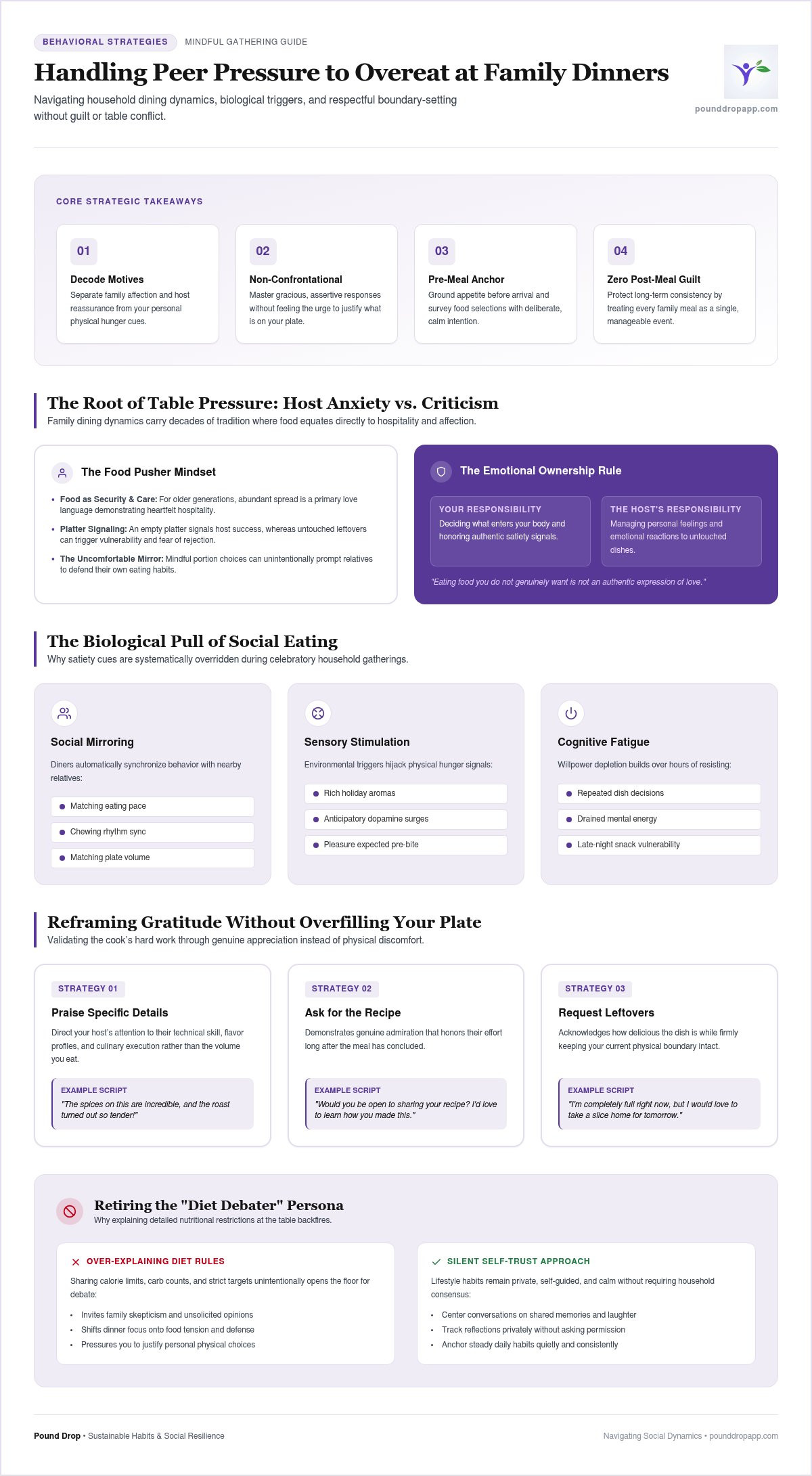
Most tension around the dinner table stems from host anxiety rather than personal criticism. When hosts spend hours preparing a feast, an empty platter signals success. Leftovers can feel like a quiet rejection. Recognizing this dynamic is the first step in learning how to handle peer pressure to overeat at family dinners with steady confidence.
The Psychology Behind the "Food Pusher"
Food pushers rarely intend to derail your goals. For older generations, abundant food represents security, generous hospitality, and heartfelt care. Serving seconds is their primary love language. When you politely decline, they may experience an instinctive flash of vulnerability, wondering if you disliked their cooking. Your mindful choices can also unintentionally hold up an uncomfortable mirror, prompting relatives to defend their own habits by urging you to join in.
The Biological Pull of Social Eating
Your biology also works against your satiety cues during festive meals. Several subtle factors make continuous eating feel automatic:
- Social mirroring: Diners naturally match the pacing, chewing rhythm, and plate volume of the people sitting closest to them.
- Sensory stimulation: Rich holiday aromas trigger anticipatory dopamine surges, which trick your brain into expecting pleasure before you even take a bite.
- Cognitive fatigue: Making repeated decisions to pass on dishes drains your mental energy as the hours pass, leaving you vulnerable to late-night snacking.
Social compliance regularly overrides physical fullness cues when you want to keep the peace. Discovering how to handle peer pressure to overeat at family dinners starts by acknowledging these biological and emotional undercurrents, freeing you from self-blame when boundaries feel hard to hold.
The Mindset Shift: Separating Love from Food Consumption
Eating an extra serving of pie does not make you a more loving relative. In many households, home-cooked food serves as an emotional proxy for deep care and connection. We often confuse consuming every bite with showing mutual appreciation. Yet, eating food you do not genuinely want is not an authentic expression of love. Respect can honor the cook's hard work while still protecting your bodily comfort.
A crucial rule in learning how to handle peer pressure to overeat at family dinners is recognizing emotional ownership. You are responsible for what enters your body; your hosts are responsible for managing their personal feelings. Approach gatherings with the mindset of a calm observer rather than bracing for an inevitable fight. When you stop expecting conflict, external pressure loses much of its power.
Reframing Gratitude Without Overfilling Your Plate
Appreciation thrives on genuine acknowledgment, not clean plates. You can validate the host's effort through thoughtful compliments rather than physical discomfort. Consider these simple approaches:
- Praise specific details: Focus on the technique or spices, such as complimenting how tender the roast turned out.
- Ask for the recipe: Requesting instructions shows genuine admiration that outlasts the meal itself.
- Ask for leftovers: Say, "I'm completely full right now, but I would love to take a slice home for tomorrow."
Letting Go of the "Diet Debater" Persona
Explaining strict calorie targets, carbohydrate limits, or complex rules rarely goes smoothly. Detailed nutrition debates unintentionally invite scrutiny, skepticism, and unsolicited advice from well-meaning family members. Keep the dinner conversation centered on personal stories, genuine laughter, and fond shared memories instead.
Your lifestyle practices can remain quiet, personal, and self-guided. Tracking daily reflections with a weight loss for beginners app allows you to anchor your routines privately without asking for household permission. When you master how to handle peer pressure to overeat at family dinners through silent self-trust, staying consistent feels natural. If you want structured tools to support your journey, explore the Pound Drop App to cultivate steady habits that last.
Polite and Assertive Scripts for Dealing with Food Pushers
Lengthy apologies often invite debate. When you say, "I really shouldn't, I'm trying to watch my intake," a persistent relative hears an opening to negotiate. Direct, grounded responses neutralize pressure before it builds. Paired with relaxed shoulders and steady eye contact, concise words establish calm presence. Mastering how to handle peer pressure to overeat at family dinners comes down to simple communication that leaves zero room for debate.
The Three-Tier Refusal Framework
When an initial refusal doesn't register, escalate your firmness without losing your warmth. Use this sequential framework:
- Tier 1 (Warm decline): "That was absolutely delicious, but I'm completely satisfied right now. Thank you so much!"
- Tier 2 (Assertive clarity): "Everything looks wonderful, but my body is telling me I'm full. I simply can't manage another bite."
- Tier 3 (The broken record): "I know how much you care, but no thank you. I'm all set."
If they insist, repeat Tier 3 with the exact same wording and a gentle smile. Predictable repetition shows that your decision is final, ending the exchange peacefully.
Redirecting the Flow of Conversation
Deliver your refusal, then immediately pivot the topic. Food pushers often continue hovering simply because an awkward pause creates space for insistence. Guide the room's focus away from your plate and back toward the people around you:
- Ask about holiday traditions: "Aunt Sarah, did you use grandma's handwritten recipe for this stuffing, or did you try something new this year?"
- Request family updates: "Before I forget, I wanted to hear all about your trip to the mountains last month."
- Use lighthearted humor: A relaxed laugh and a comment like, "If I eat any more right now, you'll have to roll me out the front door," instantly softens the moment.
Pivoting the conversation reminds everyone why you gathered in the first place. Knowing how to handle peer pressure to overeat at family dinners isn't about building emotional walls. It's about steering interactions back toward meaningful connection, keeping the table enjoyable for everyone.
A Step-by-Step Survival Plan for Family Dinner Night
Walking into a family gathering without an intentional strategy leaves your choices to chance. When sensory cues and family expectations collide, willpower alone tends to crumble. Having a reliable, step-by-step game plan protects your boundaries and helps you feel grounded from arrival to dessert. Knowing how to handle peer pressure to overeat at family dinners becomes much simpler when your evening follows a structured pattern.
Pre-Dinner Rituals: Building Mental and Physical Stability
Arriving famished almost guarantees you will buckle under pressure. Skipping meals to save room creates biological urgency, making it nearly impossible to turn down heavy second helpings. Eat balanced, routine meals earlier in the day to stabilize your blood sugar.
Before leaving your car, pause for sixty seconds. Take three slow breaths and set a private, quiet intention. Remind yourself that you control what goes onto your plate. This simple grounding ritual lowers social anxiety, allowing you to walk into the busy house feeling calm and collected.
At the Table: Pacing and Plate Management
Once dinner begins, manage your immediate environment with deliberate physical habits:
- Survey the options first: Walk along the buffet and look at every dish before picking up a plate. Choose items you truly enjoy rather than loading up automatically.
- Pace your eating: Place your cutlery flat on the table between bites. Slowing down lets your natural satiety signals register before someone offers seconds.
- Leave a polite visual cue: Leaving a deliberate bite or two on your plate signals that you are still content, which naturally deters relatives from piling on more food.
- Keep a drink in hand: Holding a glass of sparkling water gives your hands something to do and stops pushy hosts from constantly trying to fill your hands with food.
- Help clear the dishes: When you finish, stand up and offer to clear plates or rinse dishes in the kitchen. Changing rooms creates physical distance from grazing tables.
After you return home, take five minutes for non-judgmental reflection. Note what went smoothly and where boundaries felt difficult, treating every dinner as practice rather than a test. If you want a structured companion for recording these post-meal insights and reinforcing your personal autonomy, download the Pound Drop App to track your lifestyle consistency with complete confidence.
Building Long-Term Social Resilience with Sustainable Habits
A single evening around the family table will not erase weeks of intentional living. Many people leave gatherings feeling defeated if they ate more than planned, convincing themselves they broke their momentum. Progress is not fragile. Your journey is defined by the baseline habits you maintain on ordinary weekdays, not by a single festive spread. Learning how to handle peer pressure to overeat at family dinners is an ongoing skill that strengthens with practice, patience, and realistic expectations.
Ditching the "All-or-Nothing" Mentality
When you eat past fullness at a social meal, the instinct is often punishment. You might feel tempted to skip meals the next day or resort to extreme restriction to compensate. This compensatory reaction only prolongs the cycle of guilt and physical stress. Instead, wake up the next morning and step right back into your normal, balanced routine. Treat the dinner as useful feedback rather than a personal failure, asking yourself what subtle triggers made boundaries harder to protect.
Cultivating Calm Consistency with Self-Guided Tools
Resilience grows when your self-worth is anchored in steady daily routines rather than temporary social interactions. Building internal autonomy keeps your confidence steady, even when relatives continue pushing food. Focusing on small, repeatable actions rather than rigid rules gives you the space to manage social friction without anxiety.
Self-reflection tools offer a private, grounded way to log your experiences and understand recurring behavioral patterns. By tracking your daily habits without self-criticism, you turn challenging social dinners into gentle opportunities for growth. If you are ready to build steady routines that hold up anywhere, discover how Pound Drop helps you cultivate lifelong habits without restrictive diets. Over time, mastering how to handle peer pressure to overeat at family dinners becomes a natural extension of trusting yourself.
Reclaiming Peace and Control at Your Next Family Dinner
Family meals don't have to feel like an emotional test of wills. Navigating the dinner table becomes remarkably simple when you separate culinary appreciation from personal hunger cues. By preparing a calm pre-meal plan and practicing concise, polite scripts, you protect both your boundaries and your relationships without creating awkward tension.
Ultimately, discovering how to handle peer pressure to overeat at family dinners is about cultivating deep self-trust that endures in any room. True progress relies on a proven habit-based methodology that prioritizes sustainable lifestyle change over guilt-driven restriction. With a self-guided framework designed to build autonomy and confidence across all social settings, you can enjoy festive gatherings while staying centered on what matters most. Ready to transform your relationship with food? Start building quiet, resilient habits with Pound Drop and experience the calm that comes with lasting consistency.
Frequently Asked Questions
How do you politely decline food from family members who keep insisting?
Use calm, repetitive statements that acknowledge their effort while holding your line. A phrase like, "It was truly wonderful, but I'm completely satisfied, thank you," works best. If they continue pushing, simply repeat the exact same sentence without offering new justifications. Changing your explanation gives them room to negotiate. Standing firm with a warm smile ends the interaction peacefully while showing you respect both their hospitality and your physical comfort.
What should you say when a relative says you are not eating enough?
Acknowledge their concern with gratitude and reassure them that your plate feels just right. You can say, "I've had plenty of delicious food, and I feel great." Learning how to handle peer pressure to overeat at family dinners often means responding to their underlying intention. They want to know you feel cared for. Once you reassure them that you are full and happy, quickly pivot the topic to their latest news or hobbies.
Can peer pressure at social dinners ruin your entire week of progress?
Absolutely not. A single evening cannot undo days or weeks of steady, positive routines. Your overall health is defined by consistent habits, not an isolated social meal. When exploring how to handle peer pressure to overeat at family dinners, remember that occasional extra bites do not set you back to zero. Simply wake up the next morning and resume your normal, balanced rhythm without guilt, punishment, or compensatory restriction. Progress is about long-term persistence.
How can you stop eating when everyone else at the table is still having seconds?
Shift your focus from the food to the social connection around you. Put your fork down, push your plate forward slightly, and sip on water or tea. Engaging deeply in conversations or asking questions keeps your hands and attention occupied while others finish eating. You don't need to match everyone else's pace to remain an active, engaged participant at the table. Your presence matters far more than matching someone else's plate volume.
What is the best way to handle comments about your weight or food choices at dinner?
Respond with a neutral, non-defensive statement that gently closes the topic. You might say, "I'm focusing on feeling comfortable and listening to my body right now, so let's talk about something more fun." Avoid explaining specific dietary philosophies, which often invites unsolicited opinions. A brief, polite deflection protects your emotional energy and signals that your body is not a topic open for casual table commentary.
Is it rude to bring your own food or request modifications at a family meal?
Requesting extensive custom meals can unintentionally burden the host, but offering to bring a shared dish is always polite. Ask beforehand if you can contribute a side or salad that aligns with your routine. This ensures there is an option you feel confident eating without making special demands. Framing your contribution as a gift to the table rather than a separate meal preserves harmony while supporting your personal habit consistency.
What should you do immediately after overeating at a family gathering to avoid guilt?
Step away from self-blame and treat the meal as useful information. Drink some water, put on comfortable clothes, and avoid weighing yourself immediately. Recording your thoughts in a self-guided journal or habit app helps you reflect on which emotional triggers were at play. Skipping breakfast the next morning or starting extreme exercise only fuels the guilt cycle. Instead, accept the evening with compassion and return quietly to your usual daily habits.


