


Article by
Jesper Sorensen
Jesper Sorensen is a holistic health coach and founder of Pound Drop, a different approach to weight loss built around healthier habits. He has written ebooks and health articles for established publishers and has spent years studying nutrition, healthy eating and sustainable weight management.
An empty plate isn’t the only sign that a meal has gone well. To begin breaking the childhood clean plate club conditioning, serve a manageable portion, pause to notice hunger and fullness, and stop when you feel satisfied, even if food remains. Save what you can for another meal, and treat unfinished food as a practical decision, not a personal failure.
It makes sense to feel uneasy about wasting food, especially if you grew up hearing that you should finish everything on your plate. Those old rules can linger, but you can question them gently without blaming yourself for learning them.
This article offers practical ways to ease guilt, check in with your body, and start with smaller portions while keeping food waste in mind. You’ll also find ways to share these habits with children, so meals can be less about clearing plates and more about thoughtful choices.
Key Takeaways
- Practice leaving food behind gradually, and respond to guilt with curiosity rather than self-criticism.
- Pause during meals to notice your hunger, satisfaction, and the reasons you want to keep eating.
- Start with a smaller serving and take more if you’re still hungry; shared dishes can make this easier for everyone.
- Think through food waste with practical choices, such as saving leftovers, without making an empty plate the goal.
- Recognize how childhood mealtime rules can shape adult habits, then choose a gentler approach that fits your needs today.
Q1: How can I stop feeling guilty if I don't finish my food?
Pause, serve a smaller portion, and plan for leftovers to loosen the rule that every plate must be empty. For children, offer food without pressure and let them decide whether they’re hungry and how much they want.
-
Question the Urge to Finish
When you notice yourself eating automatically, pause and ask what is driving the next bite. Is your body still hungry, or does an empty plate feel like the only acceptable ending? If you feel satisfied but keep eating because food remains, set your fork down briefly. Treat the pause as information, not a test of discipline.
-
Recognize Childhood Food Pressure
Think of a childhood meal when an adult asked you to finish your vegetables before leaving the table. Notice whether guilt, a promised dessert, or fear of food scarcity still shapes your choices. Your parents may have wanted you to eat well or avoid asking for a snack an hour later. Understanding their intentions can help you separate them from the rule you follow now.
-
Reconsider External Food Rules
Check whether an external rule is guiding your portion more than your hunger. A clean-plate expectation, serving spoon, or fixed portion can make eating feel like a task to complete. Try serving a modest amount first, then decide whether you want more. For children, adults choose what, when, and where food is offered; children choose whether and how much to eat.
- Make unfinished food easier to handle by deciding what to do with it. Put suitable leftovers in a container for tomorrow’s lunch instead of treating them as waste. If food can’t be saved, compost it when possible so it can return nutrients to the soil. This practical plan addresses food waste without asking anyone to eat past fullness. For example, transfer extra rice or vegetables before clearing the table.
- Change the pattern gradually, without turning meals into rewards or negotiations. Don’t make dessert depend on an empty plate, which can encourage a child to eat beyond fullness. Instead, offer nourishing options and let children explore unfamiliar foods without pressure. If you’re unlearning the habit yourself, begin by leaving a bite when you feel satisfied. Repeat the experiment patiently, without self-blame.
What if I need help to identify my hunger and fullness levels?
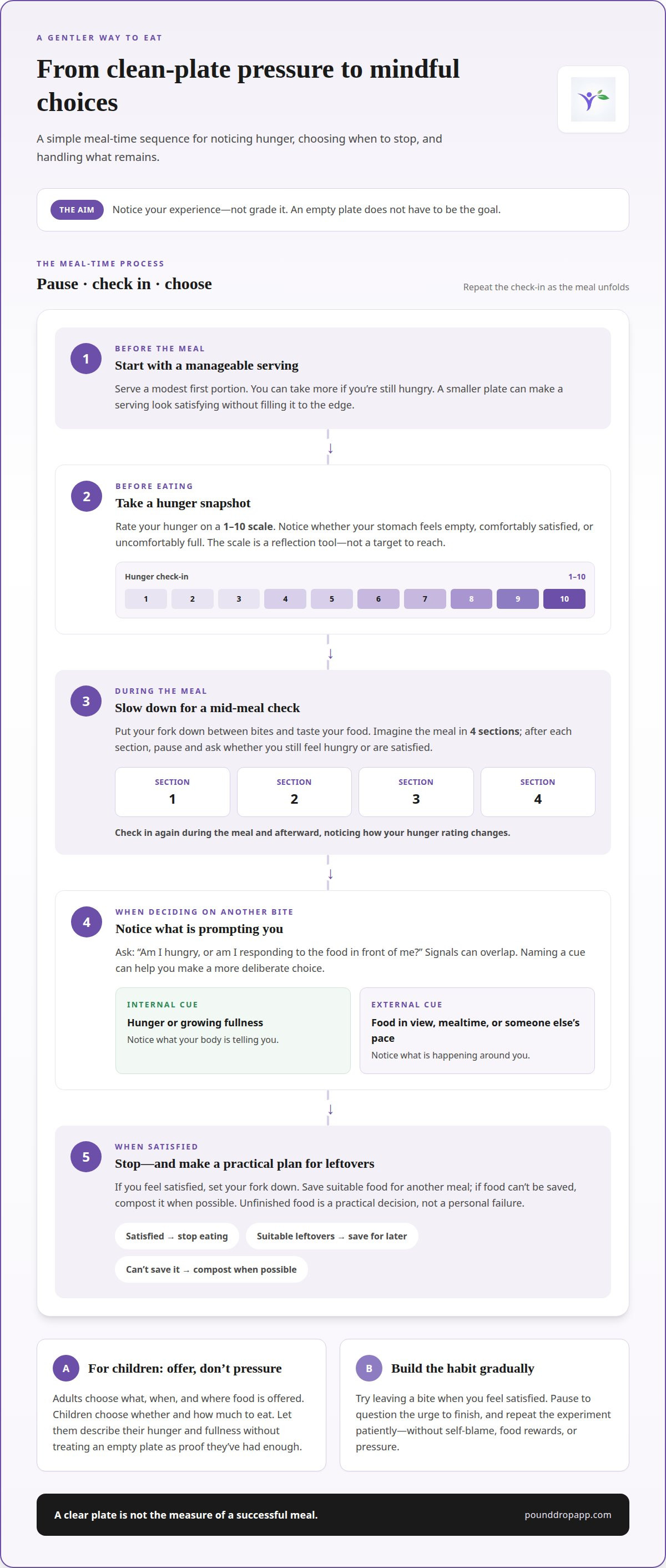
Use a simple check-in before, during, and after eating. The aim is to notice your experience, not grade it.
-
Notice Hunger and Fullness Cues
Pause before eating and rate hunger on a scale from 1 to 10. Check again during the meal and afterward, noting how the number changes. You might also notice whether your stomach feels empty, comfortably satisfied, or uncomfortably full. These observations help you recognize personal fullness cues instead of relying only on an empty plate.
Put your fork down between bites and taste your food. Imagine dividing the meal into four sections, creating natural moments to check in. After each section, ask whether you still feel hungry or are satisfied. Treat the scale as a reflection tool, not a target you have to reach.
-
Separate Internal and External Cues
Notice what prompts you to keep eating. Hunger is an internal signal; the sight of food, a familiar mealtime, or someone else’s pace can act as an external cue. Signals can overlap, so ask, “Am I hungry, or am I responding to the food in front of me?” Naming the cue helps you make a more deliberate choice.
Leptin signals fullness, ghrelin signals hunger, and stomach stretch receptors communicate satisfaction. You don’t need to interpret these processes perfectly. Simply notice experiences such as growing fullness or the urge to keep eating after hunger has eased. Turning off the television can also make it easier to pay attention to these changes.
-
Teach Children to Read Their Cues
Help children describe hunger and fullness in their own words. During a meal, ask whether they feel hungry, satisfied, or still ready to eat. Give them time to answer without suggesting that an empty plate proves they’ve had enough. This keeps the conversation focused on their sensations rather than an adult’s expectations.
Let children decide whether and how much to eat from the foods offered. Parents can choose what foods are available, when meals or snacks happen, and where eating takes place. Keep mealtimes calmer by turning off screens and avoiding pressure. These routines give children practice noticing fullness cues and describing what they feel.
-
Notice Eating Past Fullness
When guilt urges you to keep eating, pause and identify the reason. You might feel obligated to finish, worry about wasting food, or follow the portion someone else served. Eating until your plate is empty instead of stopping when comfortably satisfied can be associated with digestive discomfort, fatigue, guilt, and disordered eating patterns. Notice what happens without blaming yourself.
Try a brief check-in midway through your next meal. If you feel satisfied, you can stop, save suitable food, or choose what to do with what remains. Repeating this practice helps separate fullness from the old rule that eating must continue until the plate is clear. For a steady self-guided routine, explore support for mindful eating habits.
Using smaller portions and family-style meals
Set up meals so the first serving feels manageable, not compulsory. Start small, then let hunger and satisfaction guide whether anyone wants more.
-
Start With Smaller Portions
Serve a smaller first portion, then pause before adding more. A smaller plate can make the serving look satisfying without filling it to the edge. Larger portions can make it easier to eat past comfort, especially when the plate seems like a target to finish. Restaurant portions are often described as two to three times an appropriate portion, so box half before eating if that suits you.
-
Adjust Portions Flexibly
Put shared dishes on the table and let each person choose how much to take. A child might start with a spoonful of rice and a small piece of chicken, then ask for more after tasting. Keep extra food available so a small first serving doesn’t become a restriction. Family-style meals make it easier to match portions to appetite instead of treating one serving size as right for everyone.
- Offer children a small portion and make seconds a normal option. For example, serve one piece of toast with fruit, then let the child ask for another piece if they’re still hungry. This gives them room to listen to their own signals. Avoid framing seconds as a reward or an empty plate as proof of good behavior. Food can be nourishment, not a scorecard.
- Notice how the setting affects your portion choices. If a large serving dish stays beside you, it may be easy to take more without checking whether you feel full. Try serving the meal in the kitchen, then bringing a plate to the table. If you’re eating family-style, keep serving spoons within reach and pause briefly before taking more.
- Use flexibility rather than a strict portion rule. Appetite can shift depending on the meal, activity, and how hungry someone feels beforehand. If you’re unsure whether you want more, pause briefly and check in before serving again. That pause can also reveal whether you’re eating from hunger, habit, or emotion. A registered dietitian can offer guidance if you’re concerned about your eating patterns or food-related distress.
- Plan for leftovers before the meal ends. Keep a container nearby and move extra pasta or vegetables into it while they’re still suitable to save. This reduces pressure to eat beyond comfort and gives tomorrow’s lunch a starting point. The aim isn’t to serve as little as possible, but to begin with a manageable amount and respond to appetite as it changes.
But What About Food Waste?
Food waste matters, but eating past fullness isn’t the only way to address it. Plan for leftovers while changing habits that pressure you or children to finish every bite.
Clean-plate conditioning is a learned expectation to finish food; food insecurity involves difficulty accessing enough food. They aren’t the same, though food insecurity among adults is associated with binge eating, compensatory behaviors, and bulimia nervosa.
- Notice what pressure to finish teaches at the table. For children, insistence, threats, and dessert rewards can turn eating into a struggle and make an empty plate seem more important than fullness. Pressure to eat is associated with children eating fewer vegetables, liking food less, showing more picky or emotional eating, and eating less overall. Replace “finish your dinner” with a calm check-in about whether they feel satisfied.
- Make a leftovers plan before clearing the table. If you’re satisfied but food remains, put suitable portions in a container for another meal. For example, save extra soup for lunch instead of treating your plate as a waste bin. Compost food scraps when possible. This gives food waste a practical solution without making eating past fullness the answer.
- Try mindful eating by removing distractions and paying attention to the meal. Put away phones, laptops, and the television, then notice the food’s taste and texture, along with your hunger and fullness, without judgment. A pause midway through a meal can help you ask whether you’re still hungry or already satisfied. Mindfulness doesn’t require perfect focus. If your attention wanders, bring it back to the next bite.
- Practice intuitive eating by noticing internal cues instead of obeying a plate-clearing rule. Before continuing, ask whether hunger, enjoyment, habit, or guilt is driving your choice. If you’re satisfied, stop eating and decide what to do with what remains. This check-in can help adults and children distinguish appetite from external pressure without turning every meal into a test.
- Seek support if overeating or a history of disordered eating makes meals difficult. A registered dietitian or mental health professional can offer guidance suited to your experiences and needs. Describe the pattern, such as feeling compelled to finish despite discomfort, and discuss what support may help. Professional guidance can help you address food-related habits without relying on punishment or stricter plate rules.
What the clean plate club means
The phrase describes a rule that treats an empty plate as success. Its history helps explain why this expectation can feel familiar across generations.
- Look at the phrase’s historical roots before judging your family’s habits. The Clean Plate Club campaign began in 1917, during food shortages and regulations around World War I. In that setting, finishing food could represent thrift and respect for limited supplies. Today, the same instruction may continue even when the original circumstances have changed. Recognizing that history can help you separate a once-useful message from your appetite now.
- Notice how the rule shows up in everyday family language. “Clean your plate,” “there are children who need food,” or “you can leave after one more bite” can turn finishing into a measure of good behavior. Parents may intend to teach gratitude or prevent food waste. Still, repeated messages can make a child focus on pleasing an adult rather than noticing whether they feel hungry or satisfied.
- Separate nutrition from the appearance of an empty plate. A meal can contain nourishing foods, yet one person may want less than another. For example, a child might eat the vegetables and leave some rice while an adult finishes both. The plate alone can’t show whether someone has had enough. A more useful family goal is to offer food and let each person notice their appetite, rather than treating leftovers as poor manners.
- Identify whether the old rule is causing mealtime struggles today. You might feel anxious when food remains, eat past comfort to avoid waste, or feel watched while serving yourself. A parent might insist on a few more bites and meet resistance. Name the pattern without assigning blame: “We’re treating a clean plate as the goal.” This makes the family expectation visible and opens the door to a different approach.
- Choose a new definition of a successful meal. Try describing success as sharing food, enjoying the meal, and responding to appetite. If extra food remains, decide whether it can be saved or composted. If a child stops eating, don’t use dessert or praise as a reward for finishing. These choices respect nutrition and concerns about food waste without making an empty plate the measure of care.
Pound Drop: Pound Drop App
The Pound Drop App offers a structured, self-guided way to work on lifestyle habits over time. If you’re practicing more mindful choices around portions and fullness, a consistent approach can help you reflect on what you’re learning and how it fits into your daily routine.
The Pound Drop App, The Method, The Book, and The Journa are part of the system. They provide tools to manage and reflect on progress without requiring every meal to go perfectly. Start with a step that feels practical today, then build from there.
Visit pounddropapp.com to explore Pound Drop.
Let Your Next Meal Be a Fresh Practice
Changing an old food rule doesn’t require getting every meal right. Let the next meal be a chance to notice what changes when you choose your portion and respond to your appetite without judgment. If guilt appears, treat it as a familiar reaction, not an instruction you have to follow.
Breaking the childhood clean plate club conditioning is a gradual practice. Keep learning what feels comfortable, adjust as routines change, and let your choices develop over time. Progress may be quiet: a pause before another bite, a manageable serving, or a calmer response to food left behind.
If you want a structured, self-guided way to keep building lifestyle habits, explore Pound Drop’s approach and decide whether it fits your next step. Contact Pound Drop for support.
Be patient with yourself. Every meal offers another opportunity to choose with care.
Frequently Asked Questions
Q3: Can a dietitian really help me break this habit?
Yes, a registered dietitian can help you understand how food rules affect your eating habits. You might discuss what happens when food remains, which situations trigger pressure, and how your routine supports regular nourishment. For example, describe a family dinner when you ate past comfort to avoid waste. That context can make practical changes more relevant than simply telling yourself to stop.
What’s the Problem with Clean Plate Syndrome?
The concern is that an empty plate can become more important than your appetite. If you repeatedly eat beyond comfort, you may miss opportunities to recognize satisfaction and choose based on your needs. At a restaurant, for instance, you might keep eating simply because food remains. The goal isn’t to leave food every time, but to make finishing optional.
Why do I feel compelled to clean my plate every time?
The urge can come from learned family rules, concern about food scarcity, or discomfort with waste. Social situations can reinforce it too: you may feel watched when a host serves dinner or worry that declining more food seems rude. Notice the setting and thought that come before the urge. Naming “I don’t want to offend anyone” can reveal a reason other than hunger.
What is childhood clean plate club conditioning and how can it affect eating habits?
It describes learning, often in childhood, that finishing everything is expected or praised. Later, that rule may influence how much you eat, even when your appetite has changed. For example, an adult might finish a large serving because a parent once insisted on an empty plate. Breaking the childhood clean plate club conditioning starts with noticing when an old expectation, rather than present hunger, guides your choice.
How can I stop feeling obligated to finish everything on my plate?
Decide before eating that finishing is a choice, not a requirement. If you notice a sense of obligation after a few bites, pause and ask whether you want more. At a shared dinner, you can say, “That was enough for me,” without explaining your appetite. If the remaining food is suitable to save, store it promptly; if not, find a practical way to handle it without eating past comfort.
How can I recognize hunger and fullness cues after childhood food pressure?
Use a brief written check-in to connect sensations with meals. Before eating, note whether you feel physically hungry or are responding to stress, routine, or a food cue. During the meal, record when the food becomes less appealing or your body feels comfortably satisfied. Afterward, compare your notes. This can help separate your experience from inherited rules about serving size or clearing your plate.
How can parents encourage children to listen to hunger and fullness cues instead of requiring a clean plate?
Ask neutral questions instead of telling children to finish. For example, say, “Would you like more, or are you finished?” and accept either answer without praise or criticism. Parents can also keep mealtimes focused on conversation rather than monitoring bites. If a child leaves food, respond calmly and follow your household routine for saving leftovers. This gives children room to express their appetite without a mealtime power struggle.
When should food guilt or overeating lead someone to seek help from a therapist or dietitian?
Seek support when guilt or overeating repeatedly causes distress, affects your daily routine, or feels difficult to change alone. A registered dietitian can help explore eating patterns and nutrition concerns. A mental health professional can support you with emotional distress or a history of disordered eating. If meals regularly bring fear, shame, or conflict, describe those experiences and how they affect your day when seeking help.


