


Article by
Jesper Sorensen
Jesper Sorensen is a holistic health coach and founder of Pound Drop, a different approach to weight loss built around healthier habits. He has written ebooks and health articles for established publishers and has spent years studying nutrition, healthy eating and sustainable weight management.
What if the way to stop starting over on diets isn’t to make stricter rules, but to stop treating one difficult day as the end of your progress? You planned to eat a certain way, life got in the way, and suddenly it feels easier to wait for Monday and begin again. If that pattern sounds familiar, you’re not alone in finding it hard to know what comes next.
Strict plans can make ordinary disruptions feel like failures. A meal that didn’t go as planned becomes a reason to criticize yourself or set the whole effort aside. But one imperfect day doesn’t erase what you’ve been practicing, and it doesn’t require a dramatic reset.
This article will help you understand why the restart cycle happens and what to do after a lapse, without guilt or all-or-nothing rules. You’ll learn how to return to ordinary habits with one manageable next step, build routines that can bend when life gets busy, and track patterns with curiosity rather than judgment. Progress can continue, even when a day doesn’t go to plan.
Key Takeaways
- Recognize how a perceived lapse can turn into a full restart, and why that cycle doesn’t erase what you’ve learned.
- See how rigid rules and self-criticism can make it harder to return to supportive routines.
- Learn how to stop starting over on diets by choosing a flexible next step instead of waiting for a fresh start.
- Practice a calm way to respond after a difficult day without compensating or making extreme changes.
- Explore how self-guided tools like the Pound Drop App, The Method, The Book, and The Journal can support reflection and habit-building.
Why diets make starting over feel necessary
Repeatedly deciding to begin again can feel exhausting. You may have learned what helps you feel steadier, noticed which routines fit your life, or discovered what doesn’t work for you. Those lessons still count, even if your habits changed for a while.
The diet-reset cycle happens when a person sees a lapse as a reason to abandon a plan, then waits for a fresh start date before trying again. It might involve restarting a named diet, but it can also mean resetting your expectations: “I’ll be perfect from Monday,” or “I’ve already messed up, so I’ll try again next week.” The language of Weight cycling often describes repeated losses and regains, but the day-to-day reset mindset can begin with something much smaller.
A disrupted routine is an event, not proof that your progress has disappeared. One meal, late night, or missed walk doesn’t erase the experience you’ve gained. The challenge is that strict expectations can make an ordinary interruption feel like a verdict.
What does starting over on a diet actually mean?
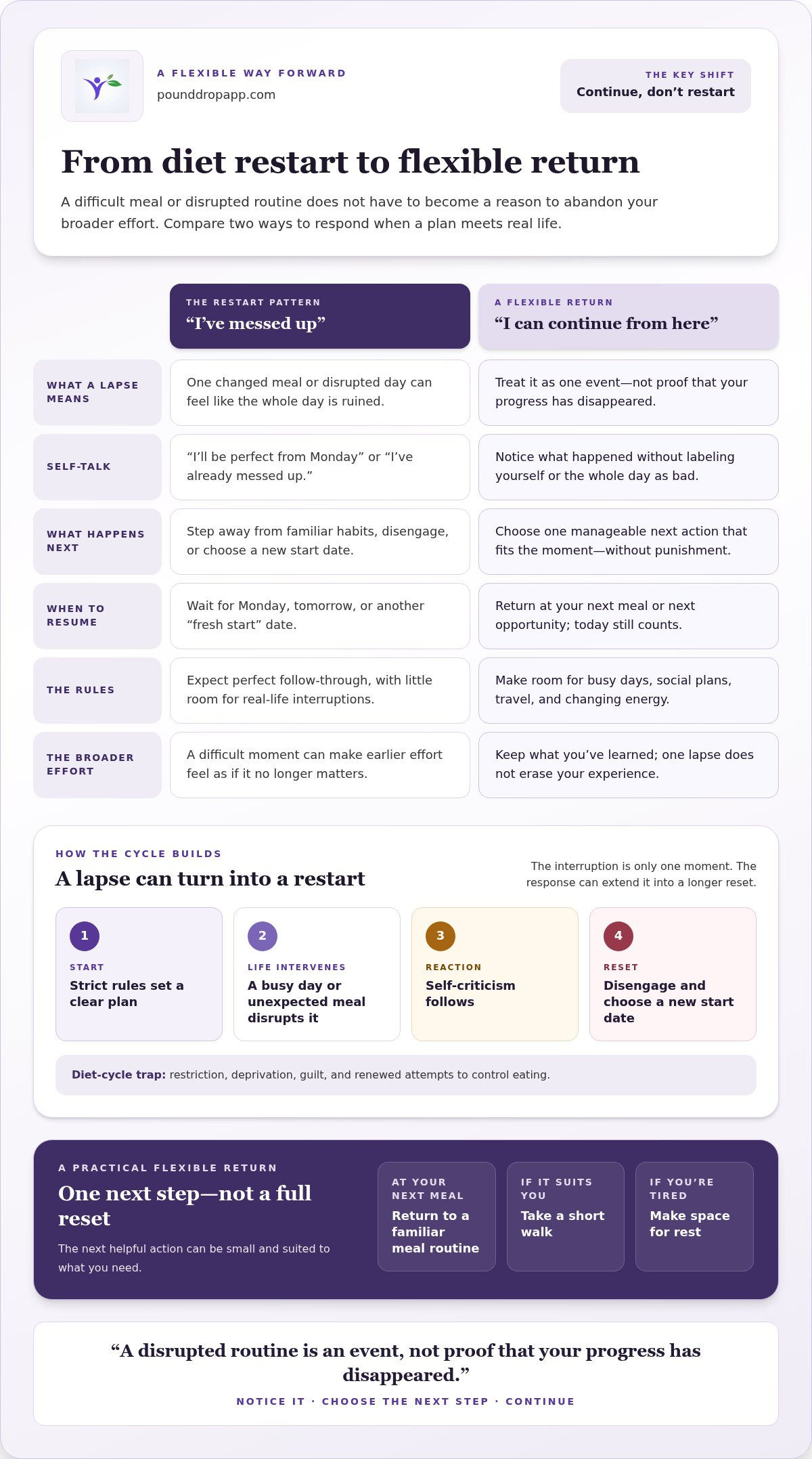
The pattern often looks like this: strict rules create a clear plan; a busy day or unexpected meal interrupts it; self-criticism follows; then you disengage and choose a new start date. The next attempt may use the same rules or a different plan, but the expectation is similar: this time, nothing will go off track.
This isn’t a character flaw. It’s a response that can develop when a plan leaves little room for real life. And “starting over” isn’t always a formal decision. It may be setting aside familiar habits, abandoning a goal after a difficult moment, or feeling that previous effort no longer matters.
Why does one off-plan moment feel like everything is ruined?
All-or-nothing thinking turns a single choice into a sweeping conclusion. Imagine lunch runs late, so you grab something different from what you’d planned. Instead of treating that as one changed meal, you might think, “The day is already ruined.” That thought can make it easier to stop paying attention to the rest of the day.
Guilt can strengthen the pattern. If your standard is perfect follow-through, anything less may feel like failure, even when it’s a normal response to stress, social plans, fatigue, or a changing schedule. Those disruptions don’t mean you lack commitment. They’re part of life, and routines that allow for interruptions are easier to return to. Understanding this pattern is a useful first step in learning how to stop starting over on diets: a lapse can be noticed without turning it into a reason to abandon the broader effort.
How rigid diet rules keep the restart cycle going
Rigid rules can create a pattern that feels hard to escape: you set demanding expectations, life interrupts them, and you judge yourself for not following the plan exactly. That judgment can make stepping away feel easier than continuing. Queensland Health describes the diet cycle trap as a pattern of restriction, deprivation, guilt, and renewed attempts to control eating. The problem isn’t wanting routines that support your health. It’s expecting those routines to unfold perfectly.
Food labels can add pressure. If some foods or days are “good” and others are “bad,” an unplanned choice may seem like evidence that you’ve failed. But one eating occasion doesn’t define your health or determine what happens next. It’s one moment, not a verdict.
The all-or-nothing trap after a lapse
Imagine you’re at a friend’s birthday dinner and eat something you hadn’t planned. All-or-nothing thinking might turn “I missed one planned action” into “I’ve failed completely.” Then you might decide to put off your next supportive choice, such as returning to your usual meal routine, until tomorrow or Monday.
That response is understandable, especially if you’ve been relying on strict rules. But it gives one moment more power than it needs to have. A lapse is different from abandoning your broader effort. You can acknowledge what happened without labeling the whole day or yourself as bad.
Why waiting for Monday can keep you stuck
A new date can feel reassuring, but it can also make today seem like it doesn’t count. If change only begins on Monday, an ordinary Wednesday becomes a waiting room for a more ideal version of life. The next helpful action doesn’t need to be a full reset. It might be returning to a familiar routine at your next meal, taking a short walk if that suits you, or making space for rest when you’re tired.
Small actions are useful because they don’t depend on perfect circumstances or a surge of motivation. They help turn “I’ll start again” into “I can continue from here.” For more reflection on building a less rigid approach, explore these mindful weight loss strategies.
A sustainable routine needs a way to resume after interruptions. Learning how to stop starting over on diets means keeping room for real life, then returning to supportive habits without punishment. If a little structure would help you practise that approach, the Pound Drop App is one self-guided option to explore.
What to change instead of starting another diet
After recognizing how rigid expectations can turn a disruption into a perceived failure, the next step is to change what you do afterward. A perfection-based restart says, “I need to begin from scratch.” A flexible return says, “I can continue with the next choice that fits.” This isn’t a claim that every diet or goal is the same. It’s a comparison between two ways of responding when a plan meets real life.
Diet restart versus a flexible reset
A flexible approach doesn’t mean giving up on your goals or ignoring routines that support your wellbeing. It means making room for travel, social occasions, busy days, and changing energy without demanding a completely new start. Use the table to consider how you might respond to a common disruption:
| Trigger | Restart response | Flexible alternative | Practical example |
|---|---|---|---|
| Travel disrupts your usual schedule | Wait until you’re home to “get back on track” | Choose one familiar routine that fits where you are | Take a short walk during a break if it works for your day |
| A busy day crowds out a planned habit | Decide the week is already off course | Resume at the next available opportunity | Return to your usual meal routine at your next meal |
| Your energy is lower than expected | Assume the plan only counts if you do it fully | Adjust the habit to match your capacity | Choose gentle movement or rest, depending on what you need |
The aim is to keep a connection to your routine, not to force the same action in every circumstance. That shift can make how to stop starting over on diets feel less like finding a perfect plan and more like learning to adapt one.
Choose habits that can survive an imperfect week
Start with a small number of routines that feel practical in your current life. Link each one to a cue that already happens, such as having breakfast, finishing work, or preparing for bed. Before adding another habit, ask: “Could I still do a manageable version of this during a busy week?” If not, make it simpler or choose a better cue.
Tracking can help you spot what supports a habit and what tends to interrupt it. The point isn’t to score yourself for perfect follow-through. It’s to notice patterns and make adjustments. Explore daily habit tracking for weight loss for ideas, or use a weight loss tracking journal to reflect on what feels workable over time.
How to get back on track after a difficult day
A difficult day doesn’t call for punishment or a brand-new plan. It calls for a pause, a little perspective, and one reasonable next action. This approach helps you respond to what happened without turning it into a larger judgment about yourself or your ability to keep going.
A simple four-step response to a lapse
Try this sequence when your routine gets interrupted. It’s not a test to pass, but a way to find a calm next step:
- Pause and describe the event neutrally. For example, “My afternoon ran late, and I ate what was available.” Leave out labels like “failure” or “cheating.”
- Name one circumstance that made your usual routine harder. Was it timing, stress, limited options, or something unexpected? You’re gathering context, not looking for someone to blame.
- Choose one manageable action. Pick something that fits the rest of your day or tomorrow, such as returning to a familiar meal routine or taking a few minutes to plan for a busy morning.
- Resume your regular routine. You don’t need to skip a meal, exercise to compensate, or make an extreme change to make up for the interruption.
The next step isn’t a way to undo the lapse; it’s a way to continue with care. It doesn’t need to be impressive. It just needs to be supportive and realistic for the moment you’re in.
Use reflection to prepare for the next interruption
If it feels useful, take a moment to note what helped, what got in the way, and what might make the next attempt easier. Maybe keeping a convenient option available would help on busy afternoons, or perhaps your usual plan needs more room for changing schedules. Keep the review brief. A few honest observations are enough; tracking doesn’t need to become a scorecard or another source of pressure.
Learning how to stop starting over on diets includes making a plan for what to do when life interrupts your habits. If reflection brings up recurring concerns about eating or your health, consider discussing them with a qualified health professional. You deserve support that fits your needs.
For a structured way to reflect on habits and weight management, explore the self-guided Pound Drop App.
Build a weight-loss routine that does not require starting over
A routine that lasts isn’t one you follow perfectly. It’s one you can practise, adjust, and return to as life changes. A disrupted week doesn’t cancel the effort that came before it. Each time you notice what’s workable and make a small adjustment, you’re learning how to stop starting over on diets and build continuity without relying on ideal conditions.
Make returning part of the plan
Decide in advance what a low-pressure return looks like for you. Keep it simple enough to use on an ordinary busy day, not just when you have plenty of time and energy. For example, you might choose to resume a familiar routine at your next meal, or return to a usual movement habit when your schedule allows. The point is to have a response ready, not to follow a new set of rules.
Consider whether your habits can adapt to different days. A routine might have a shorter version for a packed schedule and a steadier version for a more settled one. This lets you keep practising without treating every change of plan as a reason to begin again.
A journal or tracker can help you notice which circumstances make routines easier or harder. Keep reflection neutral and brief. You might jot down what you tried, what got in the way, and one adjustment to consider next time. Use those notes to learn about your patterns, not to grade your effort.
When structured self-guided tools may help
Sometimes it’s useful to have resources that give habit-building and reflection a little structure. Pound Drop offers the App, The Method, The Book, and The Journal as self-guided tools for weight management and habit formation. These digital and physical resources can offer different ways to engage with learning and reflection. Choose a format that feels practical for you, and use it as support rather than as a measure of perfect adherence.
Change can be gradual. Some weeks will feel easier than others, and adjusting your approach is part of the process. You don’t have to wait for a fresh start to practise a helpful habit. If structured, self-guided resources would suit your next step, explore Pound Drop’s self-guided tools.
Keep moving forward, one return at a time
Learning how to stop starting over on diets begins with changing what a difficult day means. It isn’t proof that your effort has vanished or a signal to wait for a perfect Monday. It’s a chance to notice what interrupted your routine and choose a manageable way to continue.
Remember: progress comes from practising and adjusting, not from getting every day exactly right. Make room for real-life changes by choosing habits you can return to, and use reflection to understand patterns rather than judge yourself. The next step can be ordinary and small. It still counts.
If structured self-guided support would help you build habits and reflect along the way, Pound Drop offers the App, The Method, The Book, and The Journal. Explore Pound Drop’s self-guided tools and find a resource that fits the way you want to begin.
Change can take time. You don’t need to start over to keep going.
Frequently Asked Questions
Why do I keep starting over on diets?
Repeated restarts often happen when strict expectations make an interruption feel like proof that the whole effort has failed. A busy day, an unplanned meal, or a missed routine can lead to self-criticism and the thought that you need a fresh start. This pattern isn’t a character flaw. Learning how to stop starting over on diets begins with noticing what triggers the reset and treating it as information, not a verdict.
How do I stop the all-or-nothing mindset with dieting?
Practise describing what happened without turning one moment into a judgment about yourself or your entire day. Instead of “I ruined everything,” try “I ate differently than I planned, and I can decide what feels supportive next.” Then choose one realistic action, such as returning to a familiar routine at your next meal. The goal isn’t to lower your standards for wellbeing; it’s to let progress include adjustments and imperfect days.
Should I start my diet again after a bad day?
You don’t need to wait for a new day or a new week. One difficult day doesn’t erase the habits you’ve practised, and starting over can make ordinary disruptions feel bigger than they are. Pause, notice what happened, and return to a familiar, supportive routine when you’re ready. Avoid trying to compensate by skipping meals or making extreme changes. A steady next step is more useful than a dramatic restart.
What should I do after falling off my diet?
Start by describing the situation neutrally, then consider what made your usual routine harder. Maybe your schedule changed, you felt tired, or convenient options were limited. Choose one manageable action for the rest of today or tomorrow, such as returning to a familiar routine or preparing for a busy morning. You don’t need to make up for anything. Learning how to stop starting over on diets means continuing without punishment.
Can tracking help me stop starting over on diets?
Tracking can help you notice patterns, especially if you use it to learn rather than judge. Keep it simple: note what you intended to do, what got in the way, and what might help next time. A journal or habit tracker doesn’t need to record every detail or assign a score. If writing things down increases stress or self-criticism, it’s okay to pause or choose a gentler way to reflect.
How do I make weight-loss habits last when life gets busy?
Choose habits that fit your real schedule, then decide on a simpler version for busy or low-energy days. For example, if a longer walk isn’t practical, a shorter one may help you keep the routine connected to your day. Link habits to cues you already have, such as finishing work or preparing for bed. Review what feels manageable before adding more demands, and adjust when your circumstances change.
Is it normal to struggle with consistency on a diet?
It’s common for routines to become harder when schedules, energy, stress, or social plans change. Consistency doesn’t have to mean doing the same thing perfectly every day. It can mean returning to supportive habits after interruptions and adapting them when needed. If eating or health concerns are causing ongoing distress, consider speaking with a qualified health professional. Support can help you find an approach suited to your circumstances.


