


Article by
Jesper Sorensen
Jesper Sorensen is a holistic health coach and founder of Pound Drop, a different approach to weight loss built around healthier habits. He has written ebooks and health articles for established publishers and has spent years studying nutrition, healthy eating and sustainable weight management.
What if the most useful psychology of weight loss book isn’t the one with the biggest promises, but the one that helps you practise small changes without judging yourself?
If you’ve cycled through bursts of motivation, strict rules, and starting over, it makes sense to want more than another encouraging message. Psychology can help explain how thoughts, feelings, habits, and surroundings shape everyday choices. The ideas are most useful when they fit real life.
This guide will help you assess whether a book offers practical guidance or mainly motivational language. You’ll learn what to look for in its approach to behavior change, how to try ideas without all-or-nothing rules, and how to choose a format that suits the way you learn. We’ll also consider how The Book might fit alongside written reflection with The Journal or digital habit support through the Pound Drop App. The aim isn’t to get everything right. It’s to find a helpful next step you can return to, even when life gets messy.
Key Takeaways
- A useful psychology of weight loss book connects thoughts, feelings, habits, and surroundings with everyday choices, without promising a particular result.
- Look for practical guidance on building habits and noticing patterns, presented as opportunities to learn rather than reasons for self-criticism.
- Compare books by their approach, exercises, tone, flexibility, and format to find guidance that feels realistic for you.
- Turn an idea into practice by choosing one small step, trying it in your routine, reflecting, and adjusting as needed.
- Consider how The Book and The Journal, alongside the Pound Drop App and The Method, can support a self-guided approach.
What should a psychology of weight loss book help you understand?
Weight-loss psychology looks at how thoughts, emotions, habits, and everyday circumstances can shape choices around eating and activity. It shifts the question from “Why didn’t I try harder?” to “What was happening around this choice, and what might make a different response easier next time?” That broader view can help you identify practical ways to change, without suggesting that behavior alone controls every outcome.
Psychological insight connects what influences your choices with small, repeatable actions you can practise in everyday life. A useful psychology of weight loss book makes that connection clear. Rather than offering only motivation or rigid rules, it helps you notice patterns, consider options, and try manageable steps. It also recognizes that change doesn’t guarantee a particular weight or result.
For a related concept, this video offers another perspective on the psychology of weight loss:
How thoughts, feelings, and routines can shape eating and activity
A choice rarely comes from willpower alone. Hunger, stress, mood, sleep, time, access to food, social plans, and established routines can all play a part, and their influence differs from person to person. For example, someone finishing a late shift may choose what’s quick and available because they’re tired and hungry. That context helps explain the choice; it isn’t a character flaw. A practical book encourages curiosity about what happened and what small adjustment might suit the person’s circumstances.
Some books discuss set point theory, a proposed way of describing how the body may resist changes in weight. Treat it as one framework, not a simple explanation for everyone’s experience or a promise that a particular approach will work.
What a book can, and cannot, do
A book can introduce ideas, offer prompts for reflection, and help you examine how a strategy fits your day. You might try one suggestion in a familiar routine, notice what made it easier or harder, then adapt it rather than forcing a perfect plan. That’s different from relying on motivational slogans or rules that leave no room for changing needs. A book can offer guidance, but it can’t guarantee an outcome. If you have personal medical concerns, seek advice from a qualified health professional.
Which psychology principles make a weight-loss book practical?
A psychology of weight loss book becomes useful when it helps you move from a broad intention to a practice that fits an ordinary day. Look for guidance that treats habits as behaviors repeated in context, not transformations that happen overnight. Reflection should feel like gathering information, not scoring yourself as good or bad.
A small, specific plan can bridge the gap between wanting to change and knowing what to do next. One way to make a plan concrete is an implementation intention: an “if this happens, then I’ll try that” response to a predictable situation. For example, “If I notice I’m eating while distracted, I’ll pause and check whether I’m still hungry.” It’s a flexible prompt, not a rule or a guarantee.
Habit cues, repetition, and realistic routines
An existing routine can act as a cue for a small behavior. After making a morning drink, you might take a moment to notice how you feel before starting the day. If your schedule shifts, attach the practice to another reliable moment, or return to it later. The aim is to make the action easier to remember, not to follow a perfect timetable. A helpful book won’t claim that habits form on one fixed timeline for everyone.
Reflection, self-efficacy, and responding to setbacks
Self-monitoring works best as observation, not punishment. A brief note about what was happening, how you felt, or what made a routine easier can help reveal patterns. If a plan didn’t fit, use that information to adjust it. Repeated, manageable practice may help build confidence in your ability to respond, though progress can vary and isn’t always steady. For more ideas, see this simple weight loss methodology guide.
Reflection can also mean giving an everyday moment your attention. For example, pause during a meal to notice its taste and how you feel, without treating the moment as a test or expecting a particular outcome. The point is to observe your experience with curiosity.
You can practise these ideas independently and adapt them to your circumstances. Pound Drop offers a structured, self-guided option for habit work through its resources. Explore Pound Drop’s self-guided approach.
How to compare psychology of weight loss books without falling for quick fixes
A compelling promise can be easy to remember. A practical guide is easier to use. As you compare books, look past bold claims and ask whether the author explains the ideas clearly, offers actions you can adapt, and leaves room for real-life interruptions. A credible resource avoids guaranteeing a specific personal outcome. It can offer useful guidance without claiming that one method works the same way for everyone.
Use this table to compare the features that shape a book’s usefulness, not just its sales description.
| What to compare | Signs of practical guidance | A reason to pause |
|---|---|---|
| Approach | Explains behavior in clear terms and distinguishes established evidence from interpretation. | Makes sweeping claims without explaining the basis, limits, or sources. |
| Practical exercises | Offers small prompts or actions you can adapt to your own routine. | Relies on inspiration but gives little direction for everyday situations. |
| Tone | Encourages curiosity and learning, including after a difficult day. | Uses shame, blame, or perfectionist language to demand compliance. |
| Flexibility | Recognizes that schedules, needs, and circumstances change. | Frames any deviation from a strict plan as failure. |
| Format | Fits how you prefer to read, reflect, or use digital tools. | Requires a format or routine you’re unlikely to return to. |
Signs a book offers usable guidance
Look for explanations that lead to manageable actions. A book might help you identify a situation where a habit tends to occur, then suggest a question or adjustment to consider. Its examples should allow for missed days, changing energy, and different circumstances. Reflection prompts should help you ask what supported a choice and what got in the way, rather than rate yourself or assign blame. If a book makes strong claims about psychology or health, see whether it explains the evidence and acknowledges uncertainty. Be particularly cautious about claims of guaranteed results.
Questions to ask before choosing a format
Would you rather read a few pages in print, write thoughts by hand, or use an app as part of your routine? A physical book can suit someone who likes focused reading; a journal may appeal if writing helps them reflect; app-based support may fit someone who prefers digital tools. A combination can work for some people, while a single resource may feel simpler for others. Choose the format you can realistically revisit. This weight loss tracking journal guide can help you consider what kind of reflection tool fits your life.
How to put ideas from a weight-loss psychology book into practice
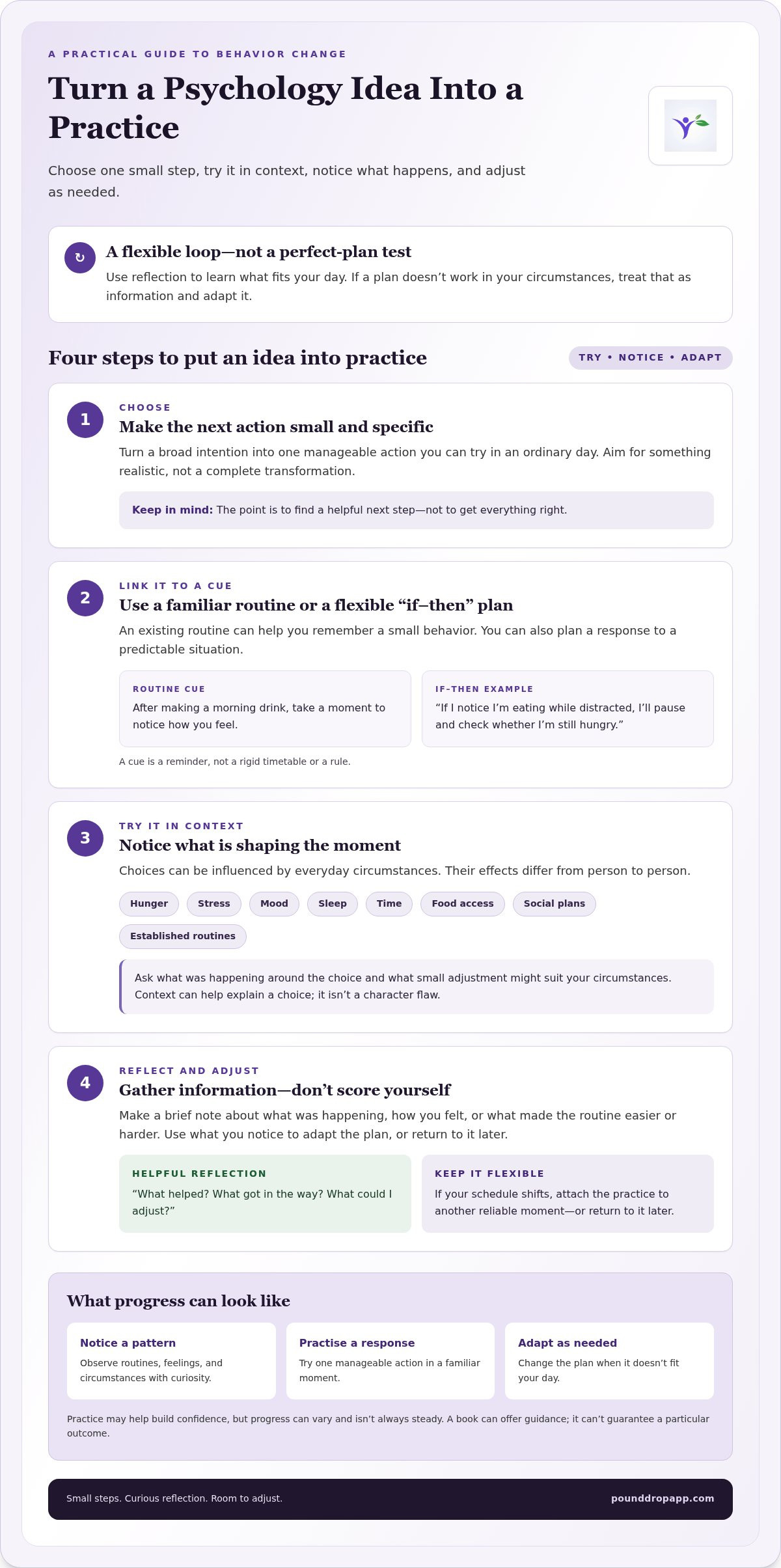
Reading can give you a fresh perspective, but applying one idea in a real routine is how you learn whether it fits. Treat the idea as a small experiment, not a new standard you have to meet perfectly. A psychology of weight loss book should help you turn insight into a next step that can flex with everyday life.
Turn one useful insight into a manageable experiment
Start with a situation that comes up naturally. For instance, if you often arrive home feeling rushed, you might pause at the doorway and notice what you need before moving into the rest of the evening. Keep the action small, and choose a backup for days when the usual cue or schedule changes.
- Choose one idea. Pick a suggestion that feels relevant, rather than trying to apply several at once.
- Adapt it. Decide where it could fit in your routine and make it specific. “After I put my keys down, I’ll take a moment to check in with myself” is clearer than “I’ll be more mindful.”
- Practise. Try the action when the cue appears. If the moment doesn’t work out, you can try again when it makes sense.
- Reflect. At a natural check-in point, ask what helped, what got in the way, and how the action felt.
- Adjust. Keep the idea, make it smaller, change the cue, or choose another approach based on what you noticed.
There’s no universal timeline for this experiment. Let your experience guide when you review it. A missed day isn’t evidence that you’ve failed; it may simply show that the cue or action needs to fit your circumstances better.
Use tracking to learn rather than judge
If it feels useful, record a few observations in a notebook, journal, or app: the situation, what you tried, and what made it easier or harder. You don’t need to record everything. Tracking is optional and should support curiosity, not become a scorecard. If writing feels burdensome, a brief mental check-in may be enough. For another perspective on digital tools and habit-focused support, read this weight loss app for beginners guide.
Self-help can offer ideas and structure, but it can’t assess individual health needs or replace professional care. If you have medical concerns, distress around eating, or questions about how a change may affect your health, speak with a qualified health professional. Pound Drop offers a self-guided way to explore habit-focused practice through its resources. Explore Pound Drop’s self-guided approach.
Where The Book fits in Pound Drop's self-guided weight-loss system
A psychology of weight loss book can be one part of exploring behavior change, rather than a complete answer on its own. At Pound Drop, The Book and The Journal are physical resources within a broader self-guided system that also includes the Pound Drop App and The Method. Each gives you a different format for engaging with the approach, so consider what best fits your day-to-day routine.
How physical and digital tools can support different routines
Reading can give you time to engage with ideas at your own pace. Writing in a journal can offer a place to record observations or reflect on what you’re learning. The Pound Drop App is the digital part of the system, while The Method is another self-guided element. These tools sit alongside The Book and The Journal; you don’t have to use them all.
Think about how you naturally make space for reflection. Do you like to read away from screens, jot down thoughts by hand, or use digital resources? Some people may find a combination suits them; others may prefer to start with one format. The right fit is personal. A tool is useful when it feels manageable enough to return to, not because it promises a particular result.
Decide what kind of support feels manageable now
Before choosing where to begin, consider three things: the format you enjoy, the attention you can realistically give it, and how much structure feels helpful. If you’d rather focus on one resource, that’s a reasonable starting point. If your routine changes, revisit what works and adjust. Steady practice matters more than finding a perfect setup from the outset.
The Book may suit someone looking for a physical resource within a wider self-guided approach. The Journal, the app, and The Method offer other ways to engage with that system. They can support your effort to learn and reflect, without guaranteeing weight loss or replacing personal health advice when you need it.
If you’d like to explore how these self-guided resources fit together, explore Pound Drop.
Choose one useful idea and begin at your pace
A helpful psychology of weight loss book does more than inspire for a moment. It helps you understand how routines and circumstances shape choices, then offers ideas you can adapt and practise without shame or rigid rules. Look for clear explanations, realistic exercises, and guidance that doesn’t promise a specific personal outcome.
You don’t need to change everything at once. Choose one manageable idea, try it in a familiar part of your day, and notice what helps or gets in the way. Reflection can guide your next step, whether you continue, adjust, or try something different.
Pound Drop brings together The Book and The Journal with the Pound Drop App and The Method in a self-guided approach that doesn’t rely on supplements or one-on-one coaching. Start with the format that feels workable for you now. Explore Pound Drop’s self-guided resources and take your next step with patience. Steady practice matters more than perfection.
Frequently Asked Questions
What should a psychology of weight loss book include?
A useful book should explain how thoughts, feelings, habits, and surroundings can influence behavior, then show how to apply those ideas in everyday life. Look for clear explanations, adaptable exercises, and reflection prompts that encourage learning rather than self-criticism. Strong guidance also recognizes that individual circumstances differ and avoids guaranteeing a particular result. Practical ideas should feel like options to test, not strict rules you must follow perfectly.
Can reading a book help with weight loss?
A book can offer ideas and structure for practising behavior change, but reading alone can’t guarantee weight loss. Its value depends partly on whether the guidance fits your life and whether you choose to try it. For example, test one small suggestion in a familiar routine, then reflect on what helped or got in the way. Progress varies, and a book is one possible support, not a promised outcome.
How do I choose a weight loss mindset book?
Choose a book that helps turn insight into realistic action. Check whether it explains its approach, offers practical exercises, and makes room for changing routines and imperfect days. Notice the tone: compassionate, learning-focused language is generally more supportive than shame or demands for perfection. A psychology of weight loss book should help you reflect and adapt, not make you feel that every difficulty means you’ve failed.
Are weight loss psychology books evidence-based?
Some discuss established psychological ideas, while others rely more on personal viewpoints or motivational language. Look for a book that explains where its claims come from, distinguishes research from opinion, and acknowledges what it can’t establish. Be cautious of sweeping statements or guaranteed results. A confident tone isn’t proof. If a specific health or psychological claim matters to your decision, look for credible supporting sources and discuss personal health questions with a qualified professional.
Is a weight loss book better than a journal or app?
Neither format is automatically better. A book may suit you if you like reading explanations, while a journal can give you space to record reflections. An app may fit more easily into a digital routine. Pound Drop offers The Book and The Journal alongside the Pound Drop App and The Method as parts of its self-guided approach. You might prefer one resource or a combination, based on what feels manageable to revisit.
What happens if I stop following a book's advice?
Stopping or changing an approach doesn’t mean you’ve failed. You may have found that an idea didn’t suit your schedule, needs, or preferences. Consider what you learned, keep any part that remains useful, and adjust or set aside the rest. Guidance is there to support your choices, not control them. If a practice feels stressful or unhelpful, you can pause and seek appropriate advice when needed.
Can a self-help book replace professional weight-loss support?
No. A self-help book can provide general ideas and prompts for reflection, but it can’t assess your personal health needs or replace care from a qualified professional. If you have medical concerns, questions about treatment, or distress related to eating or weight, seek advice from an appropriate health professional. A book or other self-guided resource may complement that support, but it shouldn’t be treated as a substitute for individualized care.


