


Article by
Jesper Sorensen
Jesper Sorensen is a holistic health coach and founder of Pound Drop, a different approach to weight loss built around healthier habits. He has written ebooks and health articles for established publishers and has spent years studying nutrition, healthy eating and sustainable weight management.
What if changing how you eat doesn’t have to mean asking your partner to change, too? If you’re wondering how to tell your partner you are changing your eating habits, it’s understandable to worry they’ll hear criticism where you mean to share a personal choice. Food is part of daily routines and shared moments, so even a positive change can feel delicate to bring up.
You can be clear about what matters to you without making your partner responsible for your progress. A calm conversation can explain why you’re making the change, name the support that would help, and leave room for both of you to make your own choices. You don’t need every detail figured out before you talk.
This article will help you plan what to say, choose a low-stress moment, and ask for specific support without turning meals into a source of pressure. You’ll also find practical ways to keep shared food routines flexible, from planning some meals together to respecting different preferences. The goal is a change that feels personal and manageable while protecting the connection you share.
Key Takeaways
- Clarify what you want your partner to understand before you start the conversation.
- Choose a calm, private moment instead of bringing it up during a tense meal.
- Learn how to tell your partner you are changing your eating habits without implying they need to make the same choice.
- Ask for a specific kind of support while keeping food-related decisions and progress your responsibility.
- Agree on a small, flexible way to make shared meals comfortable, then revisit what works as your needs change.
Why telling your partner you’re changing your eating habits can feel difficult
It makes sense to feel nervous before bringing this up. Food is personal, but it’s also woven into ordinary routines: grocery shopping, familiar recipes, meals together, and the small habits that make a household feel settled. A change to your eating habits may affect those routines, even if you aren’t asking your partner to do anything differently.
That distinction matters. Sharing your intention is not asking for permission, demanding agreement, or suggesting your partner should follow the same approach. You’re letting someone close to you know what you’re working on. In relationships, people influence one another while still making individual choices; the overview of Interpersonal Relationships and Communication explores that balance.
Different food choices also don’t automatically mean different levels of care. Your partner can enjoy familiar meals while you try a different routine, and you can still share the conversation, the table, and time together. A personal habit change describes your choice, not a rule for someone else.
Separate your personal goal from your partner’s choices
Before you talk, describe the change without evaluating anyone else’s habits. For example: “I want to plan a few meals ahead because it helps me feel more organized,” or “I’m paying attention to my routines and want to try a different approach.” These statements explain what you’re doing and why without labeling your partner’s food as good, bad, healthy, or unhealthy.
Notice the difference between an intention and a demand. “I’m going to plan my lunches” is yours to decide. “We need to stop buying the things you like” asks your partner to change, too. If a shared routine may need adjusting, discuss that separately and look for an option that works for both of you. Your partner’s agreement doesn’t have to be a condition of beginning your own change.
Decide what you want your partner to understand
Ask yourself what’s prompting you to share this now. Do you want your partner to understand why you’re making a change? Would practical help, such as leaving space in the fridge for food you’ve planned, be useful? Or do you simply want to give them a heads-up so a new routine doesn’t come as a surprise? Knowing your purpose helps keep the conversation focused.
If you’re figuring out how to tell your partner you are changing your eating habits, aim for a clear, personal message rather than a perfect speech. You might say, “I want to make some changes to how I plan my meals. It’s something I’m choosing for myself, and I wanted to let you know. I’m not asking you to eat differently.” Then pause and give your partner room to respond.
A caring partner may still have questions, feel surprised, or need time to take in what you’ve said. That first reaction isn’t always the whole conversation. You can listen, clarify your intention, and allow understanding to develop without abandoning a choice that belongs to you.
How to prepare for a conversation about changing your eating habits
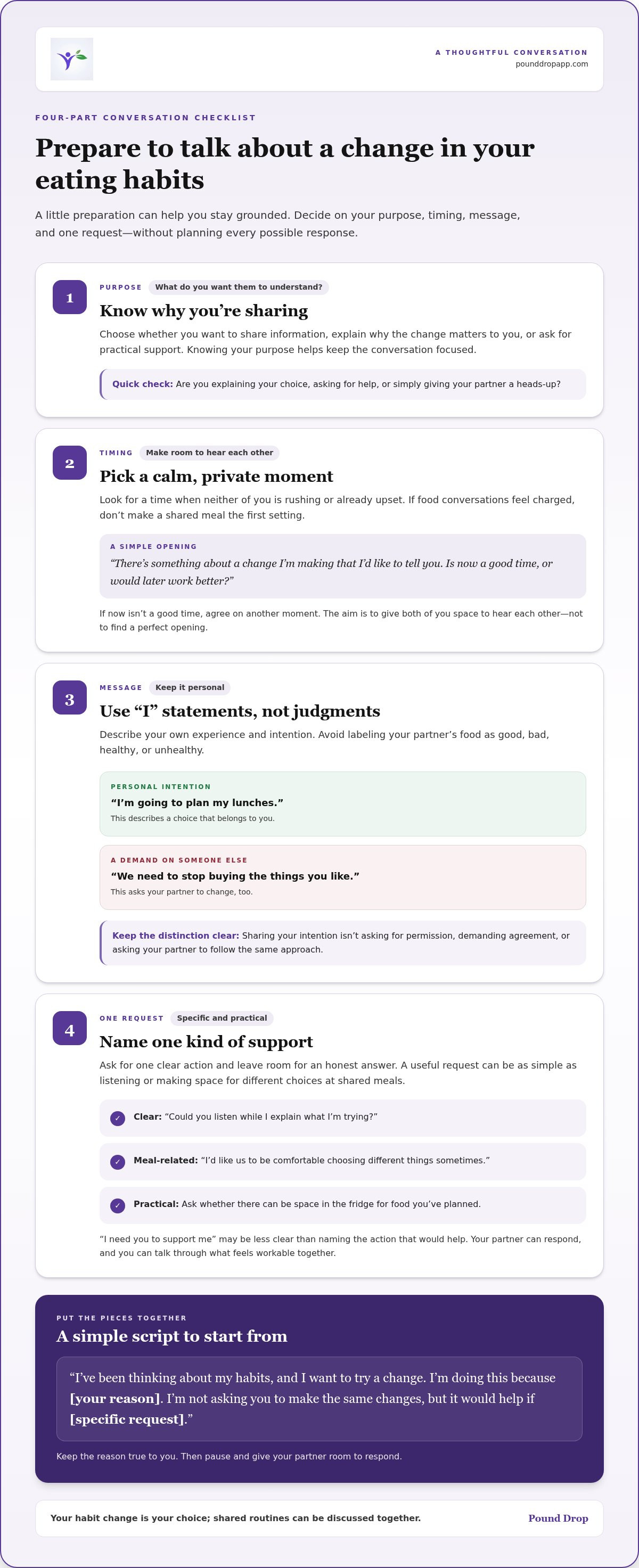
A little preparation can help you stay grounded without turning the conversation into a speech. Before you bring it up, decide four things: your purpose, the timing, the message, and one request you might make. You’re not planning every possible response. You’re giving yourself a clear starting point.
- Choose your purpose. Decide whether you want to share information, explain why the change matters to you, or ask for practical support.
- Pick a calm time. Look for a private moment when neither of you is rushing or already upset.
- Keep the message personal. Use “I” statements to describe your experience and intention, not your partner’s habits.
- Name one request. Ask for a specific action, such as listening without trying to solve it or making room for different choices at shared meals.
Choose a moment that supports a calm conversation
Choose a time when you can talk without an audience or an immediate interruption. If food conversations already feel charged, don’t make a shared meal the first setting. A short opening can make it easier to begin: “There’s something about a change I’m making that I’d like to tell you. Is now a good time, or would later work better?”
That question gives your partner a chance to be present instead of asking them to react while distracted. If now isn’t a good time, agree on another moment rather than assuming the conversation has to happen immediately. The aim isn’t to find a perfect opening. It’s to give both of you enough space to hear each other.
Use a simple script to explain your decision
Plain language is enough. Try: “I’ve been thinking about my habits, and I want to try a change. I’m doing this because [your reason]. I’m not asking you to make the same changes, but it would help if [specific request].” Your reason might be wanting more structure in your routine or feeling ready to try a different approach. Keep it true to you.
A useful request names one practical action and leaves room for an honest answer. “Could you listen while I explain what I’m trying?” is clearer than “I need you to support me.” If your request involves meals, you might say, “I’d like us to be comfortable choosing different things sometimes.” Your partner can respond, and you can talk through what feels workable together.
If reflection helps you clarify what you want to say, a self-guided resource such as the Pound Drop App can support your own habit practice. It’s an optional tool for keeping the change connected to your choices, rather than making your partner responsible for tracking your progress.
Before the conversation, jot down your main point and your request if that helps. Then let the notes go. You’re aiming for honesty and clarity, not a flawless performance.
How to respond if your partner feels criticized or has questions
Even a thoughtful conversation can land differently than you intended. Your partner might ask whether you expect them to change, sound surprised, or connect your decision to an earlier disagreement about food. That first response may reflect what they heard in the moment, not a final judgment about your choice or your relationship.
Try to stay curious without taking responsibility for managing every feeling your partner has. You can acknowledge the impact, clarify what you meant, and listen to their concern. The aim is mutual understanding, not winning agreement about what either of you should eat.
If your partner hears criticism in your decision
Start by recognizing how your words may have sounded, even if criticism wasn’t your intention. You could say, “I can see how that might have sounded like I was judging what you eat. I’m not asking you to eat differently; I’m explaining what I want to try.” That response makes room for their experience while keeping your decision in your own hands.
If you’re unsure what felt critical, ask gently: “Was there a particular part that came across that way?” Listen to the answer before explaining further. Then clarify the point they raised using first-person language. For example, “I’m talking about a routine I want to change for myself” keeps the focus on your experience. Avoid debating whether their food choices are good or bad, which can pull the conversation away from what you came to share.
If your partner offers advice you did not ask for
Advice can be a sign that your partner wants to help, but it may not be the kind of support you need. Thank them for caring, then name what would feel more useful: “Thanks for thinking it through with me. I’d rather figure out the details myself, but I’d appreciate you listening when I want to talk about how it’s going.”
A warm boundary can be both appreciative and clear. If suggestions about what you eat feel uncomfortable, try: “I know you’re trying to help. I’d like to make my food choices without comments, and I’ll ask if I want ideas.” You don’t have to justify the boundary at length. A simple request gives your partner a fair chance to understand how to support you.
Questions are different from demands, so answer what feels useful and let the rest wait. If the conversation turns into blame, repeated pressure, or an argument, pause rather than pushing for a resolution. You might say, “I want us to understand each other, and I don’t think we’re hearing that right now. Can we take a break and come back to it later?” Choose a time to revisit it if needed.
If you’re considering how to tell your partner you are changing your eating habits, remember that you can clarify your intention without persuading them to share it. You’re allowed to take time, answer honestly, and return to the conversation when you’re both ready.
How to agree on support while keeping shared meals comfortable
Support can make a change feel easier, but it shouldn’t turn your partner into a supervisor. There’s a difference between encouragement and monitoring: a partner might listen, help make room for different preferences, or plan a meal with you. They don’t need to check your choices, comment on what you eat, or enforce the habits you’re practicing.
Think about one small adjustment that could help both of you, then discuss it as a shared decision. A useful request leaves room for your partner’s preferences and an honest answer. You’re looking for a comfortable way to live alongside different choices, not asking them to adopt yours.
Ask for support that is specific and freely chosen
Vague requests such as “be supportive” can leave both people guessing. Instead, name a practical action: “Would you be comfortable planning a couple of dinners together?” or “Could we make room for different preferences at meals without commenting on each other’s plates?” Then ask what feels workable to your partner. Their input helps keep the request collaborative rather than turning it into an expectation.
Support doesn’t have to mean doing the same thing. Your partner may be happy to listen or help with a shared routine while making different food choices. Avoid asking them to track, judge, or enforce your habits. Those choices are yours to practice, and keeping that responsibility with you can protect the relationship from unnecessary pressure.
Make shared food routines flexible, not all-or-nothing
You don’t have to replace every familiar meal to make room for change. You might keep a shared dinner you both enjoy and adjust one part to suit your preference. Or you could choose recipes together while each person decides what works for them. The goal is a routine that still feels like time together, not a test of whether you’re both following the same approach.
Occasions can have room for flexibility, too. A family meal, celebration, or busy evening doesn’t need to become a debate about which foods are “good” or “bad.” Talk about what would help you feel comfortable while respecting that your partner may make different choices. Shared planning can be useful as long as neither person is expected to approve the other’s plate.
Try an adjustment for a while, then check in: Does it feel manageable for both of you? Is one person carrying more of the planning or changing more of the routine? If it creates stress or feels unfair, revisit the arrangement and choose another small step. For anyone considering how to tell your partner you are changing your eating habits, this practical conversation can turn support into something both people freely agree to.
If you’d like a structure for practicing personal habit changes, explore The Method. Its focus on habit formation can help keep your progress grounded in your own choices, without making your partner responsible for it.
How to keep the change yours and find steady support
Your partner can be part of a supportive home without becoming responsible for your progress. The choices, reflection, and habit practice remain yours. That separation can make support feel warmer and less pressured: you can appreciate encouragement while deciding for yourself what to try, what to adjust, and how to continue.
Keeping the change personal doesn’t mean keeping it secret or doing everything alone. It means sharing what feels useful and allowing the kind of support you want to evolve. A request that worked at the start may need to change as your routine, schedule, or preferences shift. That’s a reason to check in, not a sign that either of you has failed.
Check in without turning the conversation into a report card
Set aside a brief moment to ask how the arrangement feels for both of you. You might say, “Is the way we’ve been handling meals working for you? I’d like to adjust anything that feels awkward.” Keep the conversation about routines and experience, not whether you’ve been perfect or whether your partner has done enough.
If circumstances change, update your request. Perhaps planning together helps one week, but a busier schedule makes a simpler routine more practical the next. You can name what’s different and find a new arrangement without assigning blame.
A difficult day or a pause in your routine doesn’t erase the effort you’ve made. Instead of treating a setback as a reason for a relationship checkup, consider what would help you return to your own practice. Your partner can listen or offer encouragement if you want it, but they don’t need to assess your progress. The conversation is there to support connection, not create a report card.
Use self-guided resources to support your own practice
Some people find it helpful to have a structure for reflecting on and practicing habits alongside conversations with a partner. Pound Drop’s App and The Method are parts of a self-guided weight-management system focused on habit formation. The Book and The Journal are physical resources that complement the system and offer additional ways to engage with your own reflection and habit change.
These tools are optional. They don’t replace honest communication, and they don’t make your partner responsible for keeping you on track. If you prefer a structured way to support your personal practice, explore Pound Drop’s self-guided tools and choose what feels relevant to your needs.
When you think about how to tell your partner you are changing your eating habits, remember that the conversation is an invitation to understand you, not a request for them to take ownership of your choices. Support can be shared. The change itself stays yours, and it can develop at a pace that fits your life.
Take your next step at your own pace
You don’t need every detail settled before you begin. One honest conversation can be enough to open the door, and you can adjust your approach as you learn what feels comfortable for you and your relationship. If you’re still wondering how to tell your partner you are changing your eating habits, let your first step be simple: name what you want to try and give yourself room to learn along the way.
Your partner’s support can matter, but your progress doesn’t have to become a shared project. Keep choosing the habits that feel right for you, and use reflection to notice what’s helping. Pound Drop offers a self-guided system centered on the Pound Drop App and The Method, with The Book and The Journal complementing the digital tools.
Explore Pound Drop’s self-guided tools for a structured way to support your personal habit change. You can take this one step at a time. Your choices are yours, and steady progress can start with a conversation that feels true to you.
Frequently Asked Questions
Should I tell my partner before I start changing my eating habits?
You don’t need permission to begin, but sharing your plans beforehand can help if the change affects a routine you share. For example, if you’ll shop for different groceries or make different choices at a regular dinner, a quick heads-up can prevent confusion. If the change is private and won’t affect your shared plans, you may prefer to mention it when it naturally comes up. Choose what feels right for you.
What if my partner says I am trying to change them?
Clarify your intention, then invite them to explain what gave them that impression. You might say, “I hear that this feels directed at you. Which part sounded that way?” Listen for a specific concern, such as a shared routine changing, and address that practical issue without debating their food choices. You can reassure them that your decisions are yours while staying open to discussing changes that affect both of you.
Can I ask my partner to change what they eat around me?
You can make a request, but keep it specific and recognize that your partner can say no. For instance, you could ask whether they’d be willing to avoid offering you a particular food while you’re getting used to a new routine. Explain why the request would help, and look for another option if it doesn’t work for them. A request isn’t the same as a rule.
How do I tell my partner I do not want comments about my food?
Say plainly what you’d like to change and give a simple example of the comments you mean. For example: “I know you may be trying to encourage me, but I’d prefer not to discuss what’s on my plate. Please let me bring it up if I want to talk about it.” If a comment slips out, a brief reminder can reinforce your preference without turning every meal into a larger discussion.
Should my partner join me if I am changing my eating habits?
Your partner can join if they genuinely want to, but they don’t have to share your goal for you to make progress. You might invite them to help choose a recipe or join a grocery trip, while making clear that the invitation is optional. If they decline, you can still practice your habits independently and keep other parts of your routine shared. Separate goals can coexist with time and connection.
What if my partner is not supportive of my eating-habit changes?
Try to understand what “not supportive” looks like before deciding what to do next. A partner who needs time to adjust may respond differently from one who repeatedly mocks your choices or interferes with them. Explain what behavior is affecting you and what you need instead. If you can’t get the support you hoped for, keep responsibility for your choices with yourself and seek encouragement from a trusted person or a self-guided routine.
Ready to build a more structured personal habit practice? Explore Pound Drop’s self-guided tools, including the Pound Drop App, The Method, The Book, and The Journal.


