


Article by
Jesper Sorensen
Jesper Sorensen is a holistic health coach and founder of Pound Drop, a different approach to weight loss built around healthier habits. He has written ebooks and health articles for established publishers and has spent years studying nutrition, healthy eating and sustainable weight management.
An evening binge is a moment to respond to, not a verdict on who you are. Overcoming shame after an evening binge eating episode can start with treating yourself with compassion, returning to regular meals instead of trying to compensate, and telling someone you trust what happened. If eating felt out of your control, that feeling deserves attention, not blame.
It’s understandable to feel guilty or want to hide afterward. But shame can make it harder to seek support and notice what you need next. This guide offers practical ways to ease self-criticism, return to a steady eating routine, and decide when to talk with a therapist, doctor, or support group. Recognizing loss of control can help you understand the experience without labeling yourself or facing it alone.
Key Takeaways
- Notice whether the episode involved feeling unable to stop, and describe what happened without turning it into a judgment about yourself.
- Choose a steady next step, such as returning to your usual meals rather than trying to compensate by restricting food.
- Try a kinder response to shame: speak to yourself as you would to someone you care about, or write down what you’re feeling.
- Consider telling a trusted person or seeking professional support, especially if episodes or distress keep returning.
- Look for the situations and emotions surrounding an episode to help identify what support or coping strategy may be useful next time.
1. Emotional support after a difficult eating episode
After an evening episode, shame may lead you to hide, replay what happened, or criticize yourself. Try one small step instead: name the feeling, move somewhere comfortable, and tell yourself, “I’m having a difficult moment; I still deserve care.” This doesn’t excuse anything. It separates your worth from the episode and can help you decide what support you need.
Choose someone who can listen without judgment, such as a trusted friend, family member, or therapist. You might say, “I ate in a way that felt out of control, and I’m feeling ashamed. Could you stay with me while I settle?” You don’t need to explain every detail. Writing down what you feel can also help you find the words before sharing them.
Stanford Center for Health Education’s video offers a compassionate perspective on binge eating disorder and recovery:
Binge eating can indicate binge eating disorder when episodes recur, involve loss of control, and cause distress. One key pattern is binge eating at least once a week, on average, for three months. A qualified professional can assess the full picture.
Consider professional support if episodes keep happening, feel increasingly hard to interrupt, or lead you to withdraw from people. Other signs include intense guilt, persistent anxiety or low mood, and attempts to compensate by restricting food or exercising compulsively. You don’t have to wait for a diagnosis to discuss these concerns with a doctor, therapist, or registered dietitian experienced in eating disorders.
In the United States, the National Alliance for Eating Disorders hotline is available at 1-866-662-1235 from 9 a.m. to 7 p.m., Monday through Friday. The SAMHSA National Helpline can be reached at 1-800-662-HELP (4357) for mental health and treatment-referral support. These are starting points for asking about eating-disorder resources and support options.
If you’re in immediate emotional distress or worried you may harm yourself, call or text 988 to reach the 988 Suicide & Crisis Lifeline. For non-urgent support, make a short note of what happened, how you felt, and what you want help understanding. Taking that note to an appointment can make a difficult conversation easier to begin.
2. Returning to regular meals rather than restricting food
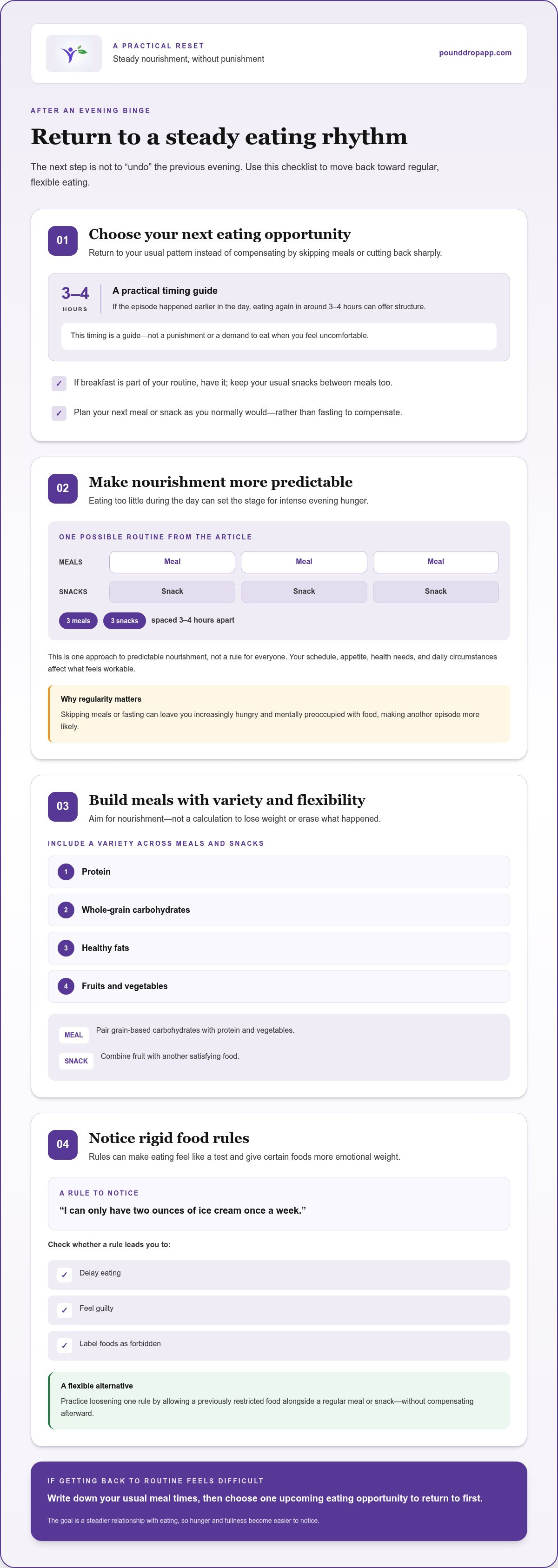
After an evening binge, skipping breakfast or cutting back sharply can seem like a way to regain control. But restriction can leave you physically hungry and mentally preoccupied with food, making another episode more likely. Instead, return to your usual eating pattern. If breakfast is part of your routine, have it; if you usually eat a snack between meals, keep that plan. Compassion means responding to your body without treating food as something you must earn.
Fasting to compensate can extend the cycle. You may skip a meal, become increasingly hungry, and find it harder to make choices that feel steady later. Instead, plan your next meal or snack as you normally would. If the episode happened earlier in the day, a practical guide is to eat again in around 3-4 hours. The timing is a structure, not a punishment or a demand to eat when you feel uncomfortable.
Eating too little during the day can also set the stage for intense evening hunger. For example, someone who has only coffee for breakfast and a small lunch may arrive home feeling depleted. A regular pattern might include three meals and three snacks, spaced three to four hours apart. This is one approach to predictable nourishment, not a rule for everyone. Your schedule, appetite, health needs, and daily circumstances all affect what routine feels workable.
Rigid food rules can make eating feel like a test. Rules such as “I can only have two ounces of ice cream once a week” may give a food more emotional weight and make it harder to respond flexibly. Notice whether a rule leads you to delay eating, feel guilty, or label foods forbidden. You can practice loosening one rule by allowing a previously restricted food alongside a regular meal or snack, without compensating afterward.
For balance, include a variety of foods across meals and snacks: protein, whole-grain carbohydrates, healthy fats, fruits, and vegetables. A meal might pair grain-based carbohydrates with protein and vegetables, while a snack could combine fruit with another satisfying food. The goal isn’t to calculate weight loss or “undo” the previous evening. It’s to rebuild a steadier relationship with eating, so hunger and fullness become easier to notice. If regular meals feel difficult to manage, write down your usual meal times and choose one upcoming eating opportunity to return to first.
3. Responding to shame and guilt with self-compassion
After an eating episode, guilt and shame can arrive together, but they describe different things. Guilt often focuses on an action: “I ate in a way I didn’t intend.” Shame turns that action into a verdict: “There’s something wrong with me.” Separating the two helps you respond to what happened without treating it as proof of your worth.
Try putting the feeling into a specific sentence: “I feel guilty because I ate past the point I wanted to,” or “I feel ashamed and want to hide.” Naming the emotion can help you pause before reacting. Then ask what you would say to a friend who shared the same experience. You might offer patience and curiosity instead of blame. You deserve that same care.
Shame can feed a cycle: an episode leads to harsh self-judgment, distress, and withdrawal, and those responses can make another episode more likely. For example, someone may call themselves a failure, avoid a friend’s invitation, and spend the evening alone with painful thoughts. That cycle isn’t a personal flaw. Recognizing it gives you a chance to choose a different response, such as reaching out or writing down what you’re feeling.
Self-compassion doesn’t mean pretending the episode didn’t matter. It means looking at it without punishment. Use a short check-in:
- Name the feeling: Identify whether you feel shame, guilt, sadness, or anxiety.
- Describe the event neutrally: Write what happened without labels such as “bad” or “weak.”
- Offer a kinder response: Try, “This was difficult, and I can learn what support I need.”
- Choose one caring action: Send a message, rest, or return to your next planned activity.
Writing can help clarify emotional experiences. Set down the thoughts you’re carrying, then reread them as if a friend had written them. Replace “I have no control over anything” with a more grounded observation, such as “I felt out of control during that episode, and I’m trying to understand why.” This acknowledges what happened without turning it into your identity.
Shame can make concerns about disordered eating harder to discuss by encouraging secrecy. Self-compassion offers a way to stay curious rather than condemn yourself: notice what came before the episode, what you felt afterward, and what might help next time. This response may take practice. If shame or guilt keeps interfering with daily life, bring those feelings to a therapist or another trusted professional. You don’t need perfect words to begin; “I feel ashamed about eating, and I want help understanding it” is enough.
4. Self-compassion and reducing hurtful self-talk
A harsh inner voice can turn one eating episode into a judgment about your whole character. Try noticing and reshaping your self-talk rather than treating it as fact. Self-compassion is associated with fewer binge-eating episodes, so a kinder response can support recovery without requiring you to feel positive right away.
How can you challenge self-blaming thoughts after binge eating? Write down the exact thought, such as “I have no willpower,” then ask what you would say to a friend in the same situation. Replace the label with a fairer description: “I had a difficult episode, and I can explore what was happening without attacking myself.”
Self-forgiveness doesn’t mean dismissing your feelings or pretending nothing happened. It means acknowledging the episode, accepting that you’re human, and choosing a next step that supports your mental health. You might say, “I wish this had gone differently, but punishing myself won’t help me understand it.” That shift leaves room to learn without making recovery a test of perfection.
Try a brief writing practice. Note what you’re feeling, what you need, and one personal quality you value, such as patience or persistence. You can also record a positive development from the day, even if it seems small. The Journal offers a place for this reflection. Keep the focus on understanding yourself, not scoring your food or creating new rules.
Self-care can be ordinary and practical: put on comfortable clothes, take a calming shower, or sit with someone you trust. If movement feels welcome, choose it for comfort or enjoyment, not to compensate for eating. A gentle 10-minute walk may help lift mood and ease anxiety; light activity can also include a relaxed walk outdoors. Stop if movement feels physically uncomfortable or begins to feel like punishment.
Moderate activity can be part of daily life, with 10 to 30 minutes as one example, but it isn’t a requirement after an episode. Notice your reason for moving: “I want fresh air” is different from “I need to undo what I ate.” Higher self-compassion is associated with less body anxiety and less compulsive exercise, alongside exercise for more positive reasons, such as enjoyment. That distinction can help protect your relationship with movement.
Make the practice repeatable. When self-blame appears, pause, name the thought, and answer it with the same respect you’d offer a friend. Recovery includes difficult moments; responding with compassion gives you a steadier way to meet them.
5. What can I do right after a binge eating episode to manage shame and distress?
Start with the next few minutes, not a plan to fix everything. Move somewhere comfortable, loosen tight clothing if needed, and take a slow breath. Then name the strongest feeling: shame, anxiety, sadness, or physical discomfort. Overcoming shame after an evening binge eating episode can begin with one manageable action, rather than judging your whole evening.
Try a grounding check-in. Notice what you can see and hear around you, then ask, “What would help me feel a little safer right now?” You might sit near a family member, wrap yourself in a blanket, or step away from a mirror. Choose comfort rather than punishment. You don’t need to make decisions about your body or eating while distress feels intense.
If your thoughts keep circling the episode, redirect your attention to one supportive next step. You could prepare for your next regular meal, choose a calming activity, or write a few neutral notes: “I ate past the point I wanted to. I feel ashamed. I can decide what support I need tomorrow.” This recognizes what happened without turning it into a personal verdict.
Being alone can make harsh self-talk feel louder. If company would help, spend time with someone you trust, even without discussing food. You could text, “Could we talk about something ordinary for a while?” Connection doesn’t require a full explanation. Overcoming shame after an evening binge eating episode can begin by letting someone keep you company.
Keep the rest of the evening gentle. Avoid fasting, extra exercise, or other attempts to compensate. If screens intensify comparison or distress, put them aside for an hour before getting ready for bed. Try listening to music, reading, or preparing comfortable clothes for the morning. The aim is to make the next transition easier, not create another strict rule.
When you feel ready, note one detail about what preceded the episode and one thing that helped afterward. “I felt lonely after work; texting my sister helped” may offer useful information without blame. If episodes or distress keep returning, bring your observations to a qualified professional. For a self-guided way to build everyday habits, explore a self-guided routine.
Once the intensity eases, focus on making your next meal manageable instead of replaying the episode. Consider what would help, without trying to work out everything that led to the binge tonight. This gives you a forward-looking step without making the episode something you must solve immediately.
If guilt is still present, spending time with another person can be a gentler alternative to sitting alone with it. You don’t have to describe what happened or ask them to fix anything. Share an ordinary activity or conversation, and let company be enough for now. The aim isn’t to force yourself to feel better at once, but to give your attention somewhere kinder to rest.
Pound Drop: Pound Drop App
The Pound Drop App supports a self-guided routine for tracking and managing lifestyle progress. If you’re practicing regular meals and more compassionate self-talk, structure may help you notice patterns and maintain habits over time. The Method provides the system behind this approach, while The Journal offers a place to reflect on progress and everyday experiences.
Pound Drop’s tools may suit you if you want support for independent habit-building. If binge eating feels out of control or shame is affecting your wellbeing, professional eating-disorder support remains important. An app isn’t a substitute for care from a qualified professional.
If a self-guided structure feels useful, visit Pound Drop App to learn more.
Let your next step be a gentle one
You don’t need to feel completely at peace before you begin. Progress can start with one response that makes tomorrow a little more manageable: writing down a question, asking someone you trust to listen, or making space for professional support. Small, thoughtful choices can help you build a more respectful relationship with yourself over time.
Overcoming shame after an evening binge eating episode isn’t about proving you’ll never struggle again. It’s about meeting a difficult moment with curiosity and finding a way forward without blame. If you want a self-guided structure for everyday lifestyle habits, explore the Pound Drop App and The Method. For eating-related distress that feels persistent or hard to manage, reach out to a qualified professional who can support your needs.
Explore Pound Drop App and take the next step at your own pace. You deserve progress that leaves room for compassion.
Frequently Asked Questions
What should I avoid doing the day after a binge, such as fasting or over-exercising?
Avoid fasting, skipping meals, or using exercise to compensate for what you ate. Those responses can increase restriction and make another difficult eating episode more likely. Try not to set a strict “starting over” rule, such as banning a food for the rest of the week. Instead, keep your ordinary plans where possible, and choose movement because it feels comfortable or enjoyable, not to erase the episode.
How can I return to regular meals after an evening binge eating episode?
Resume your usual eating rhythm with the next meal or snack, rather than waiting until you feel you’ve earned it. For example, if you usually have breakfast before work, prepare a familiar option the night before, such as yogurt with fruit or toast with eggs. If mornings are difficult, plan a portable snack for later. Choose a routine that fits your day, and adjust it gently rather than creating strict food rules.
What triggers evening binge eating, and how can I identify my patterns?
Evening episodes may follow daytime undereating, stressful interactions, loneliness, or emotions that feel difficult to manage. To notice your own patterns, keep a brief log after an episode: record what was happening beforehand, your mood, and whether you’d eaten regularly. You might notice episodes follow tense workdays or evenings spent alone. Look for recurring connections, not a single cause, then consider an alternative response for that situation.
How can I prevent future evening binge eating episodes without restrictive dieting?
Build prevention around steady nourishment and practical coping choices, not forbidden foods or strict calorie rules. You might plan a satisfying afternoon snack for a long workday, then decide whom to contact if stress builds at home. Notice whether sleep, conflict, isolation, or skipped meals tend to affect your evenings. If episodes continue or feel out of control, discuss the pattern with a qualified professional who understands eating disorders.


