


Article by
Jesper Sorensen
Jesper Sorensen is a holistic health coach and founder of Pound Drop, a different approach to weight loss built around healthier habits. He has written ebooks and health articles for established publishers and has spent years studying nutrition, healthy eating and sustainable weight management.
What if lasting weight-loss habits depend less on willpower and more on making helpful actions easier to repeat? The science of weight loss habits offers a practical starting point: everyday cues, small behaviors, and feedback can help shape routines over time. That doesn’t mean motivation never matters or that habits alone determine weight. Weight management is influenced by many factors, and real life can interrupt even well-made plans.
If work, stress, or family life makes it hard to keep a routine going, you’re not alone. Habit-based advice can sound overly simple, especially when it’s presented as a guaranteed fix. A more useful approach is to understand what habits can support, where their limits are, and how to start without expecting perfection.
In this article, you’ll learn how habits form in plain language and what behavioral science can and can’t tell us about weight loss. We’ll look at manageable actions, ways to adapt when plans change, and how tracking and reflection can offer useful feedback without promising results. The goal is steady practice, not a flawless streak.
Key Takeaways
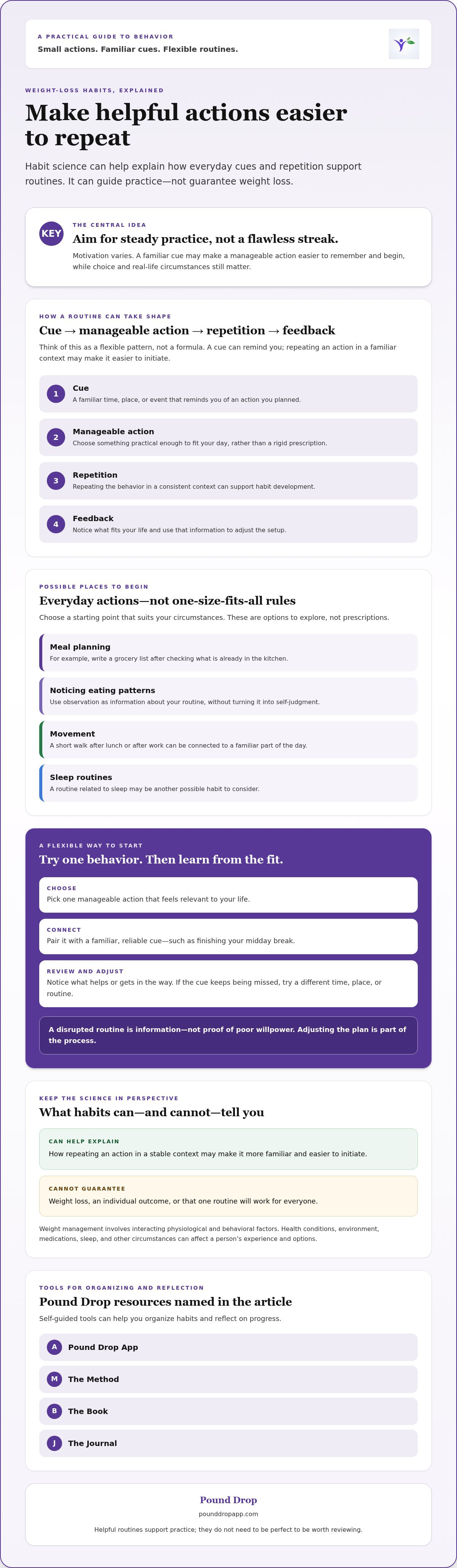
- The science of weight loss habits can explain how cues and repetition may make helpful behaviors easier to begin, but habits alone don’t guarantee weight loss.
- Connecting a manageable action to a familiar part of your day can make it easier to practice when motivation varies.
- Meal planning, noticing eating patterns, movement, and sleep routines are possible starting points, not one-size-fits-all prescriptions.
- Try one behavior, connect it to a cue, and review how well it fits your life. Adjusting the plan is part of the process, not a sign of failure.
- Self-guided tools such as the Pound Drop App, The Method, The Book, and The Journal can help you organize habits and reflect on progress.
What Is the Science of Weight Loss Habits?
A habit is a behavior repeated in a familiar context until that context helps make the behavior easier to start. For example, putting your walking shoes by the door after work may make a short walk easier to begin on weekdays. You still choose whether to go, but repeating the action in a familiar situation can make it clearer where to start.
The science of weight loss habits looks at how routines develop and how they may support behaviors related to weight management, such as planning meals or moving regularly. It doesn’t show that habits alone determine body weight. Weight management involves interacting physiological and behavioral factors, including energy balance, food, and physical activity, as outlined in this overview of the science of weight management.
For another perspective on routines and behavior, watch this video:
How is a habit different from motivation?
Motivation can rise and fall with mood, stress, energy, and the demands of the day. A habit is more closely tied to a familiar cue or situation. You might feel motivated to walk after work one day and less so the next. If changing clothes or putting your shoes by the door is already part of your routine, that cue may help you get started. It doesn’t remove choice or make every day effortless.
What does habit science explain, and what does it not?
Behavioral research can help explain how repeating an action in a consistent context may make it easier to initiate. In a study of habit formation, Phillippa Lally and colleagues described how everyday behaviors can become more automatic through repetition in a stable context. That helps explain routines, not guarantee a change in weight.
Weight is influenced by more than repeated behavior. Health conditions, environment, medications, sleep, and other circumstances can affect a person’s experience and options. A routine that supports one person may not suit another, and a disrupted routine isn’t proof of poor willpower. Habit science can help explain and guide practice, but it can’t predict an individual’s weight outcomes or establish that one routine will work for everyone.
How Do Cues, Repetition, and Rewards Shape Weight-Loss Habits?
A routine often begins with a cue: a familiar time, place, or event that reminds you of an action you planned. A cue isn’t a command and can’t guarantee you’ll follow through. Pairing a manageable action with a steady part of your day can, however, make it easier to remember and begin.
What role do cues and routines play?
You might take a short walk after lunch or write a grocery list after checking what’s already in the kitchen. In both examples, an existing event prompts a possible next step. Choose a cue that happens reliably and keep the action flexible enough for real life. If lunch takes place at different times, for instance, use finishing your midday break as the cue instead of relying on a specific hour.
The science of weight loss habits doesn’t offer a rigid formula or a perfect cue for everyone. A cue can make an action more noticeable, while your schedule, surroundings, energy, and priorities still affect whether you follow through. If you keep missing the original cue, use that as information. Try a different time, place, or routine.
Why do repetition and feedback matter?
Repeating a behavior in a consistent context can support habit development by making the behavior more familiar and easier to initiate. In a real-world study, Phillippa Lally and colleagues observed people developing everyday habits and examined how repetition in a stable context related to automaticity. Their findings describe a process, not a guaranteed timetable or proof that a particular routine will cause weight loss. Lally et al.’s habit-formation study offers a closer look at the research.
Feedback helps you see how a behavior fits your day. You might notice that you walk more often when you prepare your shoes in advance, or that making a grocery list feels difficult on especially busy evenings. Use what you notice to adjust the setup, rather than to judge yourself. Satisfaction can come from following through or recognizing what made an action easier. Food doesn’t need to be used as a reward, and missing a planned action doesn’t call for punishment.
For more practical ideas, explore weight loss success through habits. If you’d like a self-guided way to organize practice and reflection, you can also learn about the Pound Drop App.
Which Weight-Loss Habits Have a Plausible Behavioral Science Basis?
The science of weight loss habits offers useful principles, not a fixed list of behaviors everyone should follow. Repeating an action in a familiar context and noticing what helps or hinders it are established behavioral ideas. The examples below show how those ideas might work in daily life. They aren’t prescriptions, and no single habit guarantees a particular outcome.
| Possible behavior | Cue and action | Possible barrier | Gentle adjustment |
|---|---|---|---|
| Plan meals | After checking your calendar, note a few meal ideas or make a grocery list. | A busy week can make detailed planning feel like too much. | Choose one meal to plan or list only a few useful ingredients. |
| Notice eating patterns | After a meal, briefly note the context, such as where you ate or how rushed you felt. | Recording may feel burdensome or uncomfortable. | Write a short observation occasionally, or skip tracking if it doesn’t feel supportive. |
| Add movement | After a regular daily task, try a brief walk or another comfortable movement. | Weather, time, access, or energy may get in the way. | Try a shorter option, a different time, or movement that fits your circumstances. |
| Support a sleep routine | Use a familiar evening activity as a cue to begin winding down. | Caregiving, shifts, or other demands may disrupt a set schedule. | Keep one small, flexible part of the routine instead of aiming for a perfect bedtime. |
How can self-monitoring support behavior change?
Self-monitoring means noticing or recording a behavior, its context, or a barrier so you can spot patterns and consider an adjustment. It doesn’t have to involve calories, body weight, or constant measurement. A brief note such as “I had more time to walk after an earlier lunch” may be enough to guide your next step. Choose a method that feels private, accessible, and emotionally comfortable. If recording makes you anxious or overly focused, pause or use a less detailed approach.
How can small actions fit into everyday routines?
Match an action to the time, energy, and options you have that day. An implementation intention is a simple plan for when and where you’ll try it: “After I finish lunch at home, I’ll walk outside if the weather allows.” This makes the next step clearer while leaving room to adapt. For a broader approach, see simple weight loss methodology. Treat these examples as starting points, then notice what works in your own routine.
How Can You Build and Adjust a Weight-Loss Habit Without Chasing Perfection?
A useful habit doesn’t need to be impressive. It needs to be realistic enough to try in the life you have now. The science of weight loss habits can offer a structure for practice, but health needs, abilities, schedules, and circumstances differ. Treat the steps below as a flexible starting point, not a test you have to pass.
How do you choose a habit that feels manageable?
Start with a behavior you value and can reasonably attempt. Before you begin, consider what might make it difficult, such as a changing work schedule, limited access, low energy, or responsibilities that take priority. If your first version feels too demanding, make it smaller or connect it to a cue that happens more reliably. A workable plan is more useful than an ideal plan that doesn’t fit your day.
Try this simple sequence:
- 1. Choose one behavior. Pick a specific action that matters to you instead of changing several routines at once.
- 2. Attach it to a cue. Decide when and where you’ll try it, using a familiar event or part of your day.
- 3. Try the plan. Practice without expecting every attempt to go smoothly. Notice what helps you begin and what gets in the way.
- 4. Review and adjust. Keep what fits, make the action smaller, or choose a more reliable cue if the original plan isn’t working.
What should you do when a routine breaks?
Expect interruptions. Travel, illness, schedule changes, and everyday demands can unsettle routines. That doesn’t mean you’ve failed. It may show that the plan depended on a particular time, setting, or level of energy. Ask what the disruption revealed. Was the action too big? Was the cue easy to miss? Could a different version fit better?
A compassionate reset can be simple: resume the original action, reduce it to a smaller step, or choose a more dependable cue. You might also pause and reconsider the behavior if it no longer suits your needs. The aim is to learn from experience, not make up for missed days. For additional practical examples, read the science of weight loss success through habits.
If you’d like a self-guided way to organize your habit practice and reflection, explore the Pound Drop App.
How Can Pound Drop Tools Help You Put Weight-Loss Habit Science Into Practice?
Understanding habits is one thing. Finding a practical way to practice and reflect on them is another. Pound Drop offers a self-guided system that includes the Pound Drop App, The Method, The Book, and The Journal. These resources can help you organize your approach and reflect on progress, but they don’t guarantee weight loss or remove the real-life factors that can make routines difficult.
How can a structured method support habit practice?
A structure can give you a simple path to follow: choose an action, try it in your routine, then consider what you learned. That’s a way to put habit principles into practice, not a promise that a particular behavior will produce a particular result. Your schedule, health, surroundings, and personal needs still matter. Tools can support planning and reflection, but they can’t resolve every barrier for you.
The Pound Drop App and The Journal can support tracking and reflection as part of a structured approach. The Method and The Book are also part of the self-guided system. Together, the digital and physical resources offer different ways to engage with a process. The best fit depends on how you prefer to organize your efforts. For a broader overview of its principles, read the broader weight-loss methodology.
When might an app or journal be useful?
A digital tool may suit someone who prefers keeping reflections in one place on a device. Writing in a journal may feel more comfortable if you prefer paper or want a space to pause and think. You don’t need to track every behavior or keep a detailed record to practice a habit. A brief reflection on what felt manageable or what got in the way may be enough to guide a small adjustment.
Choose an approach that feels useful and comfortable. If tracking becomes stressful, overly demanding, or difficult to access, simplify it or step back. Pound Drop’s approach is self-guided; it doesn’t provide personalized meal plans or one-on-one coaching. The tools aren’t a substitute for individual medical advice, either.
The science of weight loss habits can inform how you practice, but it can’t predict your personal outcome. If you’re curious, explore Pound Drop’s self-guided tools and decide whether they fit your preferences and routine.
Let Small, Repeatable Steps Shape Your Next Move
The science of weight loss habits offers a helpful starting point: familiar cues and repeated actions can make behaviors easier to begin, while reflection can show what fits your life. It doesn’t promise a specific weight outcome. Health, circumstances, and individual needs all matter, so treat a habit as a support, not another standard to judge yourself by.
Choose one realistic action, connect it to a cue, and give yourself room to adapt. If a routine gets interrupted, use the experience to adjust the plan rather than abandon it. Progress can include learning what makes a behavior easier to return to.
Pound Drop brings together the Pound Drop App, The Method, The Book, and The Journal as self-guided resources for practicing and reflecting on habits. The system doesn’t include one-on-one coaching or personalized meal plans. If that self-guided approach sounds like a fit, explore Pound Drop’s self-guided tools.
Start where you are. A small, thoughtful next step is enough.
Frequently Asked Questions
What is the science behind weight-loss habits?
The science of weight loss habits examines how repeated behaviors can become linked to familiar cues and contexts. With practice, a routine may become easier to start in the situation where it’s usually done. This helps explain behavior patterns, not predict someone’s weight outcome. Habits don’t determine body weight by themselves. Health, environment, medication, sleep, and other personal circumstances can also shape weight management.
How long does it take to form a weight-loss habit?
There’s no single timeline that applies to everyone or every behavior. A simple action practiced in a steady context may develop differently from a more complex routine, and life circumstances can affect consistency. Rather than counting down to a universal deadline, choose a manageable behavior and notice how it fits your day. If a barrier comes up, adjust the action or cue. Progress doesn’t need to follow a fixed schedule.
Can small habits really help with weight loss?
Small habits can support behaviors related to weight management, such as regular movement, meal planning, or noticing eating patterns. Their usefulness depends on the person and broader circumstances, and no single habit guarantees a particular result. Aim for flexible practice, not perfect consistency. If you have health concerns or questions about what approach is appropriate for you, discuss your needs with a qualified healthcare professional.
What is the difference between a habit and willpower?
Willpower generally refers to deliberate effort, while a habit is a behavior that may be prompted by a familiar cue after repetition. They can work together. You might use planning and effort while a routine is new, then find that a familiar cue helps you begin. A supportive environment and a manageable action can make practice easier, but motivation and personal circumstances still matter.
Do I need to track calories to build weight-loss habits?
No, calorie tracking isn’t necessary for everyone who wants to practice habits. Some people find it useful to record a behavior, routine, or barrier, while others prefer not to track. Choose an approach that feels practical and sustainable, such as a brief note about what made a walk easier to fit in. If tracking causes distress or conflicts with medical guidance, seek appropriate professional support.
What happens if I miss a day or fall out of a routine?
Missing a day doesn’t erase previous practice or mean the effort has failed. Treat the interruption as information: perhaps the action was too demanding, the cue was easy to miss, or your circumstances changed. You can resume, simplify the behavior, or choose a moment that fits better. A routine is something to adapt, not a streak you have to protect perfectly.
Are weight-loss habits enough for everyone?
No. Habits can be one part of weight management, but they aren’t a complete explanation or solution for every person. Health conditions, medications, stress, access to resources, and other factors may affect someone’s needs. A self-guided routine shouldn’t replace individualized medical care. If you have questions about your health or need advice tailored to your situation, consult a qualified healthcare professional.


