


Article by
Jesper Sorensen
Jesper Sorensen is a holistic health coach and founder of Pound Drop, a different approach to weight loss built around healthier habits. He has written ebooks and health articles for established publishers and has spent years studying nutrition, healthy eating and sustainable weight management.
What if weight loss success through habits depends less on perfect routines and more on choices you can return to? If conflicting advice has left you unsure which habits matter, you’re not alone. Strict plans can seem clear at first, but everyday life rarely follows a perfect script. One missed workout or unplanned meal doesn’t erase the effort you’ve made.
Everyday habits can support weight management, but they aren’t a guarantee or a measure of your worth. This article separates popular habit myths from practical, compassionate approaches, so you can focus on behaviors that fit your life instead of adding another set of rigid rules.
We’ll look at what habits can and can’t do, why consistency doesn’t mean doing everything perfectly, and how to choose one realistic behavior to practice and review. The goal isn’t to transform your routine overnight. It’s to find a small next step you can return to, even after a day that doesn’t go to plan.
Key Takeaways
- Think of a weight-loss habit as a repeatable behavior that can support health-related routines, not a guaranteed route to a specific result.
- Notice the cue and context around a behavior to make practicing it easier, especially when motivation varies.
- Separate weight loss success through habits from all-or-nothing thinking: one small action can help, but no single habit guarantees weight loss.
- Try one behavior that suits your circumstances, make it manageable, then observe and adjust without treating a missed day as failure.
- Choose a journal, book, or app only if its structure feels useful and encourages reflection. Tools can support practice, but they can’t guarantee outcomes.
Weight loss success through habits: what the idea really means
If you’re tired of restarting after a plan becomes too difficult to maintain, it makes sense to want a clearer way forward. Weight loss success through habits isn’t about finding a perfect routine. It’s about understanding how repeatable behaviors may support your health-related routines, while recognizing that no single behavior guarantees a particular change in weight.
A habit-based approach differs from a short-term reset or a strict set of rules. It makes room for real life, including days when routines change. The aim is to practice behaviors that feel workable, not to judge yourself for missing a day.
For another perspective on the mindset involved, watch this video:
What does a habit-based approach to weight loss mean?
A habit is a behavior you repeat in a familiar situation. For example, someone might take a short walk after lunch when their schedule allows, or keep a water bottle nearby during work. These are examples, not universal prescriptions. Repetition can make a behavior easier to remember, but it still takes attention and may be disrupted when circumstances change.
Unlike a rigid diet, challenge, or short-term reset, a habit-based approach focuses on routines that can be practiced beyond a limited time frame. The broader topic of long-term lifestyle strategies includes behaviors and other factors involved in managing weight. Individual outcomes vary with health, circumstances, and personal needs, so the same routine won’t suit everyone.
Why can small repeated choices matter?
Motivation naturally shifts. A familiar cue, such as finishing a meal or arriving home, can make a chosen behavior easier to remember, so you don’t have to make the decision from scratch each time. That doesn’t make the behavior effortless, and repetition alone can’t promise weight change. It offers a way to practice a supportive routine with less reliance on feeling motivated in the moment.
You might prepare a comfortable place for movement or set aside a moment to plan tomorrow’s schedule. What’s useful depends on what fits your life. Consistent practice means returning to a behavior when you can, not following it perfectly every day. A missed opportunity is information about what may need adjusting, not proof that progress has failed.
How weight-loss habits form: why repetition matters more than motivation
Motivation can help you begin, but it naturally rises and falls with energy, stress, time, and what else is happening in your life. You don’t have to wait until you feel inspired. A repeatable cue can remind you of a behavior and give you a chance to practice on an ordinary day. That’s one practical way to think about weight loss success through habits.
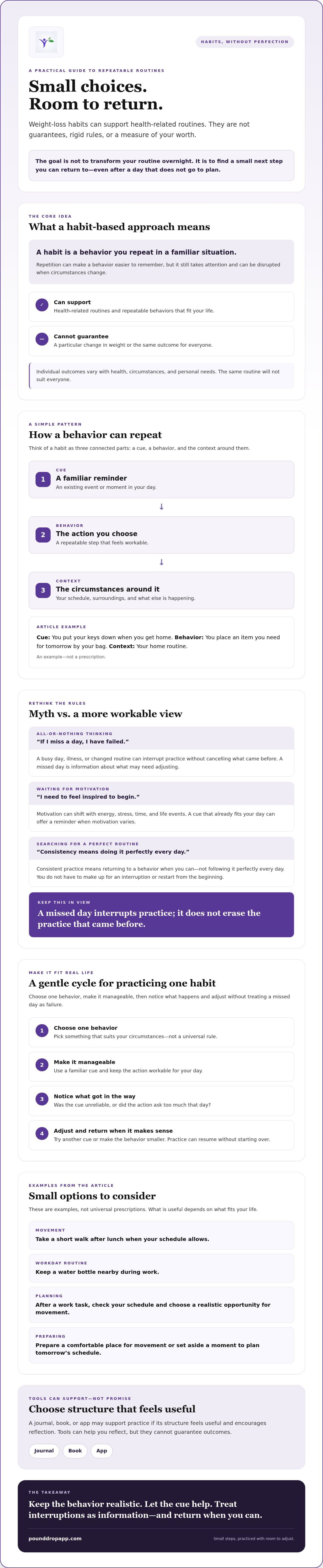
A simple pattern has three parts: a cue, a behavior, and the context around them. For example, after you put your keys down when you get home, you might place an item you need for tomorrow by your bag. The keys are the cue, preparing the item is the behavior, and your home routine is the context. It’s an example, not a prescription.
How do cues and routines help a behavior repeat?
An existing event can serve as a reminder. After finishing a work task, for instance, you might check your schedule and choose a realistic opportunity for movement. The useful cue is one that already fits your day. If that moment is often rushed or easy to miss, try another cue or make the behavior smaller. Habits are practiced, not switched on automatically.
Does missing a day mean the habit has failed?
No. A busy day, an illness, or a change in routine can interrupt practice without cancelling what came before. Instead of asking, “Why can’t I stick to this?” consider what got in the way. Maybe the cue wasn’t reliable, or the action asked too much of you that day. Adjust the plan and return when it makes sense.
A missed day interrupts practice; it doesn’t erase the practice that came before. This is why all-or-nothing rules can make routines feel more fragile than they need to be. You don’t have to make up for an interruption or restart from the beginning. Decide what a manageable next opportunity looks like.
For a gentle experiment, choose a relevant behavior, connect it to a familiar part of your day, and notice what helps or hinders it. If it keeps slipping, treat that as useful information. Change the cue, simplify the action, or choose something better suited to your circumstances.
If having some structure would help you reflect and keep practicing, explore the Pound Drop App as one self-guided option. A tool can support your process, but the routine should still fit your life.
Weight-loss habit myths: small actions, motivation, and perfect consistency
Habits can make supportive choices easier to practice, but they’re sometimes described as if they guarantee results or require unbroken discipline. A realistic view of weight loss success through habits leaves room for individual differences, changing circumstances, and adjustment. Here’s how a few common claims compare with a more balanced perspective.
| Myth | Reality |
|---|---|
| One small habit guarantees weight loss. | A single behavior may support a health-related routine, but it can’t guarantee a specific change in weight. Weight management involves more than one isolated action. |
| A perfect streak is the only kind of consistency that counts. | Consistency can include interruptions. Returning to a behavior or adapting it to fit your circumstances is different from following a rigid rule without exception. |
| Low motivation means you aren’t ready or capable. | Motivation varies. Stress, health, time, and access can all affect a routine, and none of them is a measure of your character. |
Myth: one habit or a perfect streak guarantees results
It can feel appealing to find one action that promises to make everything fall into place. But tracking, changing a food routine, or adding movement won’t produce the same outcome for everyone. Habits can support behaviors that matter to a person’s wellbeing, but weight is affected by multiple influences, including health and life circumstances.
It’s better to treat a habit as a practice than a bargain: “If I do this, I’ll get a guaranteed result.” A useful routine should be flexible enough to adjust, rather than becoming a rule that creates pressure whenever life interrupts it.
Myth: low motivation means a person cannot succeed
Motivation can help, but it isn’t a dependable daily fuel source. A manageable action connected to a familiar cue may take less decision-making than waiting to feel ready. If a routine isn’t happening, consider whether the timing, setting, or action itself needs to change. A smaller step or a different reminder may fit better.
Stress, health needs, limited time, and access to suitable options can all shape what’s realistic. Those are practical conditions to work with, not personal shortcomings. Consistency isn’t a perfect streak; it’s the willingness to adjust and return when circumstances allow. That shift makes room for practice without turning every interruption into a verdict about your ability.
How to practice one supportive weight-loss habit without turning it into a rule
A helpful habit experiment should fit your real day, not an imagined version with unlimited time and energy. Pick one behavior you’re willing to try because it feels useful to you. The aim is to learn what makes practice easier, not to prove your discipline or earn a particular result. That’s a grounded way to approach weight loss success through habits.
Use these steps as a flexible starting point:
- 1. Choose. Select one specific action that feels manageable and relevant to your wellbeing. It could be setting out something you’ll need for a planned activity or pausing to consider what would make your next meal feel satisfying. Choose what suits your needs, not a behavior someone else says you must do.
- 2. Anchor. Connect the action to a familiar event or reminder, such as finishing a work task or putting your bag down at home. Pick a cue you’re likely to notice.
- 3. Simplify. Make the action small enough to fit a busy or low-energy day. If your first version feels like too much, reduce it or choose a gentler alternative.
- 4. Observe. After trying it, briefly note whether the cue helped and what got in the way. A few words about practice or barriers may be enough. Tracking should support reflection, not become constant monitoring or another standard to meet.
- 5. Adjust. If the behavior doesn’t fit, change the action, cue, or timing. You can also decide that a different habit makes more sense. Adaptation is part of the experiment.
Review, learn, and adjust without self-blame
After you’ve had a chance to try the routine, ask: What made it easier? What interrupted it? Did it feel useful, manageable, and appropriate for my circumstances? There’s no need to grade yourself. Your answers can guide the next version, especially if your schedule, energy, or access to resources changes.
Keep the experiment separate from strict food rules, calorie targets, or intense exercise goals. A single habit can support a routine, but it can’t guarantee a change in weight. If a behavior starts to feel distressing or preoccupying, it’s reasonable to pause and reconsider whether it’s helping you.
If you have a medical condition, specific nutritional needs, a history of disordered eating, or concerns about how a change may affect your health, seek guidance from a qualified health professional. General habit ideas may not be suitable for every situation.
If a little structure would help you reflect on a behavior and its barriers, explore the Pound Drop App for habit practice as a self-guided option. Choose tools only if they feel supportive; the experiment should remain flexible and yours to shape.
How structured tools can support weight-loss habits without demanding perfection
A tool can give a routine somewhere to live. A journal, book, or app might help you record a reflection, notice patterns, or return to an intention after a busy stretch. It’s support, not a promise: no tool can guarantee weight change or replace choices that fit your needs. Weight loss success through habits still depends on practice in the context of your real life.
What can a journal, book, or app help you do?
Think about what kind of structure would genuinely help. You might prefer writing a few thoughts by hand, reading guidance at your own pace, or using a digital resource. Consider whether the format is accessible to you and encourages reflection rather than pressure. If recording details makes you anxious or overly focused on monitoring, a simpler approach, or no tracking, may feel more supportive.
Tools can help organize your own observations, but they aren’t clinical care. They don’t determine what’s right for your health, and they shouldn’t be treated as a substitute for qualified professional guidance when you need it.
When might self-guided support be a fit?
Self-guided resources may suit someone who likes to explore ideas independently and build a flexible routine without relying on scheduled support. That won’t be everyone’s preference. If you’re weighing up approaches, read about a simple weight-loss methodology and choosing a weight-loss app for beginners to consider what kind of structure may feel useful.
Pound Drop’s self-guided resources include The Method, the Pound Drop App, The Book, and The Journal. They offer digital and physical options to explore as possible supports for practicing habits. Choose based on your preferences and whether the approach feels manageable. You’re not expected to use every format, follow a perfect routine, or treat a tool as a guarantee.
If you’d like to see whether a self-guided structure feels right for you, take a look at Pound Drop’s resources. Start with the format that feels most comfortable, and keep the focus on small, realistic practice.
Take one realistic step forward
Weight loss success through habits isn’t about finding a flawless routine or expecting one small action to guarantee a result. It’s about choosing behaviors that suit your circumstances, practicing them when you can, and adjusting when life changes. A missed day doesn’t cancel your effort; it can be a chance to learn what would make the next attempt easier.
Keep the next step modest. Pick one behavior that feels meaningful, then review whether it’s actually working for you. Supportive structure can help, but it should make reflection easier, not turn your routine into another source of pressure.
Pound Drop offers a self-guided approach with an app and physical resources, including The Method, The Book, and The Journal. If you’d like to see whether that kind of structure suits you, explore Pound Drop’s self-guided tools.
You don’t need to have every day figured out. Start with what feels manageable, and let steady practice grow from there.
Frequently Asked Questions
Can habits help you lose weight?
Yes, habits can support weight management, but they can’t guarantee weight loss or a particular result. Repeating health-supportive behaviors may make them easier to practice as part of everyday life. The effects depend on individual health, needs, and circumstances, among other influences. Think of weight loss success through habits as building routines that may help, not following a formula that promises the same outcome for everyone.
What are the best habits for weight loss?
There isn’t one set of best habits for everyone. Consider behaviors that support your wellbeing and feel realistic in your day, such as making time for enjoyable movement, planning a routine that helps you feel prepared, or pausing to reflect on what’s working. Choose one to try rather than adopting several rules at once. A useful habit is one you can adapt to your needs, not one that feels punishing.
How long does it take to build a weight-loss habit?
There’s no reliable fixed timeline that applies to everyone. How quickly a behavior starts to feel familiar can depend on the action, how often you practice it, and how predictable your routine is. Focus less on a deadline and more on whether the behavior fits your life. If it’s hard to repeat, adjust the cue or simplify the action. Habit-building is practice, not a countdown.
Do you need motivation to build healthy habits?
No. Motivation may help you get started, but it naturally changes with mood, stress, energy, and daily demands. A familiar reminder and a manageable action can make it easier to practice without waiting to feel inspired. For example, you might connect a brief planning moment to an existing part of your routine. If that cue doesn’t fit, try another. Low motivation isn’t a verdict on your ability or character.
Can you still make progress if you miss a day?
Yes. Missing a day doesn’t erase earlier practice or mean you’ve failed. Treat the interruption as a normal part of life, then consider what made the routine difficult. Was the timing inconvenient, or was the action too demanding? You can adjust the plan and return when it suits you. Progress doesn’t require a perfect streak; a flexible approach leaves room to pause, learn, and continue.
Are weight-loss apps and journals necessary for building habits?
No, you don’t need an app or journal to practice a habit. Some people like having a place to record reflections or review routines, while others prefer a simple reminder or no tool at all. Choose a format that feels accessible and supportive, not one that increases pressure or unwanted monitoring. Pound Drop offers a self-guided approach with an app and physical resources, but tools can’t guarantee outcomes or replace clinical care.
When should I talk with a healthcare professional about weight loss?
Speak with a qualified healthcare professional if you have a health condition, take medication, have specific nutritional needs, or aren’t sure whether a behavior change is appropriate for you. It’s also wise to seek support if weight-related efforts bring distress or affect your relationship with food. A professional can consider your individual circumstances and help you discuss suitable options. General habit guidance isn’t a substitute for personalized clinical advice.


