


Article by
Jesper Sorensen
Jesper Sorensen is a holistic health coach and founder of Pound Drop, a different approach to weight loss built around healthier habits. He has written ebooks and health articles for established publishers and has spent years studying nutrition, healthy eating and sustainable weight management.
Someone else’s pace is not a measure of your progress. To stop comparing your weight loss speed to others, focus on your own habits, goals, and changes over time rather than treating another person’s results as a standard. Your path is personal, and slower or less visible change does not make your effort less meaningful.
It’s understandable to see someone else’s progress and wonder whether you should be further along. These comparisons can affect how you see your body, distract you from goals that fit your life, and add stress or pressure. They can also make it harder to notice the steps you’re already taking.
This article explores how comparison can shape body image and personal goals, and why it may fuel stress and perfectionism. You’ll learn to spot triggers in social media and everyday life, then bring your attention back to progress that matters to you. Small, steady steps are worth noticing, even when they don’t look like someone else’s highlight reel.
Key Takeaways
- Notice when comparisons make you judge your body more harshly, and practice recognizing progress that matters to you.
- Choose goals based on habits you can build, rather than copying someone else’s routine or expected results.
- Pay attention to situations that trigger comparison in daily life, then create a small pause before they shape your choices.
- Remember that social media often shows selected moments, not the full experience behind someone’s progress.
- When comparison adds pressure, return your focus to your own next step instead of chasing perfection.
1. Body image and dissatisfaction with physical progress
Comparing your body with someone else’s can turn a personal goal into a judgment about appearance. A size 4, benching 300 pounds, or running a 6-minute mile might represent someone’s benchmark. None is a universal measure of health, effort, or worth. Ask what you want progress to make possible in your own life, rather than adopting a target simply because someone else reached it.
There’s no single weekly weight-loss rate that suits everyone. A sustainable pace depends on the person and their circumstances, so another person’s weekly change isn’t a reliable standard for yours. If you’re unsure what approach suits your health, a doctor or registered dietitian can help you set an appropriate goal.
Why do results differ? People have different starting points, routines, bodies, and circumstances. Age, activity, and starting weight can all affect a person’s experience, so two people following similar habits may not see the same changes at the same time. Comparing their results as if they started under identical conditions leaves out important context.
The scale reflects more than body fat. Water and the contents of your digestive system can contribute to short-term changes, while body composition affects how weight relates to appearance and fitness. A daily increase or pause, therefore, doesn’t explain by itself what has changed in your body. Look at longer-term patterns alongside other signs of progress.
Instead of treating every weigh-in as a verdict, choose a simple tracking routine. Record your weight under similar conditions, then note habits and changes that matter to you. For example, track how consistently you move, how your clothes fit, or whether a planned activity feels easier. Celebrate a small win, such as completing a planned walk, even if the scale stays still.
For a gentler reflection practice, write down one thing to feel excited about each day, or three things you’re grateful for. These prompts shift attention from appearance alone to daily experiences. Someone else’s reported loss of 20 kilos or a milestone below 100 kg for the first time since high school may sound impressive, but those outcomes don’t define your next step.
Weight loss that feels too rapid or leaves you physically unwell deserves attention, not comparison. Extreme restriction, pressure to match another person, or difficulty managing everyday activities can be reasons to seek guidance. Consult a doctor or registered dietitian if you have health concerns, want help setting a suitable goal, or feel unsure how to proceed. Compare your habits and progress with your own earlier experience, not someone else’s body.
2. How comparison can confuse personal weight-loss goals
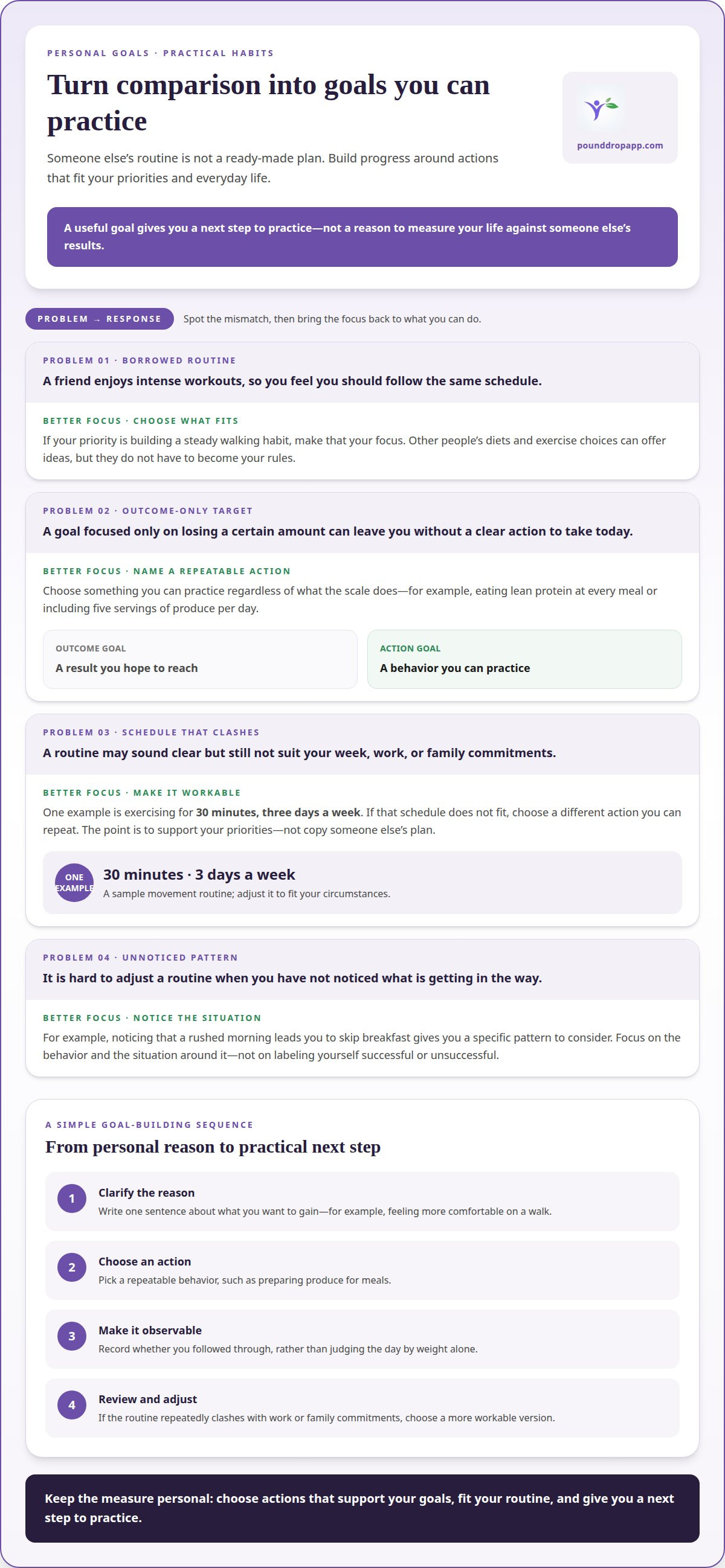
Another person’s routine can look like a ready-made plan, but it may not fit your priorities or daily life. A friend might enjoy intense workouts, while you want to build a steady walking habit. Copying their schedule can shift your focus from what you value to what they happen to be doing. Learning to stop comparing your weight loss speed to others starts with defining what progress means to you.
Begin with a goal you can influence directly. A target such as losing a certain amount focuses on an outcome, while an action-based goal describes what you’ll practice. For example, you might aim to eat lean protein at every meal or include five servings of produce per day. These actions give you something specific to work on, even when the scale doesn’t change as expected.
Make the goal fit your circumstances. If movement is your focus, exercising for 30 minutes, three days a week is one example of a clear routine. If that schedule doesn’t suit your week, choose a different action you can repeat. The point isn’t to adopt someone else’s plan. It’s to select a realistic step that supports your own health and fitness priorities.
- Clarify the reason: Write one sentence about what you want to gain, such as feeling more comfortable on a walk.
- Choose an action: Pick a repeatable behavior, such as preparing produce for meals.
- Make it observable: Record whether you followed through, rather than judging the day by weight alone.
- Review and adjust: If a routine repeatedly clashes with work or family commitments, choose a more workable version.
These steps can also help you recognize habits. For example, noticing that a rushed morning leads you to skip breakfast gives you a specific pattern to consider. Awareness comes before change: you can’t deliberately adjust a routine you haven’t noticed. Focus on the behavior and the situation around it, rather than labeling yourself successful or unsuccessful.
Other people’s diets and exercise choices can offer ideas, but they don’t have to become your rules. Before adopting one, ask whether it supports your personal goal and fits your everyday routine. A useful goal gives you a next step to practice, such as planning produce for tomorrow’s meals. Your own actions offer a clearer guide than someone else’s visible results.
Repeatable choices matter more than whether they resemble someone else’s routine. Eating lean protein at every meal or having five servings of produce per day can make a broad fat-loss goal more practical.
Keep examining your habits: awareness helps you work on and change them. Habits matter for long-term weight loss, so choose actions that support your goals rather than copying another person’s diet or exercise routine.
3. Recognizing and avoiding comparison triggers
Comparison often begins with a specific cue, such as a weigh-in conversation, a changing-room mirror, or a relative’s comment about clothing size. Notice what happened just before your mood shifted. For example, if hearing a coworker describe their progress makes you judge your body, the conversation may be a trigger. Naming the cue helps separate the moment from the story you tell yourself afterward.
For a week, make a brief note when comparison appears. Record the situation, the thought, and what you did next. A note might read: “At lunch, Maya mentioned her new routine; I thought I was behind; I skipped the walk I planned.” Keep the record factual. The goal is to find recurring situations, not criticize yourself for reacting.
Triggers can arise in ordinary routines, not just online. A family member may ask about your weight, a shopping trip may prompt body judgments, or seeing a friend’s gym progress may lead you to change your plans. Look for what connects these moments: a particular person, place, topic, or time of day. That pattern can show where a small boundary might help.
- Pause: Take one slow breath after a comparison thought, before changing your meal or activity plans.
- Name the cue: Say, “That comment about jeans sizes brought this up,” rather than treating the thought as a fact.
- Choose a boundary: Tell a relative, “I’d rather talk about our weekend than my weight.”
- Return to the moment: Resume the walk, meal, or other activity you had already chosen.
Boundaries can be simple and specific. If a friend regularly shares weigh-in details that upset you, ask to talk about hobbies or plans instead. If a shop fitting-room mirror triggers harsh self-talk, step away and focus on whether the garment feels comfortable. You don’t need to explain every boundary at length. A calm, repeated sentence can redirect the conversation.
Review your notes at the end of the week. Circle any cue that appeared more than once, then choose one response to practice next time. For example, if lunch conversations repeatedly turn to weight, prepare a brief subject change before meeting coworkers. If a trigger catches you off guard, notice it and decide what would support you in that moment. This turns awareness into a practical choice, not another reason to judge your progress.
4. Social media highlight reels versus everyday reality
A polished progress post shows one selected moment, not the full routine behind it. A gym selfie may capture someone after a workout, while leaving out a tiring day, a missed session, or ordinary meals. Comparing your everyday experience with that highlight reel creates an uneven picture. You see your full, changing life beside a brief image someone else chose to share.
Captions can sharpen that contrast. A post celebrating a milestone may mention a number or clothing size, but not the person’s starting point, timeline, or circumstances. Those details shape what progress means. Instead of treating the post as a complete account, remind yourself: “I’m seeing this person’s update, not their whole process.” That sentence can create space before you judge your own experience.
Notice what happens in your body and thoughts as you scroll. For example, if a transformation video leaves you discouraged, pause before watching another. Ask what the post led you to believe, such as “I should be changing faster.” Then identify what the image can actually tell you: someone shared a particular moment. It cannot set a fair standard for your individual path.
- Curate your feed: Mute or unfollow accounts that repeatedly leave you feeling pressured.
- Choose a pause: Close the app after a post prompts self-criticism, rather than scrolling for more comparisons.
- Follow varied interests: Add accounts about cooking, music, art, or outdoor activities.
- Return to your day: Pick up the activity you planned, such as preparing lunch or taking a walk.
These choices aren’t a judgment of the person who posted. They’re a way to shape what you see and how you spend your attention. If a friend shares frequent weigh-in updates, you can hide those posts while staying connected in other ways. If a transformation account encourages you to copy an unfamiliar routine, pause and consider whether it fits your priorities.
Try a short reset after a difficult scroll. Put your phone down, name the comparison thought, and look around your actual setting. You might notice a meal you prepared, a walk you completed, or time spent with someone you care about. These moments won’t create a dramatic before-and-after image, but they belong to your real life. Let your feed be one part of your day, not its measure.
One helpful check is to separate what is visible from what is missing. A post gives you a chosen glimpse, while your own day includes its unedited details. When a comparison starts to feel convincing, describe it plainly: “I’m comparing my everyday reality with someone else’s highlight reel.” Naming the mismatch can make the comparison easier to question, without deciding whether the post is genuine or the person has an easier life. You can appreciate what someone chose to share and still leave it out of your measure of yourself. Bring your attention back to what matters today, rather than asking a brief image to explain a whole life.
5. Comparison, stress, and perfectionism
Comparison can turn a personal goal into a moving standard. Psychologist Leon Festinger coined social comparison theory in the 1950s. The idea helps explain why people may judge their progress against peers. If you believe you’re behind, the next post or weigh-in can feel like another test. That pressure can make a steady routine feel inadequate, even when it still supports your own goals.
Peer groups can shift the yardstick, too. People tend to feel good when they believe they’re in the top third of their group. Someone who thinks they’re ahead of two-thirds of their peers may then compare themselves with a different group. That cycle has no reliable finish line. There will always be someone with a different body, schedule, or result to measure against.
Fitness offers a clear example of why one comparison can mislead. Sara took over four hours to finish her first half marathon, while the author ran the distance in less than 90 minutes. Those times describe different experiences, not a fair judgment of Sara’s effort or value. The same principle applies to weight loss: another person’s pace cannot tell you whether your own habits are worthwhile.
Perfectionism can grow when every difference feels like a reason to do more. You might respond to a friend’s update by adding workouts, skipping rest, or treating one unplanned meal as a ruined week. Pause in that moment. Name the pressure, then ask whether your next choice supports your goal or simply tries to erase the discomfort of comparison.
- Spot the rule: Notice thoughts such as “I must match their pace” or “one missed workout means I failed.”
- Replace the measure: Focus on a choice you control, such as following your planned routine today.
- Allow an imperfect day: Return to your next usual meal or activity instead of compensating.
- Recognize effort: Mark a completed walk or a planned meal as progress, regardless of another person’s update.
A useful reset is to write down your goal, the action that supports it, and the next small step. For example: “I want more energy for weekend walks; I’ll keep my planned walking routine; today I’ll take the walk I scheduled.” This brings your attention back to your own direction. You can’t control someone else’s pace, but you can choose whether comparison changes your next decision.
If tracking your habits helps you stay focused on personal actions, explore a structured way to keep progress visible.
Pound Drop
Pound Drop offers a self-guided structure for building weight-loss habits without making someone else’s pace the standard. If comparison has left you unsure what to focus on, The Method, The Book, and The Journal can support a more personal approach to progress. The Pound Drop App is another part of the system, with tools to track and manage your journey. Together, these offerings can help you return to your own routines and focus on the steps you choose, rather than another person’s results. Progress doesn’t need to look the same for everyone. To learn more about using Pound Drop as part of your journey, contact Pound Drop.
Choose a Pace That Belongs to You
Your next step doesn’t need to be dramatic. Choose one manageable action for today, then let it be enough for now. You might plan a walk, prepare a meal, or make space for rest. The value is in choosing deliberately, not proving anything to someone else.
Learning to stop comparing your weight loss speed to others can take practice. A familiar thought may return, especially after a difficult day or an unexpected change in routine. Meet it with a simple reminder: your next choice is yours. You can pause, reconnect with what matters to you, and continue without turning someone else’s progress into your deadline.
If you’d like a steady structure for your own journey, contact Pound Drop to explore your next step. Start where you are. Keep choosing what supports your life, one decision at a time.
Frequently Asked Questions
How can you set realistic weight-loss goals based on your own starting point?
Start with your current routine, health needs, and the changes you can maintain. Write down what a typical week looks like, then choose one adjustment that supports your aim, such as adding a planned walk to a day you usually spend sitting. Treat it as a starting experiment, not a test of willpower. If your health or circumstances affect what feels appropriate, discuss your goal with a doctor or registered dietitian.
How can social media comparisons affect body image and weight-loss motivation?
They can make someone else’s update feel like a standard you’re expected to meet. After seeing a dramatic progress post, you might feel pressured to change your routine quickly, even if it doesn’t suit your life. That urgency can also drain motivation when your experience looks different. Notice whether a post leaves you feeling encouraged or judged, then decide whether engaging with that content supports your wellbeing.
What strategies help stop comparing your weight-loss progress with others?
To stop comparing your weight loss speed to others, prepare a short response to comparison thoughts, such as, “Their update is theirs; I’m choosing my next step.” Then name one action you’ve completed that fits your priorities. If weight-related conversations pull you into comparison, let people around you know you’d rather discuss another topic. These small, deliberate responses help keep someone else’s results from directing your choices.


