


Article by
Jesper Sorensen
Jesper Sorensen is a holistic health coach and founder of Pound Drop, a different approach to weight loss built around healthier habits. He has written ebooks and health articles for established publishers and has spent years studying nutrition, healthy eating and sustainable weight management.
What if the best weight-management tool is the one you can still use when life gets busy? It’s understandable to want a clear system while worrying that daily tracking could become tedious, restrictive, or discouraging. The most useful long term weight management tools make helpful habits visible without asking you to be perfect.
This guide compares digital tools, paper-based resources, and habit-support approaches so you can choose a small toolkit that fits your routines. You’ll learn what each type can and can’t do, how to assess whether a tool is practical, and how to review your progress and adjust when your needs change.
You don’t need to choose every tool at once. A digital resource may suit you if you like keeping information on your phone; a book or journal may feel more comfortable if you prefer to reflect on paper. Pound Drop brings together the Pound Drop App, The Method, The Book, and The Journal as self-guided resources, giving you digital and physical formats to choose from. Start with the option that fits your routine, then add another only if it serves a distinct purpose. The aim is a manageable system you can return to over time, not another set of rules to follow perfectly.
Key Takeaways
- Choose long term weight management tools that fit your everyday routine, rather than adding tracking you’ll struggle to maintain.
- Compare digital and paper formats by how easy they are to use, how they support reflection, and how comfortable they feel.
- Use a simple checklist to assess flexibility, privacy, personal relevance, and whether a tool supports learning instead of all-or-nothing thinking.
- Start with one behavior you want to notice, try one tool consistently, then review whether it still works for you.
- Explore Pound Drop’s self-guided digital and physical resources to shape a toolkit around your preferences.
Why long-term weight management tools matter after the initial push
The first burst of motivation can make new routines feel straightforward. Keeping them useful as work, family life, energy, or priorities shift is a different task. Long term weight management tools are resources that help you practise everyday behaviors, notice what’s happening, and adjust your approach. They might help you reflect on meals, movement, or routines, but they can’t guarantee a particular weight or outcome.
Think of a tool as a guide for decisions, not a judge. A note about a disrupted routine can help you identify what got in the way and what might work next time. That kind of reflection matters because Weight management involves more than a short period of change. A resource that supports maintenance should remain useful during ordinary, busy, and unpredictable weeks.
What makes a weight-management tool useful over time?
Look for clarity, repeatability, flexibility, and reasonable effort. A tool should make it easy to understand what to do and simple enough to return to, without demanding more attention than the routine itself. It can help you spot patterns, such as which parts of the day leave less room for movement, without treating a missed entry or changed plan as a personal failing.
A tool’s role is to support awareness and reflection. A journal may help you record observations; a digital resource may give you a place to engage with a structured approach. Neither independently causes weight loss. The value lies in whether the tool helps you make informed, realistic adjustments that suit your circumstances.
Why can a helpful routine need to change?
A routine that fits one season of life may not fit the next. A new work schedule might shift mealtimes; travel can make familiar movement habits harder to follow; changing family priorities may leave less time for planning. These changes don’t erase what you’ve practised. They’re useful signals to reconsider how a routine could work now.
Adjusting your approach isn’t the same as abandoning a long-term goal. You might choose a shorter walk, a simpler way to record a habit, or a different time to reflect. The guide to sustainable weight loss strategies offers related ideas for building habits around real life rather than relying on a brief push of motivation.
A maintenance-support tool helps you return, reflect, and adapt; a short-term motivation boost only helps you get started. That distinction can make choosing easier. Instead of asking whether a resource will keep you motivated every day, ask whether it will still be practical when your week changes. The right fit supports steady decisions, with room to learn and begin again.
Compare long-term weight management tools by format and purpose
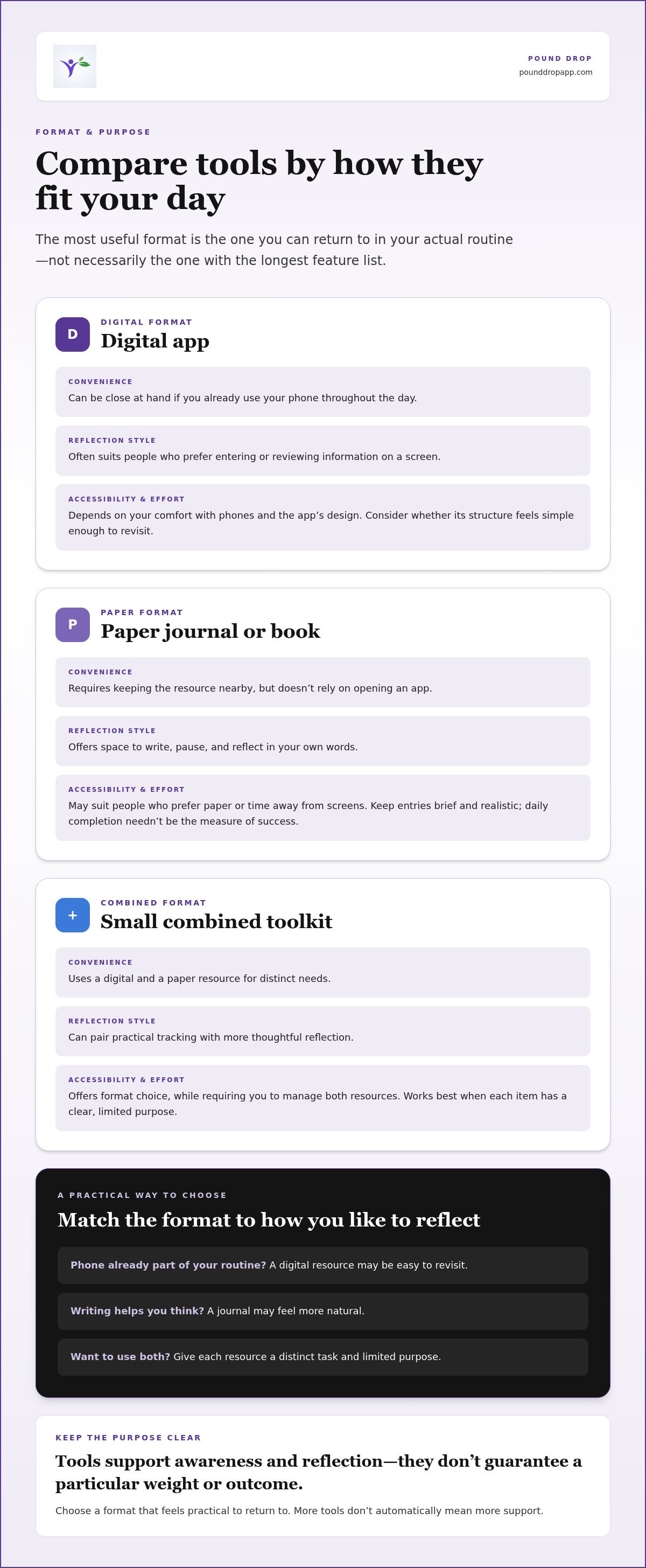
The best format isn’t necessarily the most popular one. It’s the one you can return to in your actual day, whether that means opening a phone app between tasks, writing in a notebook at the end of the day, or using both for different purposes. Compare long term weight management tools by how they fit your habits, not by how impressive their feature lists sound.
| Format | Convenience | Reflection style | Accessibility | Effort to use |
|---|---|---|---|---|
| Digital app | Can be close at hand if you already use your phone throughout the day. | Often suits people who prefer entering or reviewing information on a screen. | Depends on your comfort with phones and the app’s design. | Consider whether its structure feels simple enough to revisit. |
| Paper journal or book | Requires keeping the resource nearby, but doesn’t rely on opening an app. | Offers space to write, pause, and reflect in your own words. | May suit people who prefer paper or time away from screens. | Keep entries brief and realistic; daily completion needn’t be the measure of success. |
| Small combined toolkit | Uses a digital and a paper resource for distinct needs. | Can pair practical tracking with more thoughtful reflection. | Offers format choice, while requiring you to manage both resources. | Works best when each item has a clear, limited purpose. |
Use this comparison as a starting point, not a ranking. If you already check your phone regularly, an app may be easy to revisit. If writing helps you think, a journal may feel more natural. A combined toolkit can work when each resource handles a different task. More tools don’t automatically mean more support. Mayo Clinic’s Strategies for long-term weight loss success also emphasize lasting lifestyle changes, so choose a format that can fit those changes into everyday life.
When might a digital weight-management app fit best?
A phone-based resource may suit you if your phone is already part of your routine and you prefer engaging with information digitally. When comparing options, consider whether the layout and structure feel clear, whether using it fits naturally into your day, and whether the amount of interaction feels manageable. These are practical selection criteria, not assumptions about the features of any particular app.
When might a journal or book be a better fit?
Paper resources may feel more comfortable if you prefer handwriting, thinking without a screen, or returning to written notes at your own pace. Choose a journal or book that feels approachable to open again, rather than one that makes every missed day feel like a setback. This weight loss tracking journal selection guide explores how to match a paper format to your routine.
Prefer a self-guided approach with both digital and physical resources? Explore Pound Drop’s weight-management resources and choose the format that feels practical for you.
How to evaluate a long-term weight management tool without feeling overwhelmed
A tool can look useful on paper and still feel like too much in everyday life. Before adopting one of the many long term weight management tools available, consider not only what it tracks but how it affects your time, attention, and peace of mind. A simple checklist can help you decide whether it deserves a place in your routine.
Ask yourself:
- Ease of use: Can you understand what to do without a lot of setup or repeated effort?
- Personal relevance: Does it help you notice something that matters to your own routines?
- Flexibility: Can you adapt how you use it as your schedule or priorities change?
- Privacy: Are you comfortable with what you record and how the information is handled?
- Emotional comfort: Does using it feel supportive, or does it leave you feeling watched, guilty, or preoccupied?
Does the tool fit your routine and comfort level?
Picture a typical week, not an unusually quiet one. Think about how much time and attention the tool asks of you, and where using it might fit naturally. A workable resource should allow for missed days and shifting schedules without making you feel you need to catch up. You also don’t have to use every tracking category available. Focus on information that helps you make a practical decision.
If a tool feels demanding, try narrowing its use. You might record one routine rather than several, or check in less often. That isn’t cutting corners. It’s adjusting the process so it stays useful rather than becoming another source of pressure.
Does it support reflection instead of judgment?
Look for prompts or a structure that helps you notice patterns and think about a next step. For example, instead of treating a missed goal as failure, ask: “What made this difficult today, and what could make it easier next time?” A plateau or change in plans is information to consider, not a verdict on your effort or character.
The best tool is one you can use without making life smaller. If tracking starts to create stress, takes attention away from daily life, or affects your wellbeing, it’s reasonable to reduce what you record, pause, or stop using that tool. Consistency isn’t helpful if the process comes at the cost of feeling okay.
Pay attention to your response over time, not just whether you complete entries. If weight-related tracking causes distress, or you have concerns about your health, consider speaking with a qualified health professional. They can help you think through an approach that fits your needs. A tool should support your decisions, not replace care or make you feel you have to manage everything alone.
Build and review a simple toolkit that can adapt with you
A useful toolkit starts with a real need, not a list of resources to collect. Choose a manageable way to notice one everyday behavior, then see whether that information helps you make a practical adjustment. This keeps long term weight management tools connected to your life rather than turning them into another routine to maintain for its own sake.
- Identify one need. Name the routine you want help noticing or organizing. You might want to remember when you fit movement into your day, or reflect on what makes a regular meal routine easier. Choose something you can observe without trying to track everything at once.
- Choose one tool. Match the need to a format you’re likely to use: a digital resource, a paper resource, or a simple combination with distinct purposes. If you’re comparing app-based structure, this guide to weight loss for beginners apps can help you think about how an app may fit into habit-building.
- Use it consistently enough to learn from it. Pick a realistic moment to record or reflect, such as after a routine you already do. Keep the focus on the behavior you chose. You’re looking for useful information, not a perfect record.
- Review its fit. Ask whether the tool makes the routine clearer, takes a reasonable amount of effort, and gives you information that leads to a helpful next step. If it doesn’t, simplify how you use it or try another format.
Start with one need instead of collecting every tool
Be specific about the challenge. “I want to be more active” may be too broad to guide a tool choice; “I want to notice which days leave room for a walk” gives you a clearer starting point. Select one resource that helps you pay attention to that routine. Add another only if you find a practical gap the first one doesn’t address, not simply because more tracking is available.
Review the toolkit as routines change
Check in occasionally, especially after a shift in your schedule or priorities. Is each resource still easy to use? Does it clarify a pattern or help you decide what to adjust? You might change how often you use it, switch formats, or narrow its focus. A helpful review is a chance to adapt, not a reason to restart.
Let the routine guide the toolkit. If recording something takes more time than it gives back in useful insight, scale it down. If the information is hard to interpret, choose a simpler focus. A small system that changes with you is more practical than one you feel obliged to follow exactly.
For a self-guided way to bring digital and physical resources into your routine, explore Pound Drop’s toolkit.
How Pound Drop brings digital and physical weight-management tools together
Some people prefer a digital resource; others like to read, write, and reflect on paper. Pound Drop brings together the Pound Drop App, The Method, The Book, and The Journal in a self-guided system of digital and physical resources to support lifestyle changes over time. You can start with the format that fits your preferences instead of taking on every resource at once.
These resources are options within a structured approach, not a checklist you need to complete. Begin with the format that feels most natural, then decide whether another component adds something useful. The aim is to make it easier to practise and reflect at your own pace, not to add pressure or promise a particular result.
What does a self-guided digital and physical system offer?
The system brings together an app, The Method, a book, and a journal. That gives you digital and paper-based formats to choose from according to your preferences. A self-guided resource can provide structure while leaving decisions about how and when to use it in your hands. Pound Drop’s approach is self-guided, without one-on-one human coaching or personalized meal plans, and you don’t need to adopt every component for the system to be relevant to you.
Consider practical fit: Do you tend to reach for your phone, or would you rather sit with a book or journal? Would one format be enough to start? Choosing fewer components at first can help you see whether the approach fits your routine before adding anything else.
Who may want a structured self-guided toolkit?
A self-guided toolkit may suit people who value a defined approach but want to practise at their own pace. Pound Drop’s resources offer a structured, self-guided approach without one-on-one human coaching or personalized meal plans. The best fit depends on what feels useful and manageable in your day-to-day life, and there’s no need to use every resource just because it’s part of the system.
Weight management can involve personal health considerations. If you have medical concerns, or you’re unsure what approach is appropriate for you, seek guidance from a qualified health professional. Self-guided tools can support everyday practice, but they aren’t a substitute for care tailored to your health needs.
As you consider long term weight management tools, think about whether digital and physical resources together offer the structure you want while leaving room to adapt. Start with the component that feels practical. You can reconsider your choice as your routine changes.
If this combination sounds like a helpful fit, explore Pound Drop and its self-guided resources at your own pace.
Choose one small step you can return to
Your next step doesn’t need to be a complete plan. Choose one routine you’d like to pay attention to, then decide what kind of support would make it easier to practise. Let your needs guide the choice, and give yourself permission to adjust as life changes. The best long term weight management tools support your choices without demanding perfection.
If you’d like a structured, self-guided option, Pound Drop brings together the Pound Drop App, The Method, The Book, and The Journal. These digital and physical resources support lifestyle changes. Start with the format that feels practical for you.
Explore Pound Drop’s self-guided weight-management tools and take the next step at a pace that feels manageable. Progress can begin with one useful choice, repeated when it works and adapted when it doesn’t. You can build from there.
Frequently Asked Questions
How do I choose long-term weight management tools?
Choose long-term weight management tools that fit the way you already organize your day. For example, if you have a regular evening pause, a brief check-in then may feel more realistic than recording information during a busy workday. Decide what you want help noticing, then test whether the tool makes that easier. Keep what’s useful; if it adds friction without clarifying your next step, reconsider the format or focus.
Are weight management apps better than journals?
Neither is automatically better; choose the format you’re more likely to revisit. An app may feel convenient if you usually turn to your phone, while a journal can suit you if handwriting helps you think. Consider what you want to remember and where you’d naturally record it. If both formats appeal, try one first before deciding whether a second resource would add anything.
Can I use more than one weight management tool at a time?
Yes, if each resource has a distinct purpose and the combination stays manageable. For instance, you might use a digital resource to support one routine and keep a book for occasional reflection, rather than recording the same details twice. Notice whether switching between formats creates extra work. If you can’t explain what a second tool adds, set it aside for now and see how the first works on its own.
How often should I use a weight management tool?
Use a tool as often as its purpose requires, not because you feel you must complete a daily record. A reminder about a particular routine may be useful when it happens, while reflecting on a broader pattern may call for occasional review. Choose a rhythm you can follow during an ordinary week. If you start avoiding the tool or feel pressured by it, try using it less often or taking a pause.
Do I need to track my weight to manage it long term?
No, weighing yourself isn’t required for everyone. You could instead pay attention to whether a routine is becoming easier to repeat, or how your energy and daily habits feel. Choose indicators that are meaningful and comfortable for you, rather than collecting numbers by default. If weight tracking causes distress or you’re unsure which measures suit your health needs, step back and discuss your concerns with a qualified health professional.
What should I do if tracking feels discouraging?
Pause and ask what part feels difficult: the amount you’re recording, the frequency, or the way you interpret the information. You might switch to noting one practical observation, such as what helped you keep a routine on a busy day, instead of trying to capture everything. A missed entry doesn’t need to be made up. If tracking continues to affect your wellbeing, consider stopping and seeking professional guidance.
Can weight management tools replace medical advice?
No. An app, book, or journal can help you organize personal routines, but it can’t assess your health or provide care tailored to your medical circumstances. If you have a health condition, take medication, or have questions about treatment, speak with a qualified healthcare professional. You can bring notes about your routines or concerns to that conversation if they’re useful, but you don’t need to track everything beforehand.


