


Article by
Jesper Sorensen
Jesper Sorensen is a holistic health coach and founder of Pound Drop, a different approach to weight loss built around healthier habits. He has written ebooks and health articles for established publishers and has spent years studying nutrition, healthy eating and sustainable weight management.
What if a useful weight loss tracking journal helped you notice patterns, rather than judge every choice or focus only on the number on the scale? The right tool isn’t the one with the most fields. It’s the one that fits your routine well enough to return to, even after a missed day.
It makes sense to wonder what’s worth recording, or whether daily tracking will become one more demanding task. You may also be weighing the ease of an app against the hands-on feel of paper. You don’t need perfect entries for tracking to be useful. A few notes about routines, movement, or how your day went can give you something specific to reflect on and help you notice what supports your habits.
This guide will help you decide what to track, compare physical journals with app-based tools, and choose a format that feels practical in everyday life. You’ll learn how to review entries without turning them into a scorecard, so your journal can support steady habits at your own pace.
Key Takeaways
- Choose a weight loss tracking journal that makes it easy to record information you want to learn from, without making tracking feel like a test.
- Decide whether paper or digital better suits your routine and how you prefer to review your notes.
- Start with one or two habits or patterns you want to understand, then keep entries realistic and manageable.
- Look for a format you can return to after a break; consistency doesn’t require perfect daily records.
- Consider how Pound Drop’s dedicated journal fits alongside its app, methodology, and book as part of a self-guided system.
What Is a Weight Loss Tracking Journal, and What Should It Help You Notice?
A weight loss tracking journal is a tool for recording progress, daily routines, and personal reflections as you work toward your goals. It can be a paper notebook or a digital record. Its purpose isn’t to grade your choices. It’s to help you look back and notice what your days are like.
That context can matter as much as a scale reading. You might note when you tend to take a walk, how a change in routine felt, or what made a habit easier to follow. Journaling can support reflection, but it can’t guarantee weight loss or any particular result. Choose what to record and how often based on what feels useful to you.
A simple visual example can make the idea more concrete. This video offers one look at a weight loss tracker:
What Can a Weight Loss Journal Help You Track?
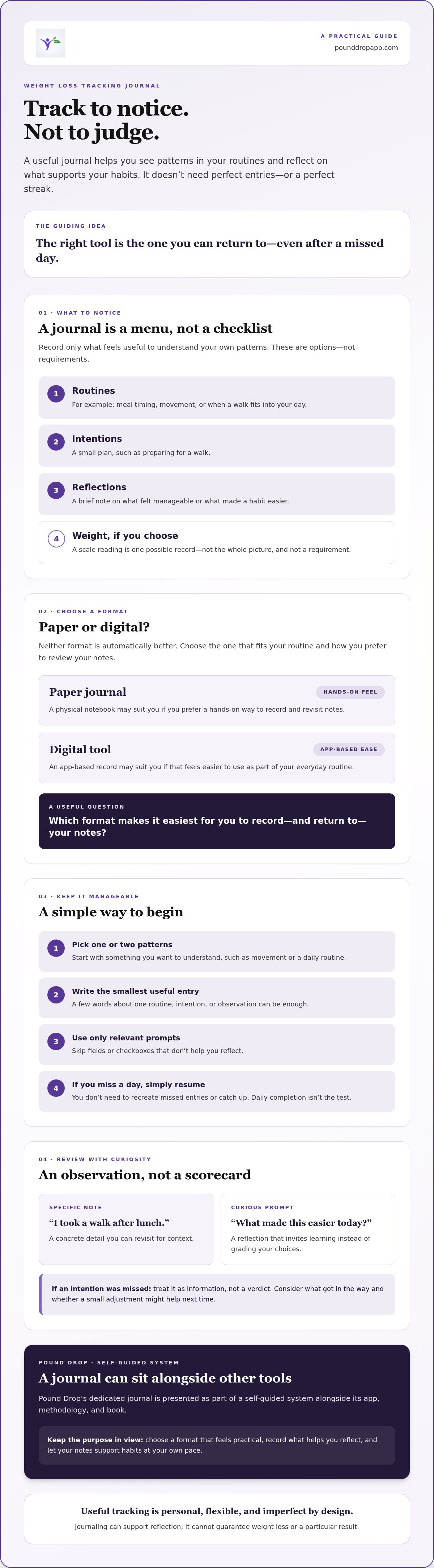
Think of possible entries as a menu, not a checklist. You could note routines, such as meal timing or movement; an intention, such as preparing for a walk; or a short reflection on what felt manageable that day. Some people may also choose to record weight. None of these entries is required. Keep the details that help you understand your own patterns, and leave out anything that feels burdensome or unhelpful.
For example, if you’re trying to make movement part of your routine, note whether you moved and when it fit into the day. That may be more useful than a detailed account. The Self-monitoring of diet section offers a broad overview of tracking as one aspect of weight loss.
Is a Journal Only for Recording Weight?
No. Scale readings are one possible record, but they don’t describe every part of your experience. You might also reflect on consistency or daily routines. Treat these as personal observations, not clinical measurements or guaranteed signs of progress. If weighing feels discouraging, you can focus on other entries instead.
Useful notes are specific enough to revisit: “I took a walk after lunch” gives you more context than a general judgment about the day. Over time, entries can help you ask practical questions about what supports your routine. The journal is a place to notice and learn, not a promise that every pattern will lead to a particular outcome.
Which Journal Features Make Weight Loss Tracking Easier to Maintain?
The most helpful features are the ones that make it easy to start, pause, and return. Look for clear sections and an entry style that suits how you think. A short checklist may help you move quickly; space for a few words can help you capture context. If a journal includes repeated prompts, consider whether they feel useful or like another set of tasks.
The most useful journal is one you can return to without needing to catch up or get every entry right. That usability test matters more than a complicated layout. A journal that takes too long to complete or leaves you unsure what to write may be harder to maintain, even if it looks thorough. Choose a format that helps you reflect without adding unnecessary work.
How Much Should You Record Each Day?
Begin with the smallest amount of information that helps you reflect. You might note one routine, an intention, or a brief observation about how the day unfolded. If your journal has prompts or checkboxes, use the ones that feel relevant and skip the rest. An entry can be a few words. It doesn’t need to read like a complete report.
Daily completion isn’t the test. If you miss a day, pick up again when it suits you; you don’t need to recreate what you didn’t record. A flexible approach leaves room for busy days and changing routines. Tracking should serve your reflection, not create pressure to maintain a perfect streak.
What Makes a Journal Feel Supportive Rather Than Judgmental?
Notice the language. Prompts that invite curiosity, such as “What made this easier today?” can feel more constructive than wording that frames choices as success or failure. A supportive journal makes room for honest notes without turning them into a score.
If you write about a missed intention, treat it as information, not a verdict. Ask what got in the way and whether a small adjustment might help next time. If tracking begins to feel distressing or overly consuming, it’s reasonable to pause, simplify what you record, or choose another way to reflect.
If you’re considering a digital option, you can explore the Pound Drop App as a separate self-guided tool. Choose the approach that feels manageable; paper and digital records don’t need to be combined to make tracking useful.
Paper Journal or Digital Weight Loss Tracker: How Do They Compare?
A paper journal and a digital tracker can both help you record and revisit habits. The better fit depends on what feels easiest in your day: writing by hand, opening an app, or setting aside time to reflect later. Michigan State University Extension notes that keeping a food journal increases your awareness of eating patterns, and tracking can take place on paper or digitally.
Think about when you’re most likely to make an entry. A notebook may suit someone who prefers writing away from a screen. A phone-based tool may be more convenient for someone who already uses their phone to keep track of daily tasks. Either way, the value comes from reviewing information in a way that helps you learn, not from choosing the format with the most features.
When Might a Physical Journal Suit Your Routine?
Handwriting may feel natural if you like to slow down, add a short reflection, or keep your notes in one dedicated place. A physical journal can be easy to revisit when it’s somewhere you’ll see it, though carrying it around may not suit every routine. Pound Drop includes a dedicated journal among its physical resources. Check its current format and contents before choosing it for specific features.
If you’re also thinking about how tracking might fit into a broader approach, read about a simple weight loss methodology. A journal can be considered as a physical resource within a self-guided system, without assuming that it has particular prompts or works in a specific way with an app.
When Might an App-Based Tracker Be a Better Fit?
An app may feel convenient if your phone is usually close by and you prefer keeping records digitally. Digital tools may make entries easier to store and review, though capabilities vary from one app to another. Don’t assume that a particular tracker includes reminders, charts, or automatic calculations unless its current product information confirms them.
The Pound Drop App is a digital tool within Pound Drop’s self-guided system, but check current details rather than assuming specific functions. For more context about a digital option, explore this article on a weight loss app for beginners. Choose paper or digital based on how you’ll record and revisit entries; there’s no need to use both unless that genuinely suits you.
How to Choose a Weight Loss Tracking Journal You Can Use Consistently
A practical choice starts with your routine, not an ideal version of it. Before choosing a weight loss tracking journal, decide what you want your notes to help you understand, how you prefer to record them, and what feels realistic on a full day. Look for a tool that can adapt to your life, not another rule you have to follow perfectly.
A Simple Checklist Before Choosing
Use these questions to narrow down your options:
- Which format feels natural? Would you rather handwrite, use your phone, or keep both options open?
- What do you want to notice? Choose one or two patterns, such as how often you make time for movement or which routines feel easier to maintain.
- Does the journal support that purpose? Check its confirmed contents and format instead of assuming it has particular prompts, trackers, or features.
- Can you use it on a busy day? Consider whether you can make a useful entry in the time and setting you actually have.
For instance, if you want to understand a routine, a brief note about whether it happened and what helped may be enough. If you’re not sure what you’ll find useful, begin with one focus. Add another later if the first feels worthwhile.
How to Start Without Making Tracking Another Rule
Try a light routine that fits naturally into your day, such as pausing for a short entry at a time when you already tend to reflect. Then check whether reviewing your notes helps you understand the pattern you chose to track. If it feels like busywork, simplify the entry or change what you’re recording. The goal is useful reflection, not filling every page.
Missed entries are neutral information. You don’t have to catch up or restart from the beginning; just return when it suits you. A changing schedule may call for a different approach, and your tracking can change with it. If recording something starts to feel discouraging or distressing, consider taking a break or choosing a gentler focus.
Pound Drop includes a dedicated journal among its physical resources in a self-guided weight management system. Before choosing it, review current details to see whether its format and contents suit your preferences. Explore Pound Drop’s journal as one option to consider alongside your selection checklist.
How Pound Drop’s Journal Fits into a Self-Guided Weight Loss System
A journal doesn’t have to work alone. Pound Drop’s dedicated journal is a physical resource within a broader self-guided weight loss system that also includes the Pound Drop App, The Method, and The Book. These offer different formats to consider as you decide what kind of support fits your routine.
The roles are distinct at a basic level: the App is the digital tool, The Method is the methodology, and The Book and Journal are physical resources. That doesn’t confirm specific journal prompts, app functions, or automatic syncing between tools. Check current product information to understand how each is intended to be used.
How the Journal Relates to Pound Drop’s Other Tools
If you prefer a paper-based place for reflection, the Journal may be worth considering alongside a digital tool and a methodology. If you mainly want to use your phone, you may prefer to explore the App first. You don’t need to assume that every resource is necessary or that the journal connects to the App in a particular way. Choose based on the format you’re most likely to use and the kind of support you want.
Pound Drop’s approach is self-guided. It doesn’t include personalized meal plans, supplements, or one-on-one coaching. That distinction can help set expectations: consider whether a weight loss tracking journal and the other available tools match the independent approach you’re looking for.
What to Confirm Before You Choose the Pound Drop Journal
Product details can help you decide whether the Journal suits your needs. Before choosing it, check its current contents and physical format. Look for verified information about how it’s intended to be used, and whether that approach matches what you hope to record or reflect on. If you’re considering using it alongside the App, confirm how the tools relate rather than assuming they share entries or features.
A helpful final check is simple: Can you picture using this physical resource in your real routine, and does its confirmed format make sense for your goals? If the answer is yes, it may be a fit. If not, you can choose another tool or keep your tracking simple.
Explore Pound Drop’s weight loss tools to review the available options and decide what, if anything, belongs in your own approach.
Choose a Tracking Rhythm That Works for You
A helpful weight loss tracking journal isn’t defined by how much it records. It’s defined by whether it helps you notice patterns that matter to you. Choose paper or digital based on what fits your routine, focus on one or two things you want to understand, and keep entries manageable. Missed days don’t erase what you’ve learned; you can adjust your approach and begin again whenever it feels right.
If you’d like to consider a journal as part of a broader self-guided approach, Pound Drop offers a journal, a book, an app, and a methodology. Check the current details to see which tools suit your preferences and goals.
Explore Pound Drop’s journal and self-guided tools. Take the next step at your own pace, with a tool that supports thoughtful reflection.
Frequently Asked Questions
Is a weight loss tracking journal helpful?
A weight loss tracking journal may help you notice routines, choices, and reflections that are easy to miss in the moment. Its usefulness depends on whether recording feels manageable and relevant to you; it can support reflection, but it can’t guarantee weight loss. Start with a few details you genuinely want to understand, such as a routine you’re trying to maintain. If tracking feels burdensome, simplify your entries or try a different approach.
What should I write in a weight loss tracking journal?
Write down details that help you reflect on your routines, such as an intention, a habit you practiced, or a brief note about how your day went. You don’t need to track everything or follow someone else’s routine. Choose entries that feel useful rather than judgmental. If you’re considering a specific journal, check its confirmed contents and prompts before buying to see whether they match what you want to notice.
Should I use a weight loss journal every day?
No, daily entries aren’t necessary for everyone. You might prefer a brief daily check-in, while occasional reflection may fit better if your days are full. Choose a rhythm you can maintain without turning journaling into a strict rule. If you miss an entry, simply return when it suits you. You can also adjust how often you write if your routine changes or the current approach isn’t helping you reflect.
Is a paper weight loss journal better than an app?
Neither format is best for everyone. A paper journal may suit you if you enjoy handwriting and want a dedicated place for reflection. An app may be more convenient if you prefer using your phone. Compare how each fits your routine, writing preference, and the way you like to review entries. Check an app’s verified features rather than assuming it offers specific tools. Using both is an option if it feels practical.
Can tracking weight loss feel discouraging?
Yes, tracking can feel uncomfortable, especially if it becomes rigid or self-critical. You can record routines and reflections instead of treating the scale as the only measure of progress. Try asking what you learned from an entry rather than judging it as good or bad. If journaling increases distress, pause or change what you record. A tracking tool should support reflection, not make you feel judged or obligated to continue.
How do I choose a weight loss tracking journal for beginners?
Start by choosing the format you’re most likely to use: handwriting, a digital tool, or a combination. Then check whether the journal’s confirmed format and contents suit what you want to notice, and whether the routine seems realistic on a busy day. Begin with a few useful entries rather than trying to record everything. After you’ve tried it, keep what helps and adjust anything that feels unnecessary or difficult to maintain.


